Up a gum tree: Are koalas 'slipping to extinction'?
Climate change, habitat loss, STDs and human complacency threaten the survival of Australia's cuddliest creatures
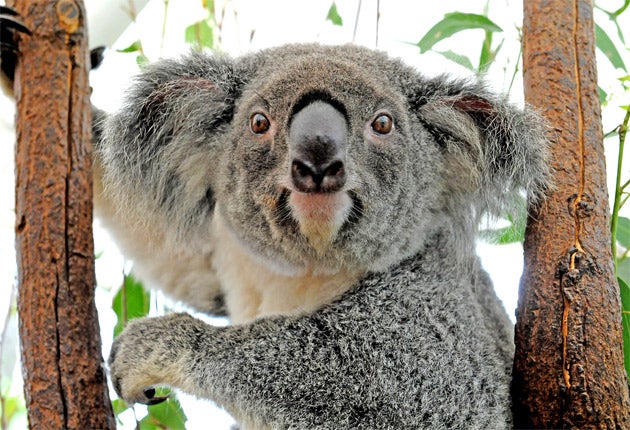
Every gum tree contains a koala, or so most Australians assume. But complacency could be killing off the emblematic native animal, according to scientists, who want it listed as an endangered species.
Already under pressure from habitat loss and disease, koalas now face a new threat: climate change. They cope poorly with the droughts and heatwaves that are expected to become more common in southern Australia in years to come. To make matters worse, increased carbon dioxide in the atmosphere is reducing the nutrient content of eucalyptus leaves, their sole food source.
Scientists say koala numbers have already declined sharply in some areas, and they warn that unless more energetic conservation measures are taken, the mammal's viability could be in doubt. "This species is supposed to be common, yet it's slipping to extinction under our noses," Christine Hosking, a nature conservationist at the University of Queensland, said yesterday.
Ms Hosking, who is researching a PhD on the impact of climate change on the koala, was one of several experts who recently gave evidence to a parliamentary committee set up to investigate the animal's health and status. She said that listing it as endangered would be a first step towards developing a national action plan to safeguard its future.
Koalas are difficult to spot in the wild, where they perch high up in gum trees, their speckled fur camouflaged against the branches. Nevertheless, with their very wide range, which encompasses much of eastern Australia, they have always been thought to be extremely numerous.
While that was once true, it may not still be the case. Population estimates are difficult to come by, because the animals are hard to count, but Clive McAlpine, a landscape ecologist at the University of Queensland, believes that there are no more than 50,000 to 100,000 left in the wild. In some areas, such as Queensland's Gold Coast, he says, populations have decreased by as much as 80 per cent over the last 10 to 15 years. Another koala expert, Bill Ellis, says that in places where researchers used to find 30 to 50 koalas in one day, only three or four are now being sighted.
Large-scale land clearing, for urban development, industry and agriculture, has progressively deprived the koala of much of its traditional habitat.
In recent years, the species has also been crippled by chlamydia, which leads to infertility and sometimes death, and a retrovirus similar to HIV, which causes various infections as well as, possibly, cancer and leukaemia.
According to Dr McAlpine, some scientists believe that the retrovirus, currently sweeping through koala populations, has the potential to be as destructive as the facial tumour disease that has almost wiped out the Tasmanian devil.
Koalas are not only being squeezed out by encroaching development, but are in danger of being run over or attacked by dogs. Now climate change is set to add to those pressures. Koalas are ill-equipped to deal with high temperatures; during heatwaves, they suffer dehydration and heat stress. Hot, dry conditions also drain the moisture out of eucalyptus leaves, from which they get most of their water. On particularly scorching days, koalas literally fall out of trees.
Ms Hosking's research shows that temperatures above 37 degrees celsius are intolerable for them. "Once you get over 37 degrees, there's zero probability of a koala," she said. "As we get more of these extreme temperatures and protracted droughts, the koalas simply won't be able to cope."
That was demonstrated during the bushfires that killed 173 people in Victoria two years ago. The fires were preceded by five consecutive days of temperatures above 40 degrees celsius, and koalas were seen climbing into swimming pools in a desperate quest for water. One fire fighter was photographed feeding a koala water from a plastic bottle.
Dr McAlpine predicted that climate change would reduce their habitat even further, pushing koalas towards the heavily urbanised east coast. "But there's not much room for them there, and there's the threat from dogs and cars," he said.
The decision on whether to list the species as endangered lies with the federal Sustainability Minister, Tony Burke, who is waiting for a report from the parliamentary committee. However, an expert panel has already recommended against the move – the second time it has rejected the call from scientists. At present, the koala is not even classed as vulnerable.
An endangered listing would facilitate conservation work, making it easier to protect remaining habitat and to find funding for research into a chlamydia vaccine. Without better protection, koala experts fear for the species. "They'll just become more and more rare in the wild, found at increasingly low densities, and populations will become unviable," said Dr McAlpine. "That's what we are concerned about."
One problem faced by scientists is that koalas are still quite numerous in certain areas, which makes it difficult to inject a sense of urgency into the debate. In many of those areas, though, they say, populations are genetically limited and riddled with disease.
Dr McAlpine said: "There's a lot of evidence to support the case for action. We can't afford to wait until the population is down to 10,000 before we do something, because by then it will be too late."
Join our commenting forum
Join thought-provoking conversations, follow other Independent readers and see their replies
Comments