'Voracious' ladybird threatens native species
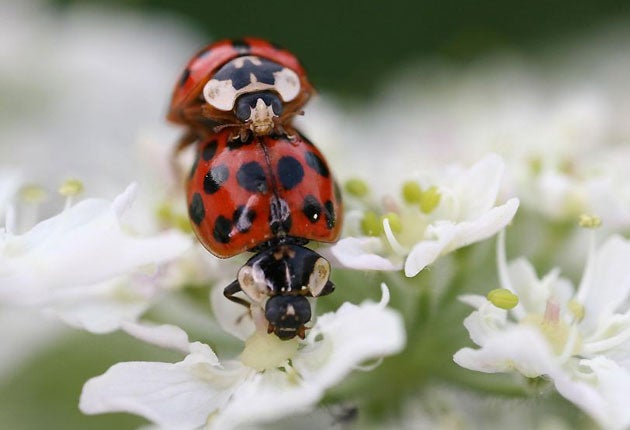
The recent arrival of the invasive harlequin ladybird in the UK is likely to threaten more than 1,000 native species, scientists warned today.
The harlequin has become a common sight as it has spread across the country in the past few years - even invading houses in the autumn to hibernate over winter in warm spots.
The ladybird is originally from Asia but was introduced in continental Europe to control pest insects which were damaging crops and has since spread to the UK on fruit and flowers and by being blown across the Channel.
A survey launched in 2005 has, with the help of the public, managed to track its progress using some 30,000 online records.
Since its arrival in 2004, the ladybird has spread from Essex to Orkney in just four years, with places such as London parks now recording staggering numbers of the insect.
The bug is a "voracious" predator, which preys on a wide variety of insects, including the larvae of other ladybirds, caterpillars and even fruit, and out-competes with native species.
As a result, the species poses a major concern for the UK's wildlife according to Dr Helen Roy of the Centre for Ecology and Hydrology (CEH).
Evidence from the US, which introduced the harlequin more than 20 years ago, shows "severe declines" in native species.
"We believe that the negative impacts of the harlequin on Britain will be far reaching and disruptive, with the potential to affect over 1,000 of our native species," she said.
"It's a big and voracious predator, it will eat lots of different insects, soft fruit and all kinds of things. Its reproductive capacity is also immense."
The harlequin ladybird has a variable appearance, is very difficult to tell apart from our native ladybirds, and can chomp through more than 12,000 aphids a year.
But it is also known to eat species such as lacewing larvae as well as pest insects carrying pathogens, depleting the supplies of the diseases which normally keep such species under control.
It will try anything it comes across when hungry, and had even been recorded eating the caterpillar of a brimstone butterfly, Dr Roy said.
Scientists from five organisations are presenting information about the harlequin at the Royal Society Summer Exhibition this week, and warn its arrival will mean "one winner, 1,000 losers".
Ladybirds do not have many enemies, as they are distasteful and toxic to many predators and let would-be diners know this with their bright colouring.
The harlequin ladybird has even fewer predators as it is not a native species.
But the researchers are exploring how the few native enemies that exist, including fungal disease, male-killing bacteria, parasitic wasps and flies, could be used to control the population - or may evolve to tackle the harlequin naturally.
One of the most promising ideas could involve encouraging the transmission of a sexually transmitted mite which makes some ladybirds infertile in a bid to reduce the harlequin population.
Dr Remy Ware, of the University of Cambridge, who is working on how the mite could control harlequin populations, said it was a naturally-occurring UK species which did not affect most British ladybirds because of their breeding cycles.
She said her team was examining if it could be artificially transferred to harlequins, where the ladybird's breeding pattern may allow it to be naturally transmitted, causing females to become sterile.
Dr Roy also said that if the harlequin is found in the habitat of rare ladybirds such as the five spot, which lives in just a few sites of disturbed river shingle in Wales, it may have to be physically removed to protect the native insect.
But she warned: "We haven't got a hope of blanket control of the harlequin ladybird. Anything we do here we'd have to do in other countries in Europe."
And she said the researchers were not encouraging people to kill harlequins as it would make no difference to the overall population and they may accidentally kill native species.
The scientists from CEH, the University of Cambridge, Anglia Ruskin University, Rothamsted Research and the University of Hull, will be at the Royal Society's Summer Science Exhibition this week.
They will be explaining how to tell the difference between harlequins and native species and what methods might be used to control the invasive insects.
* The Royal Society's Summer Science Exhibition is free to the public. It runs from Tuesday June 30 to Saturday July 4 at the Royal Society, 6-9 Carlton House Terrace, London.
Join our commenting forum
Join thought-provoking conversations, follow other Independent readers and see their replies
Comments
Bookmark popover
Removed from bookmarks