White gold: Britain's new love for snowdrops
Britain is in the grip of a strange passion: snowdropmania. The countryside is aglow with brilliant displays of these delicate flowers. Yet enthusiasts, who recognise hundreds of different varieties, are paying record prices to secure their own miraculous bulbs. Michael McCarthy reports
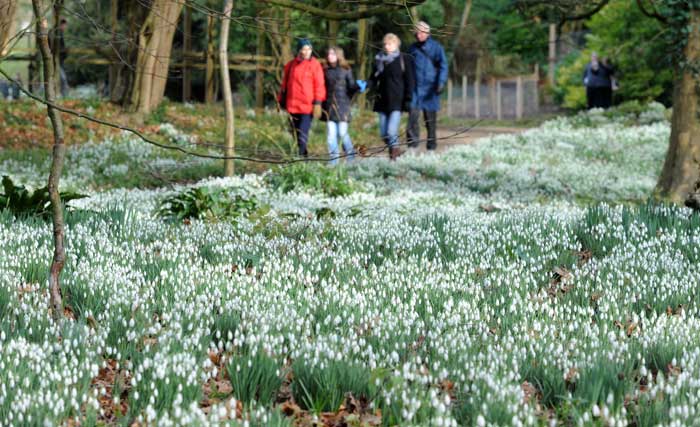
Galanthophilia: not a word you may be all that familiar with, but now is the time of year to learn it. For it means an ardent love of the snowdrop, Galanthus nivalis, the small white end-of-winter flower which at present is out in all its glory.
While many of us keenly enjoy the stunning sheets of pure white blooms currently covering the ground, the galanthophile – the person who has contracted galanthophilia – takes the liking far more seriously, cherishing many of the different snowdrop varieties and is likely to pay increasingly large sums for a single bulb of a new one.
It is Britain's version of 17th- century Holland's tulipmania, albeit written in a minor key; and there are ever more enthusiasts.
"There's a great gaggle of galanthophiles out there," says Andy Byfield, the landscape conservation manager of the wild flower charity Plantlife, and one of Britain's leading botanists. By his own admission, Mr Byfield is "a relatively serious galanthophile", with no fewer than 200 snowdrop varieties in his two-acre Devon garden.
"Why do people want them? It's like kleptomania really," he said. "They're all nice things, but more than that, the variations between them are very subtle. Superficially they all look a bit the same, but once you look closely you notice they've got all these differences. In the history of cultivation, different nations have appreciated different plants, and snowdrops have been one of the British things."
There are nearly 20 wild snowdrop species, spread over Europe but with their heartland in Turkey, and from these about 700 cultivated varieties have been developed. Some, such as Scharlockii, have green markings on the white petals; others, such as Lady Elphinstone, have markings which Mr Byfield describes as "a rich buttery yellow". Many of them have been in Britain since the 19th century; one wild species which came from Russia's Crimea, Galanthus plicatus, was probably brought back by soldiers returning from the Crimean War.
The past 20 years have seen a massive increase in galanthophilia, Mr Byfield says. "Every year there are galanthus galas; there's one coming up in Dorset soon which will have about 250 people, including people from Holland and Germany." When a new variety appears, he says, the prices shoot through the roof. "One bulb of a new variety recently went on eBay for £128; another went for £132, although perhaps it's not quite like the tulip mania in Holland, when some individual bulbs went for the equivalent of thousands of pounds. £132 is not going to break anyone financially."
Right now, he says, is the highlight of the galanthophile's year, with snowdrop articles in all the gardening magazines, and many people visiting the gardens of stately homes with outstanding snowdrop displays, such as Colesbourne Park in Gloucestershire (whose web address is www.snowdrop.org). Colesbourne was created at the end of the 19th century by the Elwes family, when the owner, Harry Elwes, was thought to have the largest bulb collection in the world (a Turkish wild species of snowdrop, Galanthus elwesii, was named after him.)
Many other gardens have remarkable displays, and The Great British Gardens website currently has a long list of them, from Cambo and Finlaystone in Scotland, to Plas yn Rhiw in Wales and Walsingham in Norfolk.
You think from its prevalence in gardens that the snowdrop is very much a naturalised flower in Britain, and not a native species – indeed, Mr Byfield's own wildflower charity, Plantlife, treats it as such, and ignores it completely. But the jury may be out on that. The snowdrop grows as a definite wild plant as near to us as France, and some of the displays in woodlands and especially along river banks in western England, where it can turn the ground white over a wide area, seem simply too extensive to have been planted by human hand.
It is possible that the truth lies somewhere in between introduced species and native – that the snowdrop was a sparsely distributed native wild flower that was spread extensively by organised planting. And for that we may have to thank the medieval Catholic Church.
Our native variety is Galanthus nivalis, the snowy milk-flower (the scientific name is Latinised Greek followed by Latin). It is a member of the lily family, closely related to the daffodil. It has certainly been here a long time, at least since the early Middle Ages, and the reason we know that is because most of all, snowdrops in Britain seem to be associated with faith: they cluster around churchyards and old religious foundations, ruined abbeys and priories.
Many such sites have splendid snowdrop displays, no doubt because they were planted on purpose, as the flowers had a strong association with a specific feast of the Church: Candlemas, which fell a week ago today (2 February, 40 days after Christmas). Candlemas is the feast of the Purification of the Virgin Mary, according to Jewish law, 40 days after the birth of her child, and a special veneration of the mother of Christ. Before the Reformation, parishioners formed in procession on Candlemas day, and brought their candles to be blessed, lit, and set before the Virgin's statue.
It is not hard to imagine how, on a typically gloomy February day in a medieval church that was fairly dark anyway, this must have provided a spectacle of brightness that left onlookers quite spellbound. It must have been the brightest moment, quite literally, of the whole year. Then the precious candles were taken home, to ward off evil spirits.
It is easy to imagine, too, how snowdrops were the perfect flower for the feast, flawless symbols of purity and cleanliness, and what pleasure must have been taken in gathering them, or in merely having them growing around a church on the day itself. They were known then as Candlemas bells.
For most of us, Candlemas and its traditions are long gone, but the flower whose plantings it inspired lives on to remind us that winter is ending.
Join our commenting forum
Join thought-provoking conversations, follow other Independent readers and see their replies
Comments
Bookmark popover
Removed from bookmarks