White lions: Fighting for them tooth and claw
White lions are one of Africa's rarest beasts thanks to their genetics and a brutal hunting industry. But they have a fierce protector in Linda Tucker. Sophie Morris meets her
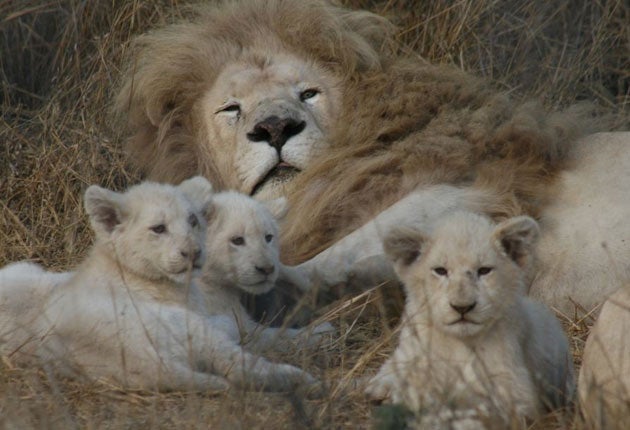
The existence of a rare species of lion, snow white with crystalline blue eyes and endemic to just one spot in South Africa, sounds like a tall tale. They were indeed the stuff of legend, evident in ancient paintings stretching back 15,000 years, until the first verified sighting of one in 1938.
In the intervening years they have all but died out in the wild but are bred successfully in captivity. The Kingdom of the White Lions at West Midland Safari Park, where four cubs were born in 2006, has a pride of eight. The infamous Las Vegas showmen Siegfried & Roy own 23 white lions.
As a tourist attraction, their value is sky high. But their striking appearance and rarity has marked them out not for protection but as hunting trophies worth tens of thousands of dollars.
The white lions, pale because of a lack of pigment rather than albinism, are bred selectively inside camps run for South Africa's brutal canned hunting industry, a sport where tame targets are released into an enclosed area, making them easy prey for those intent on a prized scalp of the king of the jungle.
This bloody industry was exposed in 1996 in a Cook Report investigation. Roger Cook revealed: "You don't even have to be a good shot because the animals are often baited into a fenced area, or drugged so that they become sitting targets. And because the head is the trophy, these regal and endangered creatures are shot at close range in the body and often endure a slow and agonising death."
That was 14 years ago. Successive environment ministers have pledged to halt the business but none have. A ban was overturned last year after determined campaigning from the hunting lobby.
The rare white lions face a further struggle. As a relative of the more common African tawny lion, Panthera leo, the genetic code which marks them out as a subspecies in their own right has not yet been discovered, so they are not even on the list of endangered species.
The tawny lion is also at risk. As a species it is considered vulnerable but estimates of its number vary from 18,000 to 39,000. Some conservationists say the population has plummeted by 90 per cent since the 1980s, but others suggest 30 per cent.
Linda Tucker established the Global White Lion Protection Trust in 2002 and has made it her life mission to reintroduce white lions into the wild and safeguard their future. Since then she has rescued, at great expense, one white lioness and her three white cubs from a zoo and successfully released them into a special reserve. Though the lioness, Marah, died in 2007, her offspring have gone on to form two healthy prides with three new white cubs, the first born outside of captivity since 1991.
Tucker's story, told in her book Mystery of the White Lions, reads like a Hollywood script, and there are plans to make it into a film. Born in South Africa, Tucker came to Britain in the 1980s to study at Cambridge, model and pursue a career in advertising. On holiday in 1991 in Timbavati, Tucker's childhood haunt on the border of the Kruger National Park, a night-time safari went awry. Her group's jeep was surrounded by a pride of angry lions. As they awaited their fate, certain that night would be their last, an old woman carrying a baby on her back and accompanied by a young boy appeared out of the blackness and clambered into the vehicle. Her presence kept the lions at bay while they sent for help. No wonder it is soon to be made into a movie.
Tucker could not forget the incredible incident and returned to Timbavati years later to seek out the woman who had saved her life. Maria Khosa turned out to be renowned in the area, a medicine woman considered a protector of the lions – a lion shaman.
It was at this point that Tucker began to ask questions. The answers were not straightforward, but over the following years she learnt that lions were sacred animals to the indigenous people. The white lions, and their return to the area, is considered auspicious, a warning sign to humans to begin nurturing the earth.
"Our conservation model is to work with lions and humanity," she says. "Once we realise we are totally dependent on nature then we have a chance of surviving together."
Tucker is working with her partner, the ecologist Jason Turner, and American geneticists to determine the gene that could get white lions placed on the endangered list by the International Union for the Conservation of Nature. She has high hopes. At the 2009 World Wilderness Congress in Mexico, 54 countries passed a resolution saying they should be protected. In Canada, 220,000 hectares have been designated for the conservation of the similarly revered white bears.
"Cultural beliefs alone should merit their protection," says Tucker, although science may yet be a more powerful talisman.
Mystery of The White Lions by Linda Tucker is published by Hay House, £12.99. Whitelions.org
Join our commenting forum
Join thought-provoking conversations, follow other Independent readers and see their replies
Comments
Bookmark popover
Removed from bookmarks