Why the day of the condor could be drawing to a close
A decline in the numbers of the giant Andean bird casts doubt on the survival of a spectacular Peruvian tradition
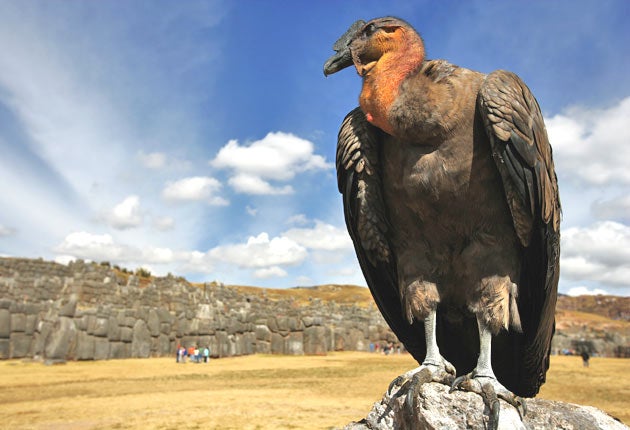
As the bull twists and bucks, the frightened condor strapped to its back helplessly flaps its huge wings, almost dwarfing the enraged animal. To a chorus of battered horns, a villager with a tattered cape steps into the dusty square.
Chicha, the fermented maize juice that is the preferred tipple of many Andeans, has been flowing for hours and the man appears unsteady on his feet. The bull snags the cape on its horns as the man barely manages to sidestep the charging beast before leaping over the barrier, back into the safety of the cheering crowd.
With its roots in the colonial era, the Yawar Fiesta symbolises the struggle between the Spanish and Andean cultures, and is viewed by many Peruvians as a key part of their identity. Here in Cotabambas, a remote village a hair-raising four-hour drive from Cusco through the Apurimac Canyon, one of the deepest in the world, the festival is the highlight of the year for many locals.
But, as condor numbers plummet across Peru, this grotesque, compelling spectacle is attracting the attention of conservationists. No detailed condor census has been carried out anywhere in South America, but Rob Williams, the British head of the Frankfurt Zoological Society in the region, estimates there may now be as few as 500 wild condors in Peru and even less in Bolivia. "If we don't get to grips with this, then the next generation of condors born in Peru could be the last," he warns.
At the root of the problem is society's efficiency in removing carrion. Dead animals are no longer left to rot and provide food for the condor. Today, when a farm animal dies in the field, it is typically thrown into the back of a pick-up truck and makes its way into the human food chain. And condors, which do not reach sexual maturity until around 12 years and breed just one chick every three years in good conditions, are particularly vulnerable to any disturbances to their population.
But there are other threats too. Trading in condor parts is illegal in Peru but feathers, bones and even entire, desiccated wings are sold openly in Cusco and other tourism hotspots.
In one souvenir shop just a block from Cusco's main square, The Independent saw a plastic shopping bag stuffed with condor feathers, each being sold for around £9.
And the Yawar Fiesta is also taking its toll. Dr Williams is aware of 37 communities across Peru that hold Yawar Fiestas, some using up to four condors at a time. Although the condors are usually released after the ceremony, Dr Williams suspects many may be too injured or traumatised to survive – an unsustainable strain on the current depleted condor population.
The legal status of the Yawar Fiesta – the name is a mixture of Spanish and Quechua, the language of the Incas still spoken by millions in the Andes today, and means Blood Festival – is unclear. Peru is a signatory of several binding international conservation treaties, such as the Convention on Biological Diversity, which outlaw the capture of species such as condors or trafficking in body parts. However, the Peruvian constitution also protects the "cultural identity" of indigenous and peasant communities.
In Cotabambas, the Yawar Fiesta clearly has deep roots. A statue in the main square and a mural on the school wall both depict a bull with a condor on its back while posters from previous years' festivals plaster shop walls.
Yet Dr Williams may have found an ally in the mayor, Yury Ortiz de Zevallos, who was Cotabambas's designated condor catcher for four decades and regards the animal as a deity.
Echoing reports Dr Williams has gathered from across Peru, the mayor says: "Before, there was a considerable quantity of condors. When we killed a horse as bait, there would arrive 30 or 40 a day. Today, when we want to capture a condor, at most four or five arrive."
Now, Mr Ortiz de Zevallos wants to establish a captive condor breeding programme to allow Cotabambas to continue its ritual without having an impact on the wild population. Meanwhile, Dr Williams, wary of provoking cultural sensitivities, says he wants to use the Yawar Fiesta to spearhead a public education campaign rather than simply attempt to ban it.
That will form part of a five-year conservation plan he is drawing up on behalf of Peru's Condor Working Group, plugging a major gap in the country's management of this emblematic species. Until now, Peru has been the only nation in the Andean condor's range without a national conservation strategy for the species.
In the village square, through clouds of dust, the bull and the condor fleetingly appear as a single, mythical creature and the idea of it gliding away from its tormentors seems almost real.
After five minutes of frantic action, the bull is lured back to its pen and the condor untethered. Despite its name, the Yawar Fiesta is considerably less bloody than conventional Spanish-style bullfights. At Cotabambas, none of the bulls were killed or seriously injured.
But the fate of the condor may not be so clear-cut. It was due to be released two days after festival, by being flung from a cliff, and after being forced to drink chicha. Mr Ortiz de Zevallos, who claims the condor is even given vitamins, insists: "Our first concern is the condor. In all our fiestas, there has barely been an injury."
But Dr Williams is unconvinced. The one thing that both can agree on, and which the conservationist hopes will be the key to the survival of the species in Peru, is that without condors, there will be no more Yawar Fiestas.
Plight of the condor
The Andean condor has the largest wing surface of any flying bird. The wingspan of an adult males can surpass 10ft (3m). It is a national symbol in Peru, Argentina, Chile, Bolivia and Ecuador.
Condors can live up to 70 in the wild, are monogamous and can eat several pounds of meat in a single sitting, often gorging to the point of barely being able to fly.
There are thought to be around 6,000 in the wild although 5,000 of these are in Argentina and Chile, meaning that few condors remain in the rest of Andes.
The wild population of the Andean condor's cousin, the Californian condor, dropped to just 22 before a successful $35m captive breeding programme – the most expensive species conservation project in US history – was launched in 1987.
Join our commenting forum
Join thought-provoking conversations, follow other Independent readers and see their replies
Comments
Bookmark popover
Removed from bookmarks