Why we should learn to love rats
In a corner of Yorkshire, there's a plague of biblical proportions. Across the nation, there's an infestation. We may love to hate them, says Jonathan Brown – but have we got them all wrong?
The old village of Flamborough, buttressed against the elements by high chalk cliffs that crumble perilously towards the North Sea below, is justifiably proud of its wildlife heritage. Above can be heard the shriek of seagulls as they patrol the skies on the look-out for a stray chip or sandwich left behind by a careless picnicker.
During the summer, the clifftop meadows resound to the sound of linnets, song thrushes and fieldfares. signs point out that the keen-eyed observer may even catch a glimpse of the occasional vole, stoat, weasel or fox, as they scavenge amid the wild flowers such as lady's bedstraw, which thrive in the teeth of the relentless wind.
But this bucolic paradise and its natural treasures have in recent weeks been overshadowed by the arrival of a creature which, to put it mildly, fails to generate the same fuzzy feelings bestowed so readily on its fellow members of the animal kingdom. Nothings heralds its presence on the wildlife trail of the Yorkshire littoral, nothing, that is, except hundreds of yards of yellow bait boxes loaded with deadly poison. That animal is, of course, the rat.
An explosion in the population of Rattus norvegicus, better known simply as the brown rat, has sent shockwaves of horror through the small community here. Locals reported huge packs – numbering 200 to 300-strong – blocking roads, swarming across gardens and bird tables and digging up grass verges. Cat flaps have been sealed, pets and children kept indoors. Flamborough has been dubbed Ratsville by prurient outsiders who gaze in twisted fascination at what is described as a biblical plague, sending television crews to broadcast every scurry and squirm live from this rat boomtown.
Arriving in Flamborough, I must confess to harbouring a gnawing anxiety at the prospect of rocking up in this latter-day Hamelin before the intervention of the vengeful piper. Like most Britons, I suffer from a fear of rats (and their equally flesh-crawling little cousin, the mouse).
My phobia dates back to my childhood, when I lived above my parents' greengrocer's. One summer's evening, as I sat blamelessly watching Blake's 7 on television, my father asked my brother and I to help with a small job in the shop. Armed with hammers and monkey wrenches, he dramatically rolled back the fake grass to reveal a seething mass of rodents, which he set about dispatching with brutal ferocity in a fury of squeaks and crunching sounds. It was an experience from which I have never really recovered, and I've spent much of my life ever since peering anxiously into darkened corners or starting at the slightest sound of rustling.
These are deeply worrying times for people like me and others who suffer from musophobia – the name for fear of mice or rats.
The UK's rat population is at an all-time high and sudden infestations, such as that witnessed in Flamborough, are becoming increasingly common. According to the most recent national rodent survey, the UK's ratcatchers reported a 90 per cent increase in business in 2008. Infestations have grown bigger and more frequent in the past 12 months. Experts were called in to deal with unwanted rats some 378,000 times – the highest figure since the survey began nine years ago.
While it is impossible to accurately know the extent of the rat population of Britain (one estimate has put their number at 81 million) it is clear that humans are easily outnumbered, and the imbalance shows signs of continuing to widen.
The main cause, argues the National Pest Technicians Association (NPTA), is the decision of local authorities to start charging up to £100 a time to deal with rat problems within their borders. Fortnightly bin collections and the decomposing mountains of discarded takeaway food that litter our streets are also to blame. But the well-intentioned householder must also shoulder some responsibility. Inadequately covered compost bins, the allotment boom and over-stocked bird feeders are fuelling the problem.
In Flamborough, it's the weather that's to blame. Waterlogged and snow-covered fields over winter meant local farmers were unable to plough in the rotting stubble, unwittingly providing an unlimited food source for this ever-opportunistic and resourceful rodent.
Keith Green, 70, enjoys the sunshine outside his Flamborough retirement bungalow as he recalls how at the height of the infestation he spotted 30 rats wandering around his immaculately manicured garden lawn and running through the trees like squirrels. Remarkably, he seems unfazed by the experience. "Most people hate the sight of them and ring the council, but I believe in the food chain," he says. "You are never more than 20 feet from a rat. You will never get rid of them – especially out here, with all this arable land. Flipping heck – where do you expect them to be? They can't all be down sewers."
Green is defying council advice to stop feeding the birds in his garden. "I said, it is a free country, they were here before us. There used to be so many birds of prey round here, you could see the hawks hovering over the clifftops, where have they all gone now? They used to keep the rats down, but they have all been shot," he said.
Britain's ratcatcher in-chief, John Davison, is a man with a somewhat less laissez-faire attitude to the rat problem. Now chief executive of the NPTA, he has been hunting rodents for 26 years and has never been busier. "Rats are public enemy number one," he tells me reassuringly. "They carry all sorts of diseases going back to the plague. You can't get much worse."
I find myself in agreement, until he admits that over the years of battle he has built up a sneaking admiration for his furry foe. "They are very intelligent, very astute – I respect them, as does everyone in this line of work," he adds.
The reason ratcatchers admire their prey so much is because of something called "new object reaction". This means if you put down a trap or poisoned bait, they will simply avoid it, which makes them rather hard to kill. "They are not stupid, and that's why they survive. When we are all dead and gone there will always be rats about. They will find a way to survive and we have to be very respectful of them," he says.
Alongside their cunning, rats are well-known for their rapacious ability to reproduce. Each female rat can give birth to eight babies or "kittens" every three to four weeks. They breed all year round and the young can produce their own litters from just three months. This poses another tricky problem for the catcher. "If we go to a factory where there are 1,000 rats and we only kill 800, in one month there will be 1,000 again. We have to aim for a 100 per cent kill rate, and that is before rats from surrounding areas start moving in," explains Davison.
And yet while there are so many, we so rarely see them. This is partly because they are nocturnal and live underground, but also because of their genius in not being seen. Recent film footage taken by a brook where children were feeding ducks revealed families surrounded by swarms of rats picking up dropped crumbs and running between their feet as they carried on oblivious. "I said to one woman, 'do you like rats?' and she said, 'No.' So I said, 'that's a shame, you've just had one sitting on your foot a moment ago.' She couldn't believe it," says Davison. "People just don't like them. We've had 16-stone rugby players who won't go into a house because there's a rat there – and women, particularly, don't like their tails," he adds.
Humans have some very good reasons not to like rats. They are the main carrier of leptospirosis, scourge of moat swimmers and canoeists alike. Better known as Weil's disease, this potentially deadly bacterial infection is one of the world's major zoonoses – a condition like bird flu which can cross from animals to humans. It can be spread by rats' urine in water, though they are not the only carriers, and the number of cases remains low, at approximately 50 each year. Then there is rat-bite fever, cryptosporidiosis, viral haemorrhagic fever, Q fever and hantavirus pulmonary syndrome – all linked to rats and some of which are deadly. Yet for all this biological armoury, even those whose main aim in life is to kill rats are forced to admit they can scarcely recall a rat attacking a human, though they can get familiar very quickly and are more than happy to nibble the hard skin on the feet and hands of sleeping people.
The modern antipathy towards rats dates back to the plagues of the 14th century. The pandemic claimed the lives of up to 100 million people – it was the greatest catastrophe ever visited upon mankind and it was caused by the micro-organism Yersinia pestis, carried by the tropical rat flea Xenopsylla cheopis, which in turn lived on Rattus. Rattus was the forerunner of the modern brown rat. Better known as the black rat, Rattus was at that time the dominant rodent in Europe, having arrived from Asia shortly before the turn of the first millennium but which, like man, fell in vast numbers to the plague.
The black rat's larger and water-loving rival, the brown rat, was misnamed Rattus norvegicus by English naturalist John Berkenhout, who mistakenly believed it had arrived in this country on board Norwegian trading ships. Originally from Asia, it arrived during the industrial revolution and drove out its darker-furred cousin. Unfortunately for rat-haters, this history puts the brown rat and its present-day descendants in the clear as far as plague is concerned.
Not that all cultures demonise rats. Not all teenage schoolboys gorged on the gore-fest novels of James Herbert, with titles like The Rats and Lair, in which giant black rats overrun a post-apocalyptic world ruined by man. Not every culture shared the fears of Winston Smith in George Orwell's dystopian novel Nineteen Eighty-Four, whose greatest nightmare is a visit to Room 101 in the Ministry of Love, where the horrors of the rat chamber await.
Many civilisations rather like rats. In India, the rat is the vehicle of Lord Ganesh, while at Rajastan's famous Karni Mata Temple, some 20,000 rats can be found. Many Hindus travel great distances to pay their respects to the kabbas, or holy animals, that guard the shrine, believing them to be reincarnations of the deity's tribespeople. In China, the rat is one of the 12 members of the animal zodiac. People lucky enough to be born in the year of the rat are said to qualities of creativity, honesty, generosity and ambition.
Rats, it seems, also taste pretty good. Though Leviticus ruled them out of the Judeo-Christian diet from as early as 500BC, they are still traded as meat in parts of Asia. Last year, a quadrupling of the price of rat meat brought severe hardship to the poor of Cambodia. Cane rats are a common sight in Africa, being sold barbecued on sticks by roadside vendors. Even in Spain, before the advent of mass-produced chicken, ricefield rats were a sought-after ingredient of the paella recipe of the Valencia region.
So is it really possible to learn to love rats? Colin Arundel, president of the Yorkshire Rat Club, invited me to his farm cottage in Pontefract, to try to convince me. Rats, he explains, have been kept as pets in Britain ever since Queen Victoria's ratcatcher, Jack Black, first domesticated one. They were particularly popular with upper-class women, he explains, forbidden by their families from indulging in most other hobbies and activities on grounds of decorum. Rats became much loved companions.
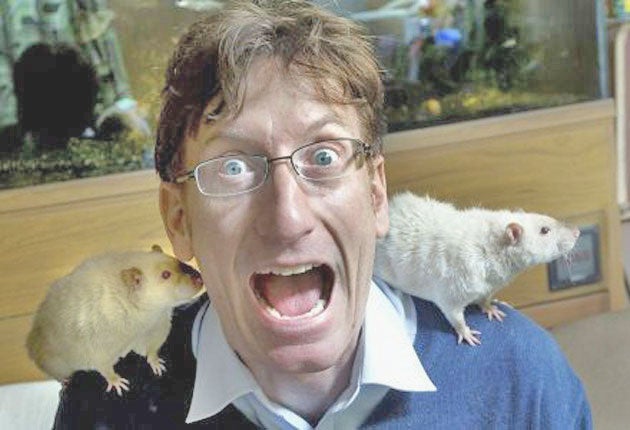
"Mankind is illogical," explains Arundel, a 74-year-old retired market gardener and grandfather, as he piles a necklace of three huge Rex "fancy" rats on to my taut shoulders. "They are extremely curious, but man can't abide an animal that is as intelligent and curious as he is. They will acquire and they will learn very quickly," he says.
It is of great irony to him that, following a serious blood clot last year, he is being kept alive thanks to the anti-coagulant drug warfarin, a traditional rat poison. "You really can't feel the tensions of life when you have got rats. Everything slows to their pace. You won't find them scratching at the door or howling on the roof like a cat – and you never have to take them for a walk. Compared with ferrets, they are very family-friendly and not sexist, like parrots, either," he says.
There are many amazing things about rats, it seems. They can smell stereoscopically, for example. This means that in a darkened room they can tell whether food is on the left or right of their nose within 50 thousandths of a second. A rat's tail – not at all cold and clammy but really rather beautiful – is a versatile prehensile tool that also acts as a cooling mechanism to make up for the fact that they don't sweat. For that matter, rats are never sick – like frogs, they are incapable.
One neuroscientist has even uncovered evidence that rats "laugh". When happy, apparently, they emit a series of ultrasonic chirps, rather like children. Their ability to feel happiness is further evidenced by their unique method of purring when content in their masters' hands. They will also blow in your ear and lick away your tears, though they do have a maddening habit of ripping off your glasses.
Rat owners will next month celebrate the ninth World Rat Day to help overturn the "ignorance and unthinking prejudice" that surrounds their favoured pet. Admittedly, Arundel's three rats are as different from wild rats as "a corgi is from a wolf" he says, though they are still highly bred brown rats. When you get up close and personal, you do start to see the attraction; though be warned – rat poo is extremely smelly and a bowel movement is easily brought on by handling.
For Colin Arundel, rats are a passion that link back to a time when people were closer to nature. "I hate it when MPs and others say they are supposed to be vermin or when they start slandering rats. I would rather trust a rat than a politician. They show you loyalty. They treat me like a big brother," he says.
As I snuggle back in my chair, rats nibbling my ears and purring in my arms, I feel tempted to agree. It's time to forget that terrible night in the grocer's shop, to put away the ratty horrors of those teen novels and start again – to understand this horribly traduced creature and maybe even learn to love it. After all, it seems to quite like me.
10 rat facts
4
April is World Rat Day, an international rat holiday designed to recognise the rat as a pet and companion animal for people of all ages.
229
years after the Great Plague hit London in 1665, the probable cause of the disease was discovered. In 1894, during an epidemic in Hong Kong, two rival research teams isolated the bacillus Pasteurella pestis (now called Yersinia pestis), a disease of black rats and other rodents, spread by their fleas, that caused the plague.
18
How many months rats typically live to in the wild. Domestic rats live for an average of three years.
2,000
The size of a colony that one pair of rats can produce in a year. Females have a gestation period of 22-24 days.
30
The number of grams of food a rat eats on average in a day. This is the equivalent of 10 per cent of their body weight.
50
The number of metres the average rat's home is in diameter.
2020
The next year of the rat in the Chinese zodiac.
20%
amount of the world's food crop damaged each year by rats.
1,000,000
The number of hairs a pair of rats can shed in a year.
25,000
The number of droppings a single rat can leave in a year.
Join our commenting forum
Join thought-provoking conversations, follow other Independent readers and see their replies
Comments
Bookmark popover
Removed from bookmarks