'Worrying' slump in tree planting prompts fears of deforestation
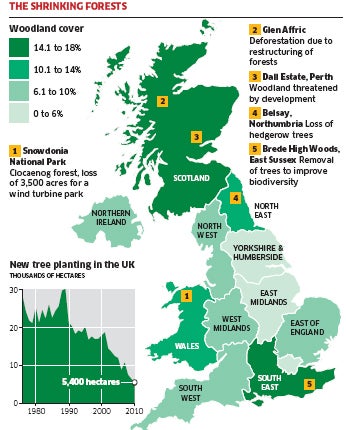
Planting of new trees has fallen to its lowest level in more than three decades across Britain, leading conservationists said yesterday.
Efforts to replace woodland in the United Kingdom, once so densely forested that trees which have sustained human populations for 6,000 years covered 90 per cent of the land mass, have slowed dramatically in the past six years, falling from 12,000 hectares of newly-planted woods in 2004 to just 5,000 hectares last year.
Britain is one of the least wooded countries in Europe, with half the average tree cover, and half of its ancient woodland lost since the 1930s. It is a worrying development at a time when reforestation is a priority to offset the effects of climate change.
Figures released by the Forestry Commission, the Government body in charge of managing Britain's woodlands, show that 2.85 million hectares of land in the UK is covered by woods – equivalent to 12 per cent of the total land area. According to the Commission, the figure represents an increase in woodland of 0.2 per cent since 2002.
But conservationists challenged the statistics, saying they failed to take into account factors including a huge loss of hedgerow trees and swathes of woodland cut down to make way for wind farms and developers. This means that far from increasing the amount of tree cover in Britain, it is actually likely to be falling.
The Woodland Trust, Britain's leading woodland conservation charity, said there had already been a loss of 9,000 hectares of tree cover in England between 1999 and 2008. The charity called on the Government to reverse the falling trend in new tree planting, which has dropped from a peak of 28,300 hectares in 1976 to less than a fifth of that level.
Sue Holden, the trust's chief executive, said: "There figures are truly worrying but should be seen as a clarion call to us all to reverse the downward trend as a matter of urgency. Woods and trees are not a luxury but essential for our future quality of life.
"We are concerned that with planting rates so low, the result may be a loss of woodland cover, at a time when increasing it is essential. There is an urgent need to compensate for these losses with large-scale woodland creation elsewhere."
Despite efforts by the Forestry Commission and private landowners to bolster planting, with the vast majority of new planting using wildlife-friendly broadleaf rather than coniferous species, the conservationists argue that four main factors have obstructed the programme to expand Britain's woodlands.
These are: pressure to build new housing; demand for windfarms; moves to fell woodland to create open habitat to increase biodiversity; and the reshaping of forests in the landscape.
For example, in Snowdonia, 3,500 acres of forest has been earmarked for felling to make way for wind turbines, while the Trust says that some 800 woods equivalent to the size of Birmingham have been under threat from developers in the last decade.
The problem is compounded, according to the trust, by a devastating loss of mature trees outside woodlands in locations such a hedgerows or fields. In England alone, there has been a 64 per cent decline in "individual" trees.
The Forestry Commission said it accepted there had been a decline in tree planting, but says it has plans which will see 100,000 hectares of new woodland planted in Wales by 2030 and 50,000 hectares planted in Scotland by 2015.
A Commission spokesman said: "The figures suggest that Britain's woodland area continues to increase, as it has for the past 90 years."
Join our commenting forum
Join thought-provoking conversations, follow other Independent readers and see their replies
Comments
Bookmark popover
Removed from bookmarks