New hope for world's biggest and weirdest flower
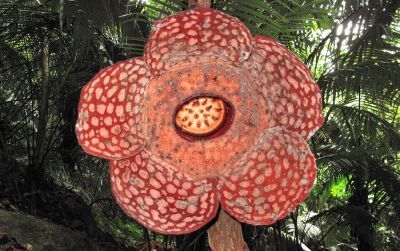
Deep in the jungles of Southeast Asia blooms the world's biggest flower -- a massive fleshy orb designed by nature to attract insects by mimicking the colour and stench of rotting meat.
The bizarre bloom, named Rafflesia after famed British colonialist Sir Stamford Raffles who stumbled across one in Borneo in 1818, is under threat from deforestation and harvesting for traditional medicine.
But under an innovative Malaysian scheme, indigenous tribes who once gathered Rafflesia buds by the sackload are being trained as custodians of the rare flowers, and to act as guides for ecotourists.
"We used to pick the buds and sell them to traders. We took many, many sackfuls," said Long Kadak, a member of the Semai tribe in Ulu Geroh, a scenic village in northern Perak state which has embraced the scheme.
"But now we're not selling them because we want tourists to come and see our flowers. We make much more money that way," said Long, one of a dozen guides who take visitors to the elusive blooms as well as to enchanting butterfly groves and waterfalls.
As the sturdy 51-year-old widow scampered effortlessly up a steep jungle trail on the hunt for a Rafflesia, with a trail of breathless tourists behind her, she said the scheme had revived traditional skills and knowledge.
"Only older people used to pick them because they knew the places where they grew. At that time we didn't know because we didn't often go deep into the jungle. Now the young people know how to reach them and return," she said.
"Now we know the value of the flowers we don't allow our people to gather them. We've got to take care of this place," said Long, whose tribe is one of Malaysia's indigenous people known collectively as "Orang Asli".
Abdul Latiff Mohamad, a world expert on the Rafflesia, said the scheme has brightened the prospects of the plant which grows only on a specific jungle vine in parts of Indonesia, Malaysia, the Philippines and Thailand.
"When we first started studying Rafflesia we were in a state of shock. We didn't know much, including where they were distributed, but we did know they were being collected by the Orang Asli and others," he said.
"Ten years ago we thought -- if this state of affairs continues we may see extinction," said the scientist from the National University of Malaysia.
The total number of species is debated, but many scientists agree on 24, of which three are already extinct.
Sometimes called the "corpse flower" for its stomach-churning scent, or the "giant panda of the plant world" for its rarity, the Rafflesia is a parasite which has no stems or leaves.
It first emerges as a small lump on the vine, and over about nine months swells into a cabbage-like bud which opens to reveal a massive five-petalled flower sometimes measuring more than a metre across.
The bloom, coloured a mottled red, pink or orange depending on the species, is visible for just a few days, before turning black and rotting away.
Not all varieties of Rafflesia have the distinctive stench, and even among those which do, the open bud has to be caught just at the right time. Abdul Latiff confesses he has rarely caught the full whiff.
"The smell is due to the exuding smell to attract the carrion flies. They come browsing and help in pollination. But the flies must have a better sense of smell than I do!" he laughs.
The conservation scheme originated in Sabah state in Borneo in 1993, when an enterprising national parks official asked indigenous people to monitor the buds so he could alert hotels, who sent guests to see an open bloom.
Abdul Latiff said that as well as providing income for local people, the new ecotourism business influenced developers who previously had quietly hacked out Rafflesia groves to avoid any interference from environmentalists.
"The Rafflesia population of Sabah really was saved. There was no over-collection any more and people took the initiative to locate new populations they had heard about from their grandfathers," he said.
There are several more sites across the country which are potential locations for Rafflesia conservation programs, he said, including some areas where "sacks and sacks" of buds are still being harvested.
New interest in the Rafflesia has seen more studies carried out, into its range and even its DNA. But Abdul Latiff says its best hope is with the Orang Asli.
"They have had an association with the jungle much longer than us. If they fail in looking after the Rafflesia, what chance do I have?" he said.
"I'm emotional about it because I'm a scientist and I don't think we have the right to drive anything to extinction. Without this programme, they would have faced a slow death."
Join our commenting forum
Join thought-provoking conversations, follow other Independent readers and see their replies
Comments
Bookmark popover
Removed from bookmarks