Tree rings: Chainsaws at dawn
Tree rings were thought to prove global warming – now climate-change deniers say they show the reverse. Both views are flawed, says Holly Williams
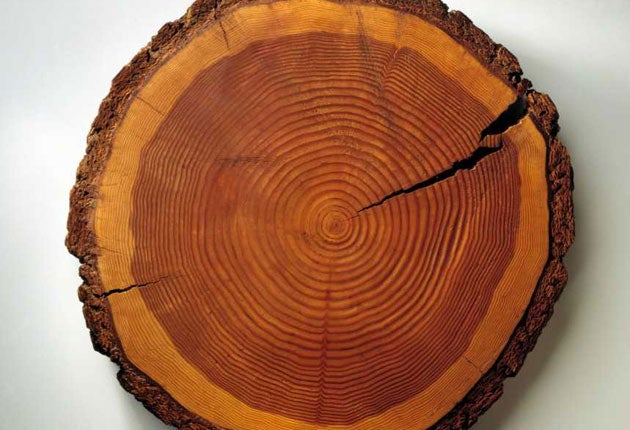
As every amateur naturalist knows, trees provide a record of their own history, in the pattern of rings seen in a horizontal cross-section. Trees growing at the same time will show similar patterns, and each year is distinctive enough to allow those who study tree rings – dendrochronologists – to date the rings, establishing chronologies stretching back thousands of years.
But trees tell us more than just when they were growing – they also reveal what the climate was like. Rings are formed as the tree grows, adding layers of new wood beneath its bark. How thick that layer – and how wide the resultant ring – depends on various factors, but most importantly the climate. A warm, wet summer will result in a wide ring; a cold summer or drought will produce a narrow ring.
Trees can therefore function as archives, invaluable sources of information for climatologists – and for those attempting to prove or disprove climate change.
And that's where it gets controversial. It turns out not all trees hold a reliable record of temperature. But as temperature-related data is hot property in the climate change debate, scientists who suggest that some tree data may not be helpful risk being accused of hiding important findings.
Last month, Queen's University Belfast was ordered by the UK Information Commissioner's Office to hand over data from 40 years of research into Irish tree rings to Doug Keenan. A City banker turned climate analyst – and climate change denier – Keenan believes the Irish tree-rings could provide evidence that there was a "medieval warm period" 1,000 years ago. If this were true, it would disrupt the notion that warming during the 20th century is unique and man-made.
Professor Mike Baillie, who collected much of the data, insists it is not suitable for use in the climate change debate. He explains why some trees – including those he studied – do not give clear, reliable temperature data. "Not all tree rings are the same. We live in a temperate climate, which means there's a limited amount of climate information you can get out of studying our trees – the climate they grew in is a balance of temperature and rainfall, it isn't extreme enough to allow the reconstruction of a single climatic variable. You get some information, but it appears to be mostly to do with rainfall – not temperature." Baillie adds that if you want accurate climate reconstructions, you have to go to places where the trees are responding to a controlling variable, such as summer temperature.
"You can extract climate information from trees – mostly pines – from more extreme environments, like northern Scandinavia and Siberia; trees from high altitudes and high latitudes where the summer warmth was very important." His tree rings just don't tell us anything very concrete about temperature, let alone confirm a medieval warm period.
It's not the first time that tree rings have been at the centre of a climate change furore. Tree ring data was at the heart of "climategate" last November, when hacked emails from the Climate Research Unit at the University of East Anglia allegedly revealed a cover-up.
Head of the unit, Phil Jones, famously wrote of "hiding the decline". But this was in reference to tree ring records, not global temperatures. The "decline" referred to the fact that recorded temperatures from reliable tree rings, broadly in line with thermometers since records began, started diverging around the 1940s.
Professor Keith Briffa, from UEA, explains that this "divergence" meant that "tree growth trends over the latter part of the 20th century, in areas where tree growth is known to be sensitive to temperature variations, were either stable or declined while measured temperatures increased".
This has led to climate scientists ditching recent tree ring data in favour of more accurate temperatures recorded by thermometers – a decision spun by sceptics as a general temperature-decline cover-up.
The real irony, however, is that it may even be because of climate change that tree rings stopped responding to temperature. Although no one has a definitive explanation, Baillie says that climate change has to be assumed to be a factor. "It is as if trees in areas where temperature was previously a controlling issue no longer regard it as such; they have enough temperature and hence their growth increasingly depends on some other variable. This could be regarded as worrying!"
Briffa says a lot more research needs to be done, but adds that "some people have proposed that erstwhile temperature-sensitive trees are becoming newly limited by lack of moisture as the climate warms".
Tree rings are undoubtedly a hugely valuable information source. "Not only should tree rings be used – they must be used if we are interested in recovering accurately-dated climate information year by year over long periods," insists Briffa. However, he adds that they must be carefully selected, from areas where a particular aspect of climate exerts a strong and unambiguous influence.
Not all tree rings lead to reliable climate reconstructions. And even some of those that used to, seem to have now – for mysterious and much-debated reasons – stopped responding to temperature. One thing seems certain though: sceptics are still likely to use trees to attempt to run rings round our perception of climate change.
Join our commenting forum
Join thought-provoking conversations, follow other Independent readers and see their replies
Comments
Bookmark popover
Removed from bookmarks