Warming brings early demise to Bolivian glacier
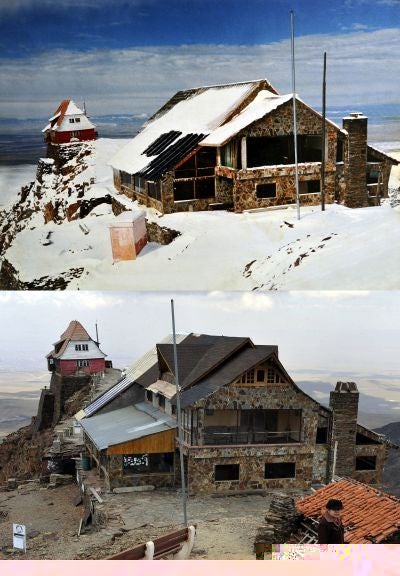
Once home to the highest ski resort in the world and now reduced to a rocky mountainside, Bolivia's Chacaltaya range bears powerful witness to the precipitous melting of glaciers.
The rusting remains of a ski lift now dominate what was once the highest ski-run in the world perched on the Chacaltaya glacier at some 5,300 meters (17,390 feet) high.
Only a snowy ice cap of some 50 square meters (538 square feet) remains of the magnificent Chacaltaya glacier which spread over 1,600 square meters in the 1950s.
"That's all there's left: a little piece of ice that is disappearing and will last no more than a year," said Alfredo Martinez, a veteran guide and founder of the Bolivian Andean Club.
Glancing at old black and white photographs, he recalled better times for his beloved Andean glacier, when ski competitions saw Argentine and Chilean athletes make the two-hour trip from the capital La Paz on a narrow and winding road.
Martinez remembered the very last race, three years ago, on Chacaltaya's steep incline that delighted extreme sports enthusiasts.
But today, "it's a dead glacier," said Edson Ramirez, glaciologist at the Institute of Hydraulics and Hydrology in La Paz.
Skiers have now migrated to nearby Cerro Charquini, where they can still find enough snow.
Ramirez is part of a team of international scientists studying the Tropical Andes stretch of mountain range on horseback in Bolivia, Peru, Ecuador and Colombia.
The scientists, who have studied Chacaltaya for the past 15-20 years, had forecast it would completely disappear in 2015.
But with accelerated global warming spurring the ice to melt at the rate of six meters (20 feet) per year compared to about a meter in the 1940s, its demise has come six years earlier than expected.
Around Chacaltaya, Bolivia's Royal Cordillera region, which boasts pristine valleys, fields, lakes and waterfalls surrounded by mountains, has lost 43 percent of its snow-capped peaks in the past 33 years.
The same grim scenario can be found at the neighboring Huayna Potosi mountain (6,088 meters) or the majestic Illimani, which dominates La Paz at 6,462 meters.
For Ramirez, there is only one culprit, climate change, blamed on greenhouse gases that are particularly prevalent in industrialized countries.
Experts say most tropical glaciers in the Andes are doomed to disappear in the medium term due to global warming.
In 2000, Bolivia only emitted 0.35 percent of the world's greenhouse gases, the humanitarian group Oxfam noted in a report published ahead of key UN-sponsored climate talks in Copenhagen next month.
And yet, Oxfam warned Bolivia will be hit disproportionately as thousands of Andean farmers and La Paz residents depend on melt waters from the glaciers, which accounts for 15 percent of the capital's supply.
Nearly half of the country's energy supply - 40 percent - comes from hydroelectric sources.
The apparent injustice is fueling a government-backed civil lobbying effort to push for "international climate justice" and pressure industrialized countries to compensate populations hit by their "climate crimes."
In the meantime, Chacaltaya with its breathtaking view of the Altiplano high plain remains a sought-after hiking spot, as the debate over global warming puts it in the spotlight.
Tourists here come face to face with one of the devastating consequences of glacier loss - that the area where snow has already melted heats up even more quickly thus causing the snow around it melt faster still.
Martinez, a 74-year-old veteran climber, demonstrated the phenomenon, grasping a handful of snow between his fingers and rubbing it against a rock.
"Before, the rock was so cold that the snow was preserved," he said. "Now, it disappears within a few seconds."
Join our commenting forum
Join thought-provoking conversations, follow other Independent readers and see their replies
Comments