A briefs history of time
The changing shape of our bras and knickers over the past 100 years offers intimate insight into women's lives. Harriet Walker delves into the nation's drawers
The world of women's underwear is as highly scientific and rarefied as it is diverse. Just as men seem to fear the contents of the female handbag, they're also woefully misinformed as to what we keep in our drawers too – chests of drawers, that is. Thankfully, the exhibition Undercover – the Evolution of Underwear opens soon at London's Fashion and Textile Museum and promises to deliver a revealing history of our smalls. From turn-of- the-century corsets to today's scantier bras and briefs, the exhibition charts a change which reflects not only the tides of fashion, but also the social shifts and developments within the women's movement over the past 100 years.
Turn of the century: All laced up
In 1900 Queen Victoria may have still been on the throne, but the large bustles and vast hooped skirts that characterised fashion during her reign were falling out of favour. The laced whalebone corsets and stays used to create tiny waists during this era were restrictive and cumbersome in the extreme.
By the beginning of the 20th century, undergarments had become less bulky. They were still designed to squeeze and smooth the wearer into an 18-inch waist hourglass shape, but Edwardian tastes were for narrower lines and as skirts became more fitted, there was no need for the clunking farthingales and hoops which previous generations had used to bulk up their bustles.
As the Edwardian age ended, clothes became less ostentatious and the trend was for the new female athleticism, which demanded a slimmer, sportier silhouette. Women were suddenly able to move freely, to participate in games, and underwear developed accordingly: Amelia Bloomer's long 'pantalettes' were ideal for tennis, and New York socialite Mary Phelps Jacobs invented a protoype bra, made of two handkerchiefs fastened by ribbon. Restrictive stays morphed into a shorter supportive belt or girdle, to be worn over looser camisoles and slips and the flappers' love of dancing meant that the garter belt was invented, to help keep their stockings up.
1930 to 1960: From femininity to feminism
After the (literally) loose women and flappers of the Twenties, undies – as well as public taste – got all buttoned up again. But steel shortages during the Second World War meant that metal couldn't be spared for corsets, so softer 'liberty bodices' became popular. The Fifties saw a return to the hourglass, as Marilyn Monroe and A-line dresses and skirts embodied the fashion for extreme femininity. By 1959, however, younger women were wearing bra and girdle sets, which were more practical underneath casual separates. These were much more recognisably related to modern underwear, highlighting the increasing prominence of youth culture and of "the problem with no name", as feminist forerunner Betty Friedan termed the burgeoning women's movement.
1970 to 2009: Wonder bras
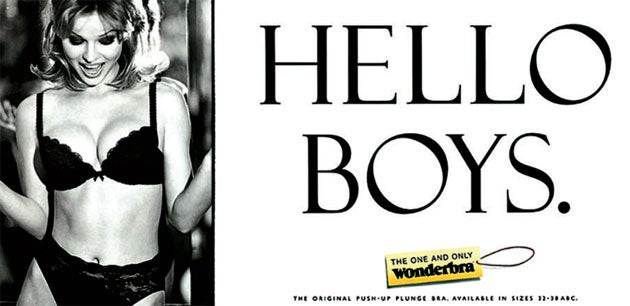
The image of the bra-burning feminist may be a myth, but the Seventies brought social and sartorial revolution. The rigid scaffolding needed to create a pneumatic Fifties silhouette faded with the rise of models like Twiggy. Bras were supple and minimal, with only a small underwire for support. Underwear also began to form an important part of fashion and commercial imagery, and became a crucial money-making arm of older fashion houses, like Christian Dior and La Perla (main picture). Risqué adverts created an aspirational – not to mention sexy – profile for the new generation of luxury lingerie. By the Eighties, power dressing 'glamazons' needed undergarments to match their formidable exteriors – so Gossard and Wonderbra stepped in, reuniting consumers with quivering cleavages. The 'Hello Boys' campaign with supermodel Eva Herzigova brought these brands and their wares into the global consciousness.
'Undercover – the Evolution of Underwear' opens 12 June at the Fashion and Textile Museum, www.ftmlondon.org
Join our commenting forum
Join thought-provoking conversations, follow other Independent readers and see their replies
Comments
Bookmark popover
Removed from bookmarks