Food & Drink

10° London Hi 14°C / Lo 8°C

Scientists develop apple that won't rot

Disease-resistant variety of fruit can be kept out of the fridge for a fortnight without going off
By Chris Green

Apple that won't rot

ALAMY

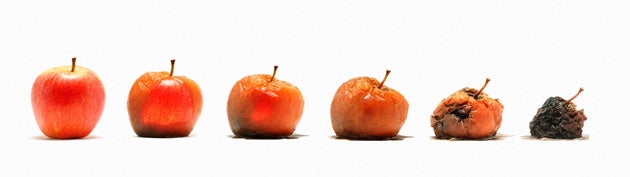
The RS103-130, which is a deep red in colour, stays "crispy" for up to 14 days if kept in a fruit bowl - unlike most apples

Ever since somebody suggested that eating one a day kept the doctor away, the health benefits of the apple have been trumpeted by grandmothers and government ministers alike. The fruit's only drawback is its tendency to lose its glossy sheen and crunchy texture within a few days – a problem that a team of scientists in Australia now claims to have solved.

For the past 20 years, researchers at Queensland Primary Industries and Fisheries (QPIF), a department of the Queensland government, have been developing a new variety of apple which they claim can stay fresh for months.

Its name, RS103-130, might not have quite the same ring as popular varieties such as Golden Delicious, Pink Lady or Braeburn, but the scientists have described it as "the world's best apple" thanks to its sweet taste, longevity and ability to resist disease.

The apple, which is a deep red in colour, stays "crispy" for up to 14 days if kept in a fruit bowl, and if stored in a fridge it can remain edible for four months. The Queensland government is seeking a commercial supply partner to distribute the fruit and hopes to begin selling it next year.

Tim Mulherin, Queenland's primary industries minister, said: "This new variety is sweet. It ticks the other boxes too because it is disease resistant, so requires few or no fungicides. Initial taste tests have been outstanding. Out of the five apple types tasted, the new variety scored the highest."

The RS103-130 variety has a naturally strong resistance to apple scab, also known as black spot, a disease caused by the fungus venturia inaequalis which affects both the foliage and fruit. The apple is not genetically modified but is produced conventionally using a gene from the Asiatic apple variety Malus floribunda which has a proven resistance to black spot.

In Britain, apple producers need to spray each crop 14 times to protect against the disease, a process which costs the £200m-a-year industry up to 10 per cent of its turnover. A variety which did not require spraying could mean huge savings for the producers.

"If you're an apple grower and this [new apple] lives up to its promise, then it really is quite a breakthrough," said Dez Barbara, a senior research scientist at the University of Warwick's Horticulture Research International.

However, he added that the new apple was not guaranteed success in Britain and would have to be trialled. The Saturn variety, which used the same gene, was introduced to the UK in 1980 but didn't catch on.

"With apples, you've got to take into account things such as how easy they are to grow and pick," Dr Barbara said. "Above all, consumers have got to like them – if consumers won't buy them, producers won't grow them."

Guy Barter, chief horticultural adviser for the Royal Horticultural Society, said the new variety's longevity could give it a major advantage.

"Apples that have ripened in storage are never quite as nice as those that ripen naturally. There's also a huge environmental cost in running the cold stores to keep the apples, so if you had a variety that required less cold storing, that would be valuable," he said.

Post a Comment

View all comments that have been posted about this article.

Offensive or abusive comments will be removed and your IP logged and may be used to prevent further submission. In submitting a comment to the site, you agree to be bound by the Independent Minds Terms of Service.

Comments

What rot
[info]remy_germain wrote:
Tuesday, 10 November 2009 at 05:51 am (UTC)
What rot
Is this paper moderated?????
[info]coochrisyorks wrote:
Tuesday, 10 November 2009 at 09:08 am (UTC)
Oi moderators, or editors, whatever you are called....get these spamming idiots off of the Livejournal on the Independent paper please!!!!
Nature would have already done this
[info]corporeal_v001 wrote:
Tuesday, 10 November 2009 at 01:22 pm (UTC)

Mankind is always trying to out-do nature. All modifications have their undesired side effects as the past has shown. We thought pestacides, fungacides, insectacides were a miracle, until we found they have their disadvantages, like wiping out on a massive scale - frogs, bees and who knows how many other lower lifeforms.

There have been experiments to selectively breed bulls with larger muscles. Over time, these experiments have given the desired growth, but the meat is inedible, so ultimately the experiment is a failure.

Just buy fewer organic apples, so the storage issue is minimised.
missing the point by a wide margin
[info]rockinrog wrote:
Tuesday, 10 November 2009 at 01:49 pm (UTC)
If an apple is tasty enough, it won't be sitting around for a fortnight because someone will have eaten it. This is another example of the food industry getting it hopelessly wrong. Does anybody buy fresh fruit a fortnight before they need it?
So What?
[info]wvwilliams wrote:
Tuesday, 10 November 2009 at 10:10 pm (UTC)
In Norh Wales we have a genuinely disease free potato.Its called Sarpo and few in the industry want its existance known.
So What?
[info]wvwilliams wrote:
Tuesday, 10 November 2009 at 10:15 pm (UTC)
Here in Bangor ,North Wales we have a genuinly disease free potato called Sarpo.The big guns of the potato industry are not overly exited by its existance and the story of its origin involves the battle of a Hungarian family to hide its very existance during communism.
nothing new
[info]boblopard wrote:
Tuesday, 10 November 2009 at 10:34 pm (UTC)
picked a load of organic apples and stored them in a cool dry dark place a few months ago. They're still edible and they will probably remain so all winter.

Instead of promoting new ways to develop cancer, why don't they promote the old ways of knowing how to look after food?
Re: nothing new
[info]corporeal_v001 wrote:
Wednesday, 11 November 2009 at 01:35 pm (UTC)

That would be too sensible, too simple, too easy, too natural :o)
Tampering with nature again, eh?
[info]tatehpikin wrote:
Wednesday, 11 November 2009 at 01:39 pm (UTC)
No! No! No! We want our apples just the way nature intended. Why the hell would I want an apple that have been in my fridge or countertop for 4 months. Stop destroying the human race with artificiality. This is just another dangerous preservative that will have it's health kick backs so that the pharmaceutical companies can get in the lab to create some deadly drug to counter it while destroying humans again. STOP stupid, profit driven research that is is in you favor and against human nature.
Re: Tampering with nature again, eh?
[info]adampooler wrote:
Wednesday, 11 November 2009 at 07:25 pm (UTC)
Err..they haven't used any preservatives. As you might have noticed if you had read the article before spewing out your spurious tosh.
[info]1maia wrote:
Saturday, 14 November 2009 at 12:10 am (UTC)
In the old days, apples for winter were picked and stored in drawers on straw or newspaper - we still do, but mice can get in. Particular varieties were grown for this purpose; i think Blenheim Orange is the best known.

Most popular in Life & Style


Tuck into our A-to-Z of recipes

Article Archive

Day In a Page

Sun | Mon | Tue | Wed | Thu | Fri | Sat

Select date