Thai chicken better than most British production, says RSPCA
Shoppers who care about animal welfare should shun standard British chicken and buy meat imported from thousands of miles away in Thailand, according to the RSPCA.
Britain's biggest animal welfare charity said that the standards in two of the biggest poultry exporters, Thailand and Brazil, were generally higher than in basic UK production.
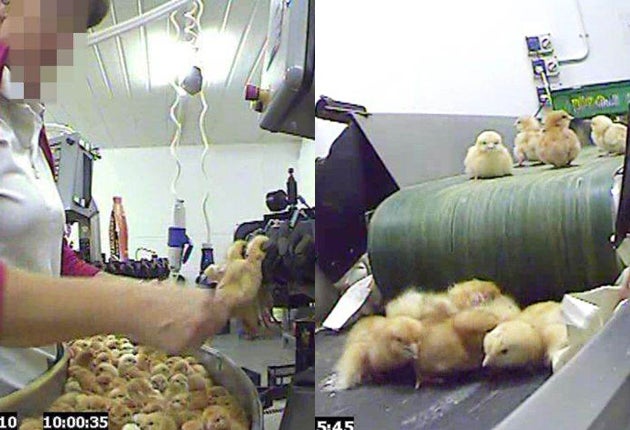
The calls came on the same day campaigners released footage showing a "conveyor belt to death" for male chicks unwanted by the egg production industry. Vegetarian organisation Viva! said that between 30 million and 40 million chicks were killed each year in gas chambers or by being thrown into electric mincers.
The RSPCA said Thai poultry had more space – around 13 chickens per square metre compared with 20 per square metre in basic UK production – and were allowed to grow for longer, 42 days, compared to as little as 35 days here. They were also allowed more rest; six hours of continuous darkness rather than the four they have here.
Although more variable, standards in Brazil were also often better, said Dr Marc Cooper, an RSPCA farm animal welfare scientist, who visited poultry farms in Thailand last year and in Brazil this year. In an interview with The Independent, he said consumers were wrong to assume that chicken from Britain was raised to a higher standard than cheaper birds from developing countries – where land and labour cost less.
"Based on what we saw it would be safer to make the opposite assumption and say that chicken that's come from Thailand has been reared to a higher welfare standard than the standard industry chicken you would buy here," Dr Cooper said.
"It's the same for Brazil. The production there is more variable, but again, it would be incorrect to assume that the chicken that's coming in from overseas – from Brazil and Thailand – is being reared to a lower standard."
While touring Thailand's second biggest producer last year, he noticed that the birds' conditions were substantially better than their UK counterparts. "They have a very low stocking density, typically they will use natural lighting, they use a slower growing breed than is typically used here, and biosecurity is on another level," Dr Cooper said.
Supermarkets seeking cheaper supplies have dramatically increased imports of chicken into the UK, which have soared more than ten-fold in value in a decade, from £36m in 1996 to £510m last year.
Thailand is the largest non-EU importer, with sales of £292m last year, while Brazil had £30m. However most of the chicken eaten here is UK-produced.
Although negative publicity about factory farming has led to a jump in sales of organic, free-range and "higher welfare" chickens, such as Marks & Spencer's Oakham range, 80 per cent of UK production is farmed intensively in sheds containing up to 50,000 birds.
Dr Cooper said: "The UK industry always say we can't raise our birds to a higher welfare standard because we are always threatened by imports and imports are coming in at a lower welfare standard. That argument simply isn't true."
Peter Bradnock, chief executive of the British Poultry Council, said: "I don't think Marc Cooper is right".
The breeds used in Thailand were not slower growing, he said, but producers had to grow the birds slower and give them more space because sheds used natural ventilation and outside temperatures were hot.
Mr Bradnock said: "I not saying it [Thai chicken] is poor quality, nor am I saying that it's any better."
UK chickens vs Thai chickens
Space: UK: About 20 chickens per square metre.
Thailand: About 14 chickens per square metre
Breeds: UK: Fast-growing breeds such as Ross 308, whose bodies grow too large for their legs, causing lameness in some
Thailand: All of a genotype that would be marketed in the UK as "slower growing."
Rest: UK: Four hours continuous darkness a night
Thailand: Six hours continuous darkness a night
Standard UK chicken production, which accounts for 80 per cent of UK market. Source: RSPCA, Assured Chicken Production
Join our commenting forum
Join thought-provoking conversations, follow other Independent readers and see their replies
Comments