What a waste: Britain throws away £10bn of food every year
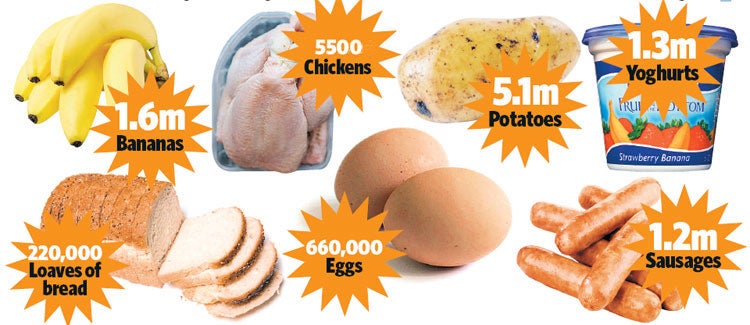
Global food shortages, soaring prices and alarm over the environment. But every day, Britain throws away 220,000 loaves of bread, 1.6m bananas, 5,500 chickens, 5.1m potatoes, 660,000 eggs, 1.2m sausages and 1.3m yoghurts
A new study has exposed the staggering amount of food thrown away every day by the British public, calculating that the annual total of wasted products adds up to a record £10bn.
Each day, according to the government-backed report, Britons throw away 4.4 million apples, 1.6 million bananas, 1.3 million yoghurt pots, 660,000 eggs, 5,500 [CORRECTED] chickens, 300,000 packs of crisps and 440,000 ready meals. And for the first time government researchers have established that most of the food waste is made up of completely untouched food products – whole chickens and chocolate gateaux that lie uneaten in cupboards and fridges before being discarded.
The roll call of daily waste costs an average home more than £420 a year but for a family with children the annual cost rises to £610.
The Government's waste campaign Wrap (Waste & Resources Action Programme) revealed the extent of Britain's throwaway food culture after sifting through the dustbins of 2,138 people who signed up to an audit of food detritus. Other items on the daily list included 1.2 million sausages, 710,000 packs of chocolate or sweets, 260,000 packs of cheese, 50,000 milkshake bottles and 25,000 cooking sauces.
The study is published as millions of the world's poor face food shortages caused by rising populations, droughts and increased demand for land for biofuels, which have sparked riots and protests from Haiti to Mauritania, and from Yemen to the Philippines. Last month India halted the export of non-basmati rice to ensure its poor can eat, while Vietnam, the second-biggest rice exporter, is considering a similar measure after Cyclone Nargis ripped through Burma's rice-producing Irrawaddy delta.
In Britain yesterday, it emerged that food prices had risen by 4.7 per cent in the past month. The soaring cost of wheat has increased food prices in the UK by up to 11 per cent in the past year, putting more pressure on domestic budgets already struggling to cope with higher mortgage costs and council tax and energy bills.
Wrap suggested households seeking to balance their finances could save money by following basic tips to prevent food waste, such as planning shopping trips better and keeping a closer check on use-by dates. It also pointed out that many people do not know the difference between a "best before date", which has no implications for food safety, and use-by data, which must be followed.
The Environment minister, Joan Ruddock, said: "These findings are staggering in their own right, but at a time when global food shortages are in the headlines this kind of wastefulness becomes even more shocking. This is costing consumers three times over. Not only do they pay hard-earned money for food they don't eat, there is also the cost of dealing with the waste this creates. And there are climate- change costs to all of us of growing, processing, packaging, transporting and refrigerating food that only ends up in the bin. Preventing waste in the first place has to remain a top priority."
Eliminating the huge level of food waste would have significant environmental consequences. Local authorities spend £1bn a year disposing of food waste, which leads to the release of methane, a potent climate-change gas. Wrap calculated that stopping the waste of good food could reduce the annual emission of carbon dioxide by 18 million tonnes – the same effect as taking one in five cars off the roads.
Food experts said the study should serve as a wake-up call to British consumers. As well as an individual "Victorian moral" effort, Tim Lang, professor of food policy at City University, called for the Government to take action to improve the efficiency of the food system to face up to the challenges of climate change, rising oil costs and water shortages. Describing modern supermarkets as "cathedrals of waste", he said: "The British food economy is one of the most wasteful it would be conceivable to design. We have to create a new set of criteria on what we want the food economy to address; it's time for politicians to catch up."
Previously, Wrap's Love Food, Hate Waste campaign put the financial cost of the 6.7 million tonnes of food discarded annually in the UK at £8bn. After interviewing 2,715 households – and then analysing the contents of most of their bins – researchers found that people were throwing away a greater proportion of edible, unused products. Rather than half new food and half peelings and scrapings from plates, the proportion of entirely unused products was 60 per cent by weight and 70 per cent by value.
Overall, that meant the total level of waste was £2bn higher, at £10bn, with the untouched products discarded worth £6bn. Of those, products worth £1bn were still "in date", Wrap found.
Launching The Food We Waste report, Wrap's chief executive, Liz Goodwin, described its findings – which mean that one in three shopping bags is dumped straight in the bin – as "shocking".
She said: "People aren't really aware that we are wasting so much food; do we think it's acceptable to throw so much away when people around the world are starving? But also with the economic situation here purse strings are getting tighter yet the average family with children is wasting more than £600 a year on food waste. It begs some questions which we all need to ask ourselves. As individuals we are all wasting food. By class or age, there isn't much difference in how much we waste."
'I chuck out a lot because I live on my own'
Andrew Small, 46, from London
I waste a lot of stuff which goes way over its sell-by date. If you don't shop that often like me there is a danger of things like milk and fruit and vegetables going off in the fridge.
Estimated waste per month: £30
Andreia Augusto, 35, from Portugal
I mostly waste salads and vegetables from the fridge; and things like HP sauce, plus beans and lentils tend to get chucked out. It can happen almost without you noticing.
Estimated waste per month: £50
Lisa Jennings, 26, from London
I throw away a lot because I live on my own and I like to cook each night instead of eating ready-made meals. I struggle with vegetables because I tend to buy them in big packets.
Estimated waste per month: £20
Alaria Alongi, 40, Italian, lives in London
I recycle everything and do my own compost. When I make a surplus I tend to eat leftovers. I look forward to a day when you use your own large containers for buying rice and pasta.
Estimated waste per month: £0
Alan Young, 58, from London
I try to avoid throwing any food away, despite eating mainly at home. I was brought up by parentswho came from a wargeneration in which waste was a sin.
Estimated waste per month: £5-10
Join our commenting forum
Join thought-provoking conversations, follow other Independent readers and see their replies
Comments