What's forcing the prices to rocket in spice world?
Paul Peachey on the freak weather and rising demand that have driven costs sky-high
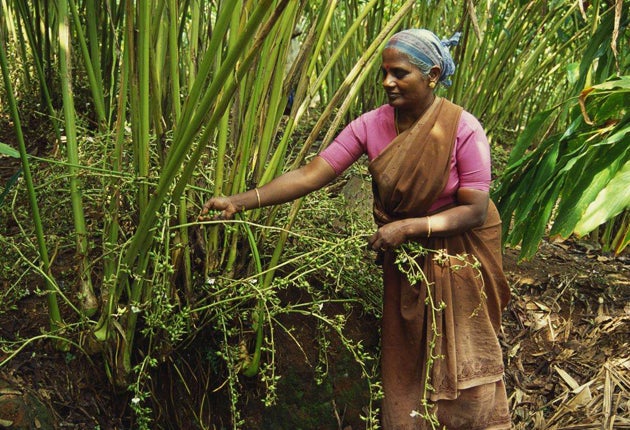
After a series of natural calamities and poor harvests, the price of spices from ginger to nutmeg have rocketed in one of the hidden stories of global food inflation. Traders and brokers reported prices of some spice staples have increased more than tenfold over the past five years and in turn hit food manufacturers and consumers.
Speculators have joined the fray encouraged by high prices and poor returns on the financial markets, leading to hoarding and pushing up prices.
Several years of hurricanes and devastation in major spice growing areas have led to a perfect storm of circumstances that contributed to the price rises. Cyclones that hit Madagascar destroyed vanilla crops, hurricanes in the West Indies affected nutmeg and unpredictable monsoons in India cut chilli harvests. Milan Shah, who imports spices for the UK food industry, struck deals to buy cardamom at £1.20 a kilo in 2007 but four years on the price stands at £16.50.
In Britain prices have followed the upward trend in the £250m a year herb-and-spice market where demand is fuelled by a growth in ethnic cooking and health concerns: reducing the salt level in diets has resulted in an increased use of spices, said Anthony Palmer, UK General Manager of Schwartz.
The spice trade represents a small sub-section of the food supply chain where prices have been volatile recently due to extreme weather. The last food price crisis, in 2008, quickly dissipated as the world entered recession, demand fell and farmers shifted into production of higher priced crops.
"Manufacturers of ready meals are changing their recipes because they need something more constant," said Anant Mathur, of British importer The Rice 'n Spice International. "The taste of food is going to change."
Sir Gulam Noon, the curry magnate who specialises in ready meals, said: "The prices of all of the raw materials have gone up all over the world.
"I hope it's a short term thing but sometimes prices don't come down again."
Cardamom
Highly popular in the Middle East, cardamom was originally grown in southern India but is now grown elsewhere, including Sri Lanka and Guatemala. Yields in Sri Lanka were down sharply this year with heavy rains that caused flooding and landslides. However demand for the crop has remained buoyant in the Middle East. It is used heavily in sweets and the early Ramadan holiday has meant supplies were snapped up. The crop was also disrupted in Guatemala.
Black Pepper
The global demand for black pepper - the dominant spice in the global market - has far outstripped supply. India - formerly the world's biggest producer - has been hit by crop failures owing to the late monsoon rains in 2009 and disease. The problems for Indian suppliers have meant that it was overtaken by Vietnam as the world largest producer, which supplies some 30 per cent of the world's exports. However its own stocks are almost exhausted, contributing to the price rises. The world's No 3 three producer, Brazil, has also been affected by high temperatures and drought that caused a big dip in supply.
Chillies
The erratic monsoon season damaged the chilli harvest in India with unseasonal rains in early December. Originally found in the Americas, it was introduced to Europe by Christopher Columbus. At least half of the crop was feared to have been damaged in India owing to the rains; disease also affected yield and quality, according to traders. Spice makers also blamed speculation for raising the price of the final product.
Coriander
Although the price for coriander (one of the first spices ever used by primitive cooks) has been largely flat over the year, there has been a sharp spike in recent weeks. The relatively stable price - compared with some of the other most popular spices - has been attributed to its diversity of supply. It is also grown in eastern and southern Europe and north Africa and the variety of growing conditions and locations have levelled out short-term spikes in price and production. The price has spiked in India over the last couple of weeks in part owing to the late monsoons that affected growing conditions and cut production.
Paprika
While the price has been driven up by increasing producer prices in Peru, brokers in Europe blame the rise in domestic price on stricter pesticide and toxin rules that have restricted supply. Originally grown in Central America, the supply of paprika to European consumers is dominated by a small group of family businesses in Murcia, Spain, who buy up a large proportion of the world's crop for processing. Brokers say rules have tightened over the last five years, preventing much of the crop being sold in Europe - driving up the price.
Cinnamon
An earthquake in 2009 in Indonesia damaged a number of plantations, causing major disruption to the cinnamon crop, contributed to supply problems and drove up the price. The damage to the trees has a long-term significance: the spice is obtained from the inner bark of trees which take some 15 years to mature. Analysts also reported that competing crops, like coffee and cocoa, were being planted instead to increase returns for farmers.
Cumin
Cumin has been relatively expensive for the last couple of years, with too little of the crop grown to satisfy demand, particularly in India, where it is a staple of Indian cooking. Spice brokers say the trade in cumin has been highly influenced by speculation, notably in India, the source of a majority of the world's spices and the centre of their trade. The nature of farming - with thousands of backyard growers each supplying a few sacks to co-operatives - has also contributed to the volatility of supply and pricing.
Ginger
The price of ginger has been hit by both strong demand in China and a smaller than expected crop in India. While it is native to those two countries - and they are two of the key producers of the crop - it is now also produced elsewhere in Asia, West Africa and the Caribbean. As a root spice, it is susceptible to damage from flooding. In November last year, China's Commerce ministry blamed hoarding and speculation for driving up prices. The food industry said that Nigeria was only slowly releasing supplies to achieve top prices.
Turmeric
Turmeric, another root spice, had a smaller annual crop last year. It is an integral part of Indian cuisine - used in most meals, with few alternatives to its use (when used to colour foods, it is much cheaper than one alternative, saffron). As well as being used for colouring, it is used in India as an aid to digestion, for skin conditions and for other medicinal purposes. Much of the smaller supply is taken for domestic use in India, thus driving up the prices for export.
Nutmeg/Mace
Historically both highly prized and expensive, the prices of nutmeg and mace - from the same tree - have increased sharply. Supply is dominated by Indonesia and Grenada.After nearly 50 years without suffering from a hurricane, Grenada was hit by two in 2004 and 2005, Ivan and Emily. Trees were destroyed and the long growing period until they can be harvested has meant that its nutmeg industry - the world's second largest - has not yet fully recovered. Indonesia, the world's largest producer, has been unable to pick up the slack.
Join our commenting forum
Join thought-provoking conversations, follow other Independent readers and see their replies
Comments