Cryonics: the chilling facts
In light of the landmark 'Frozen Girl' case, in which a 14-year-old with cancer was allowed to cryogenically freeze herself , revisit this article on the process from The Independent archive
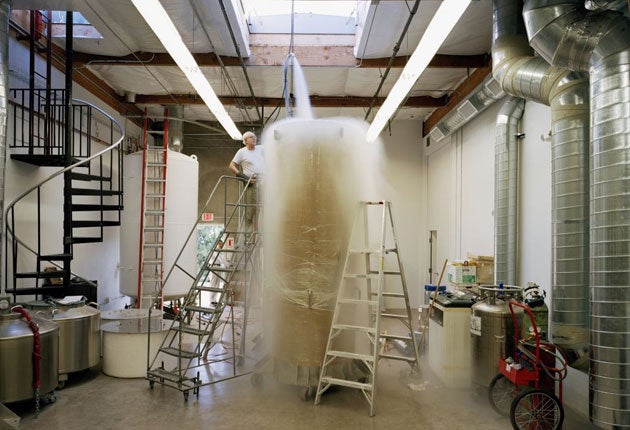
What if you were told that you could cheat death by having your veins filled with chemicals, before being hung upside down in a sleeping bag inside a freezing vat of liquid nitrogen, to be resurrected in decades or centuries to come?
As unlikely as it sounds, more than 200 bodies are stored like this around the world, as increasing numbers of people place their faith in the bizarre but fascinating science of cryonics as a means of achieving everlasting life. Now, the newest addition to the deep freezers is the father of the burgeoning movement himself, Robert Ettinger, who has died – or merely completed the first of his life cycles – aged 92.
The former physics teacher is the 106th person to be stored at the Cryonics Institute in Detroit that he founded in 1976, after science fiction ideas inspired him to write a book, The Prospect of Immortality – which presented the concept as very much not fiction. It was the bone-graft surgery that he received on his legs after being wounded in the Battle of the Bulge during the Second World War that first interested him in the advancements of medical technology – and certainly nobody could accuse Ettinger of being a pessimist. "If civilisation endures, medical science should eventually be able to repair almost any damage to the human body," he wrote, "including freezing damage and senile debility or other cause of death." He added: "No matter what kills us, whether old age or disease, and even if freezing techniques are still crude when we die, sooner or later our friends of the future should be equal to the task of reviving and curing us."
Though many people are aware of the basic concept of "cryogenic freezing", as it is commonly but erroneously called, few have seen inside the high-tech facilities such as Ettinger's which offer this practice in reality – let alone witnessed a preservation taking place. But one man who can offer an insight into what goes on is British photojournalist Murray Ballard, who has documented every aspect of cryonics there is to see (beyond the currently unachievable final stage, of course).
Ballard's project began while he was studying photography at the University of Brighton, when he was inspired by the story of a French couple who had held hopes of being revived after their death; unfortunately the freezer storing their bodies broke down. Intrigued, the photographer's research led him first to a group of enthusiasts based just along the Sussex coast in Peacehaven, and before long he and his camera made their first trip to the three main cryonic storage sites in the US and Russia.
There are around 1,000 people around the world like those in Peacehaven who have signed up to be preserved in the hope they can be reanimated in the future – with 459 having signed contracts with Ettinger's non-profit organisation – but Ballard says that most of those he has met understand it is very much an experimental and unproven science.
"In the main, they're actually very well informed about the medical research," he says. "A lot of them are sceptical themselves, and nobody can guarantee it will work. But some are a lot more positive about the prospect, and others have signed up because they're just petrified of dying. If your dream is to become immortal, this is the only option there is."
During his project he paid two visits to Ettinger's institute, as well as three visits each to the KrioRus plant just outside Moscow, where another 15 "patients" are currently held in cryostasis, and the Alcor Life Extension Foundation in Arizona which holds 104. At the Cryonics Institute, patients are only able to have their entire bodies preserved. At Alcor, however, people can opt to be neuropatients, whereby only their heads are saved – recalling the image of Richard Nixon's brain being kept alive for eternity inside a jar in the cartoon Futurama, in which the main character was himself reawoken in the future after accidentally being frozen.
"Essentially all you need is the brain," explains Mr Ballard. "The theory is that the brain is like a hard drive that stores all your memories and your personality. When you are revived at some point in the distant future, a new body will be grown to house your brain, or an entirely new brain may be built for them to somehow upload your personality into it."
The process involves bodies or brains eventually being cooled to minus 196 C, though cryonicists resist the term "freezing" as it involves much more than simply reducing their temperature. The patient must first be placed in a bath of icy water as soon as possible after death, before being connected to a blood circulation pump to keep their cells alive. This is when the most complications occur, as there may be a delay in death being pronounced, or relatives or hospital staff who have not been told of the patient's wishes may hinder access to the body.
Known as vitrification, the next stage is replacing the blood with a cryo-protectant fluid to prevent ice from forming in the cells as the temperature is lowered. The brain or body is then transported in dry ice to the preservation facility, where it is placed in an arctic sleeping bag and stored in a cryostat – effectively a giant steel Thermos flask more than 10ft (3m) high – where its temperature is gradually lowered. Each one of these units can hold five heads and four whole bodies, which are hung upside down to ensure the head is in the coldest part of the container.
The price of all this work varies. The Cryonics Institute charges $28,000, while most of the Alcor patients pay through life insurance, with a minimum policy of $200,000 required for a whole body preservation.
The only stage remaining after that, of course, would be for them to be revived. The chances of this being possible may seem incredible, but the cryonics community points to how frozen embryos can yield healthy babies, and they are confident they will be vindicated by the continual advancement of nanotechnology. Indeed, Alcor is sufficiently confident to state on its website: "There are no known credible technical arguments that lead one to conclude that cryonics, carried out under good conditions today, would not work." And Ettinger himself, like many cryonicists, even avoided using words pertaining to death, telling The New Yorker last year: "Our patients are not truly dead in any fundamental sense."
Ballard is not about to sign up to have his own body stowed away, but having spent years working on the project he believes the people involved deserve to be taken seriously, and his pictures have an admirably objective quality to them. "It's very easy to present cryonics as a freak show of strange people, because it is so extraordinary, but I want to present a fuller picture," he said.
It is an urban myth that Walt Disney was the first man to be frozen in the hope of living once again far in the future. Cryonics did find a notable supporter in the late science fiction author Arthur C Clarke – who backed Alcor in a legal battle against California's Department of Health by writing: "Although no one can quantify the probability of cryonics working, I estimate it is at least 90 per cent – and certainly nobody can say it is zero" – but even with that optimism, Clarke himself was buried rather than vitrified following his death on 2008.
Ettinger, however, lived by his word and will now been preserved along with his mother, who was the first patient at his institute in 1977, and his two wives. He was unable to persuade his brother, however, saying last year: "That was one of my major sorrows... I had hoped to save him from death."
His son, David Ettinger, paid tribute to the ambitions of his father yesterday. "My father devoted himself to doing what he could to enable his family, his friends and others to come back and live again," he said. "Whether he will achieve that nobody knows at this point, but we think he has a good shot."
Join our commenting forum
Join thought-provoking conversations, follow other Independent readers and see their replies
Comments
Bookmark popover
Removed from bookmarks