Google's world wide web wars
The giant of search engines has seen off its commercial rivals. Now it's locked in a series of increasingly fierce fights with assorted national governments
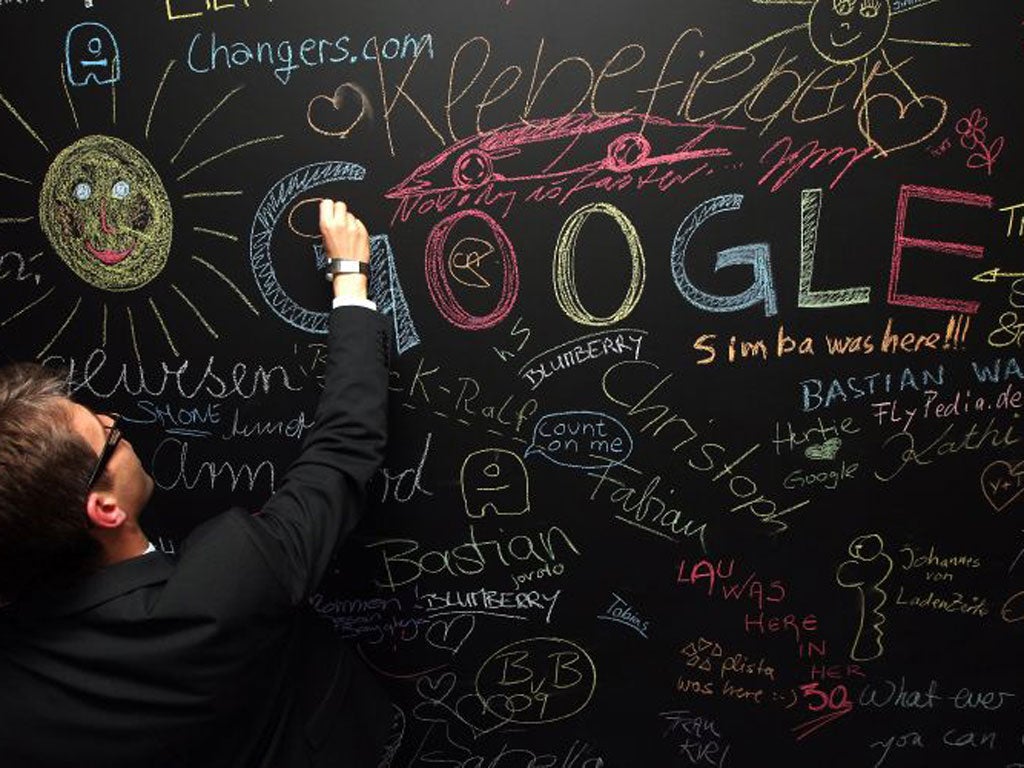
We use its technology dozens of times a day with scarcely a thought. But what is Google? Is it just a search engine? Is it a publisher, or merely a platform, an intermediary? A content kleptomaniac and parasite – in Rupert Murdoch's famous characterisation – or simply a stunning, hydra-headed incarnation of the zeitgeist? Google is a stunningly resourceful and ingenious servant – but is it on the way to becoming our master?
It was 14 years ago this month that Larry Page and Sergey Brin founded the company, and they show no signs of slowing down. At the headquarters in Mountain View, California this week, State Governor Jerry Brown signed a law allowing the company's driverless cars on to California's roads, following Nevada and Florida. "Today we're looking at science fiction becoming tomorrow's reality," Mr Brown gushed. "This is the place where new ideas, risk and imagination come together to really build the future."
But this was also the month that saw the first US Ambassador killed in living memory, as a direct result of the furious reaction to the crude video The Innocence of Muslims, a trailer for which was posted on YouTube, which is wholly owned by Google. Efforts by Islamic groups around the world to force the company to take the video down saw the head of Google's Brazilian operations, Fabio Jose Siva Coelho, arrested this week after the company lost a final appeal. He was released soon afterwards but must appear in court again.
Brazil has been a particularly turbulent market for Google, with more demands for content to be removed from the website than in any other country. This week Jose Guilherme Zagalio, the head of a commission set up by the Brazilian Bar Association to investigate information technology, said: "Our laws trying to govern the internet are outdated. It's not clear who is responsible for content, and that creates uncertainty."
But this is an issue that resonates around the globe. In Jerusalem, offended Muslims tried without success to persuade an Israeli court to grant a temporary injunction against Google, blocking the same video. "Freedom of expression is not freedom without limits," one of the plaintiffs, M K Taleb a-Sanaa, told media after the hearing. "People were actively hurt by this. It can't be that because [the courts] are not Muslim [they] won't worry about the feelings of Muslims." Inside court, Mr Sanaa compared the Innocence of Muslims trailer to a hypothetical film making light of the Holocaust. He argued that the Israeli courts would waste no time forcing Google to remove material deemed offensive to Jews.
Google's lawyer dodged that awkward line of attack. The point, according to Hagit Blaiberg, was that Google was not a publisher of offensive videos or anything else: it was merely an engine which could be used to search for anything. Google content was not out there in the public domain like an advertisement on a billboard. "It's a choice, they have to go to it," she said.
Google later commented that the plaintiffs were pursuing the wrong party: they should be suing the people who made the movie, because even if Google took the film down, people would be able to watch it on other sites, thereby arbitrarily punishing Google for the success of its search engine.
The argument will rumble on, but Google's claim to be just another search engine is starting to seem increasingly unconvincing. Fourteen years after its winningly spare and restrained home page entered our lives, its dominance of search is close to total. That's why Google was the target of the case launched in Berlin yesterday by the former Formula 1 boss Max Mosley, claiming the search engine is breaking German privacy laws by providing links to websites with videos of him at a sado-masochistic sex party.
Google's freedom of expression defence plays well in the US, where it chimes with the First Amendment. But such battles are less easily won elsewhere, and there are also copyright claims and anti-trust cases to worry about, in the EU and the US. So the company has recently been working overtime to build strong teams of lawyers, academics and professional lobbyists to fight its corner.
In Google's new office in Berlin's famous Unter den Linden, brightly coloured robots cluster in plexiglass cases, young, casual employees whizz on scooters down corridors decorated with cityscape murals, and the conference rooms are named after hip Berlin clubs. But behind the easygoing scenes, a deadly serious campaign to nail German opinion at the highest level is under way.
With the European Commission mulling a new data privacy regulation that would establish a "right to be forgotten" online, and the German Cabinet approving a rule giving publishers the right to charge search engines when they list articles together with a short text, Google risks seeing the ground it has so smartly appropriated bit by bit clawed back.
Rupert Murdoch (who recently admitted defeat on the question of allowing Google access to articles from The Times and The Sunday Times) has described the company as a "content kleptomaniac". If he is right, its impunity may not last much longer. But Google is not giving in without a fight.
Der Spiegel revealed some of the company's plans this week. Annette Kroeber-Riehl, the leader of seven lobbyists in the new office, says the company aims to be "transparent and open". But the magazine claims to have detected opacity and manipulation in the way Google is trying to make friends and influence people.
In autumn 2010, a Google-funded think-tank called Collaboratory invited 41 experts to discuss the crucial issue of copyright. But according to one of the invited experts, Stefan Herwig, who runs a music label, the "guidelines" in the final document that came out of the meeting did not represent the expert discussions but were drawn up separately by a team of nine. "We were merely window dressing," he commented.
Crucially, the guidelines described search engines like Google as "intermediaries" – a term that had not come up in their discussions. The interests of these "intermediaries", the guidelines said, should be "considered equally" with those of creators and users, because they "promote or enable the availability of creative property through secondary offerings." Five of the experts objected to the use of "intermediaries", and expressed surprise that it was in the document. "To some extent," said Herwig, "Google produced the desired results itself."
The man who assembled the guidelines' drafting group, Till Kreutzer, is himself closely connected with Google, having created the Initiative Against Ancillary Copyright, which Google co-founded.
Other examples of the company's efforts to influence public debate include the Humboldt Institute for Internet and Society, founded last year, to which Google contributed €4.5m (£2.9m). "What does it mean when a company that has an excessively large amount of influence on everyday activities on the internet is also involved in shaping the public discourse?" Der Spiegel asks. "And what happens when a company which has a quasi-monopoly as a search engine also threatens to gain a quasi-monopoly when it comes to explaining the internet?"
For 14 years, Google has been deft at dodging the sort of image issues which have clung to Microsoft and other tech giants. It "has been able to make itself look like the good guy" writes US tech writer Don Reisinger. But for how much longer?
Google provides us with a wonderfully clear window on the world – but at the same time goes to considerable lengths to control the way it is seen from the outside. As the legal challenges mount up, it is building itself a powerful, largely invisible fortress.
Join our commenting forum
Join thought-provoking conversations, follow other Independent readers and see their replies
Comments
Bookmark popover
Removed from bookmarks