Space: the new cyber crime frontier
What if hackers hijacked a key satellite? Jerome Taylor reports on the next generation of threat
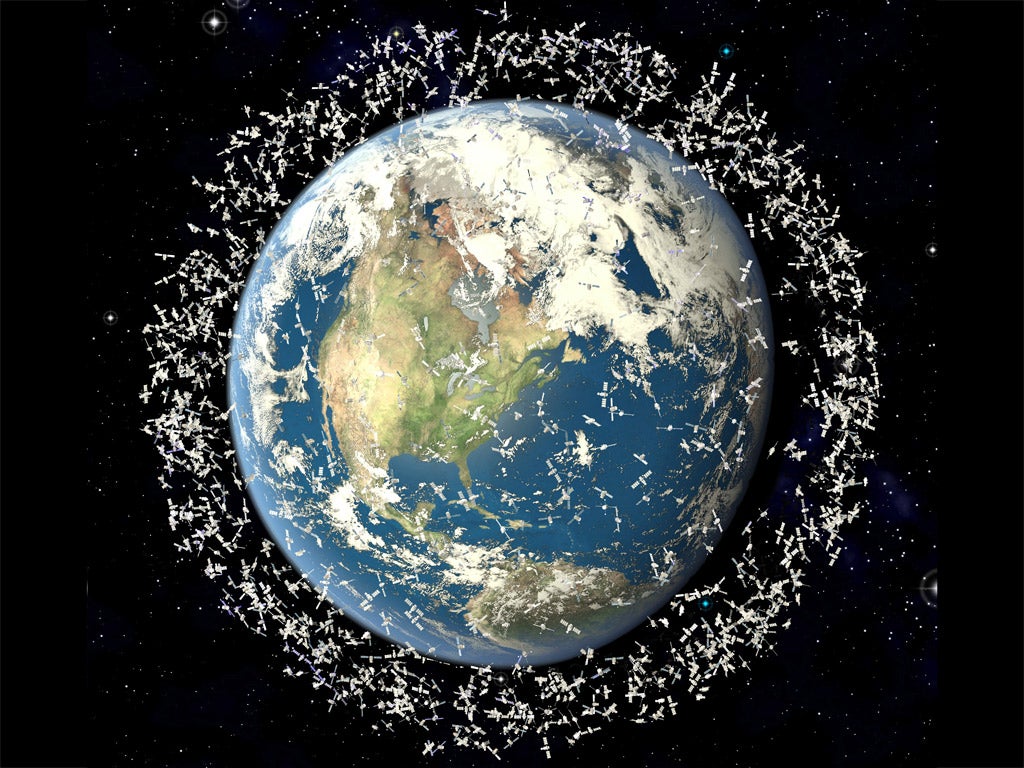
It sounds like the imaginings of science fiction writers. However cyber experts warned yesterday that hackers could send the world back to the 1960s by hijacking satellites dotted around space, creating havoc below.
Our overwhelming reliance on space technology makes us acutely vulnerable were it to ever break down or be deliberately sabotaged. For those gathered at the conference on national security and space at the Royal United Services Institute for Defence and Security Studies (RUSI) yesterday it was an issue they felt needed to be confronted more openly.
"It is a real issue and a real vulnerability," explained Mark Roberts, a former space and cyber expert at the Ministry of Defence who has recently moved to the private sector. "What we are doing is making ourselves more vulnerable to attack than we had been formerly. My personal view is that a day without space is not going – as some people say – to send us back to the dark ages. It's more likely to put us back into the 1960s."
Every day, miles above the Earth's atmosphere, an army of satellites provides us with a vital stream of information. From our mobile phones to satnavs, from shipping channels to television broadcasts, from the monitoring of our melting polar ice caps to the running of vital defence systems – our world would struggle to function without the satellites above us.
Cyber experts from across Britain gathered in London yesterday to ponder what would happen if we were forced to deal with a "day without space". The threats against our satellites are as varied as they are numerous.
From solar storms that temporarily knock out communication, to mid-stratosphere crashes and deliberate attack, satellites are frighteningly vulnerable. One of the issues causing the most concerns – that has somewhat belatedly sparked attempts to initiate a clean-up – is the sheer amount of litter surrounding Earth. Nasa estimates that there are as many as 16,000 pieces of debris larger than 10cm orbiting within 2,000km of earth – the region where most of the world's satellites are positioned. Each piece can travel at tens of thousands of kilometres an hour, and could easily destroy any satellite it meets.
It's also getting crowded up there. Since the space race began in the late 1950s, more than 6,500 satellites have been sent up, of which only 994 are still operational. As Professor Richard Crowther, from the UK Space Agency put it: "Space is infinite, but the space around the earth is finite."
Three years ago the world was given a frightening glimpse into what will happen unless we reduce the number of redundant satellites in space when a working telecommunications satellite built by the US firm Iridium was struck by a defunct Russian Kosmos satellite. The computer models predicted the satellites would pass with half a kilometre of each other. Instead the collision, which took place at 26,000 miles per hour, created more 1,000 extra pieces of debris larger than 10cm – which are still causing problems to this day.
Given the carnage that can be unleashed by a collision, the array of redundant satellites provides an opportunity for malignant hackers looking to cause mayhem for strategic or anarchic reasons.
Mark Roberts, who pioneered the introduction of cyber elements into the war games that the MoD runs, hypothesised a scenario in which hackers take control of one or multiple redundant satellites and use them to crash into more vital ones.
"There are lots of satellites in orbit at the moment that have been taken off line," he explained. "They still have propulsion, they have the ability to be restarted. Somebody particularly nasty could hack one of these things and then start to manoeuvre it."
One Nasa scientist – Donald Kessler – even predicted a single large collisions could produce enough debris to create a cascading effect where future collisions increase exponentially – making space travel and satellites impossible for a generation.
While the military has long prepared for the possibility of operating without GPS, emergency services are now beginning to consider having to do their jobs in such circumstances. Chief Superintendent Jim Hammond, from the Association of Chief Police Officers, warned that a 24-hour stoppage in GPS data within London would quickly have knock-on effects on transport, City trading as well as the emergency services' ability to communicate with or locate tagged criminals.
"The art of looking at a map is being forgotten," he said. "The rush hour might go from one to three hours."
Probably best not to throw away your A to Z maps just yet.
Junking up the skies
6,500 The number of satellites that have been sent up since Sputnik.
400,000 The number of pieces of debris smaller than 10cm in orbit.
994 The number of operational satellites orbiting Earth.
3,000 The total number of satellites orbiting Earth (including those that are now defunct).
16,000 The number of pieces of debris larger than 10cm orbiting Earth in the area where most satellites are based.
Join our commenting forum
Join thought-provoking conversations, follow other Independent readers and see their replies
Comments
Bookmark popover
Removed from bookmarks