Alison Thompson: 'I see danger all around me now'
Coroner Alison Thompson's job is to get to the truth about unexplained deaths. Every day, it brings her face to face with heartbreak and human frailty – but it's still the most cheerful place she's ever worked, she tells Enjoli Liston
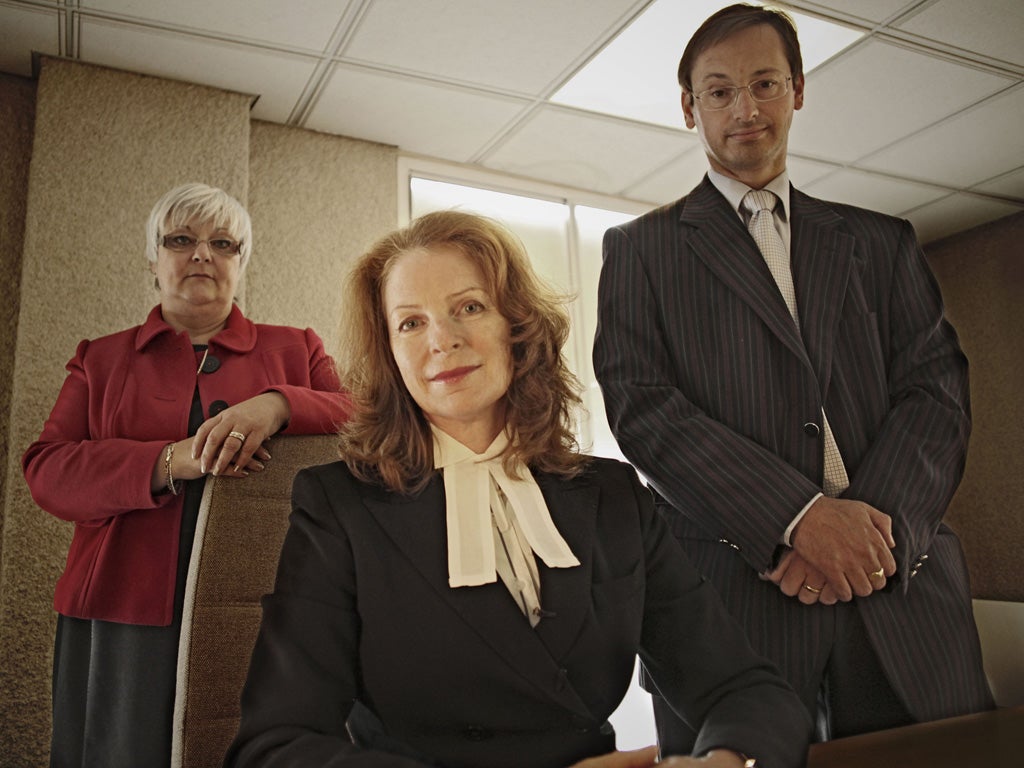
Alison Thompson is beaming as she opens the door of her cottage, nestled down a lane near the river in Richmond. She laughs often, displaying a sunny disposition that would be less remarkable if she did not deal with death every day. Thompson is Her Majesty's coroner for west London, a busy district that sees about 4,000 mysterious deaths reported every year and provides the subject for a new BBC documentary, Death Unexplained. It is the first time a television crew has been granted access to a coroner's court, which works to establish when, where, how and why a person died.
"I'm always amazed at how interested people are in what I do, though they often have a lot of misconceptions about coroners," Thompson says. "People either think you're Quincy [an American forensic pathologist TV character from the 1970s] or a funeral director." The programme shows the process following an unexplained death – from police investigations and medical examinations in the morgue to the role of funeral directors, via the central coroner's court over which Thompson presides.
Of the 4,000 unexplained deaths reported on Thompson's patch – an area that includes Heathrow airport, railways, prisons, hospitals and motorways – about 600 inquests are held in the most complex cases. The TV crew followed Thompson and her team for a year, covering such cases as Jessica (1983-2011), who was found dead with a bottle of cyanide nearby, and Fred (1945-2011), whose body lay undiscovered in his flat for two months. Cameras are not allowed into the inquests by law, but interviews with coroner's investigators, pathologists, mortuary technicians and the loved ones of the deceased show the pieces that come together to eventually complete the puzzles. "The coroner's court is about fact-finding, not fault; we don't deal with liability or blame," Thompson says. "Some people try to push for findings that suggest liability, but that is for civil proceedings. It's healthy because people giving evidence are inclined to feel less defensive and free to tell you what really happened."
Thompson is modest about her own contribution to the process, and the colourful career route she has taken to become coroner for one of the busiest districts in England and Wales. After graduating with a degree in biochemistry, she became an air stewardess and a dietician before taking the bar exam. She practised as a barrister in criminal and family law, first in London and then Hong Kong, where she was handed a "huge yellow manual" to learn the job of coroner over a weekend after volunteering to serve. Thompson returned to England 12 years ago and started work as coroner for west London.
Since then, Thompson has flown to New York after 9/11, to Bali after the terrorist bombings in 2002 and to Thailand after the 2004 tsunami to help identify and repatriate the British people who had died there. "In Bali and after the tsunami, I remember the bodies were literally still out on the street because there was nowhere to put them," she says.
At home, Thompson insists it's the coroner's officers (or investigators) who "are at the sharp end" of this process: "I don't tend to see the families until the inquest itself, which may be months down the line. The officers are the ones who go to the mortuary in the morning to show the family the body of their loved one."
Thompson was initially apprehensive about the three-part documentary, but she says she is pleased with the "accurate and sensitive" result. "I was glad to see that it shows how caring the mortuary teams are."
One of the most striking aspects of Death Unexplained is that amid the sadness of the subject matter it has some genuinely laugh-out-loud moments. In one scene, a coroner's officer is discussing with Thompson the procedure for allowing a family to take their dead loved one to Spain. "[The form] isn't necessary, ma'am – he's going as hand luggage," the officer says, before clarifying – amid mischievous giggles – that the man's ashes will travel that way, not his body.
"It's one of the most cheerful places I've ever worked, which I appreciate probably sounds rather strange," Thompson says. "Obviously it has its sorrowful moments, but you've got to counter that with some humour, otherwise you would go under. It's a sort of safety valve."
Cases involving children and the elderly are those that Thompson finds most harrowing. "Parents shouldn't be grieving over a child, the death has happened in the wrong order," she says. "And it upsets me very much to think of elderly people dying on their own."
Despite the challenges of her job, Thompson says she finds it rewarding. "The high comes when a family walks out of court satisfied that there has been a full inquiry into their loved one's death." She also makes recommendations to people in power, to help prevent future fatalities. "You feel you're doing some good, despite acting after a tragedy. Families say time and time again that they don't want their loved one to have died in vain."
Thompson's role gives her a unique insight into the way people deal with death. "Death is a subject that people shun now, and that makes it more difficult to come to terms with it," she says. "We've also lost a lot of the religious and spiritual attitudes that we used to have, which protected us and helped us to understand these things. There is an illusion that we've got control over our lives. We think that nothing that we can't predict could possibly happen, and it seems it's always a surprise to people when it does. Fate is still out there to get you. I think if people accepted that, it would be much easier."
A side effect of her work is that Thompson now sees death all around her. As she drives through Richmond Park, under the flight path, she remembers the man who smuggled himself into the undercarriage of a plane only to fall into a supermarket car park. He was found with his packed lunch beside him. She admits her work has made her paranoid. "I'm terrified of everything around me," she says, looking around her tranquil cottage. "It does make me take fewer risks but it makes me enjoy my free time and my personal relationships more, probably because I feel lucky to have made it through the day."
Her work has prompted her to write a "humourous book about avoiding death" inspired by the real cases she has seen. She shows me the draft she was working on before I arrived. "It looks at all the potential things that can go wrong: fires, drownings, sexual-bondage experiments gone wrong, drug swallowers – people who come into the country with packages of drugs inside them. I think 113 packages of cocaine is the record in our area, extracted from someone's bowel during the post-mortem."
Thompson needs to understand the circumstances of people's deaths, which often involves her having to delve into the mindset of people who took their own lives. Despite the harrowing nature of her work, Thompson insists she is not haunted by the cases themselves.
"I often worry about whether I should be concerned that I don't take my work home with me, but I'm lucky and I can switch off," she says. "I do jazz and street dancing and yoga, and I try not to work at weekends. I get asked quite often: what's the worst case you've ever done? It's a terrible thing, but nothing stands out. It's strange; the moment I'm in court I think I'll never forget a single detail of the case, it's my most important focus and the details are often extremely touching. But I come out of court and I'm immediately into the next case. The reality of it is that I have to move on, and that's life I suppose."
'Death Unexplained' begins tonight on BBC1 at 10.35pm
Join our commenting forum
Join thought-provoking conversations, follow other Independent readers and see their replies
Comments
Bookmark popover
Removed from bookmarks