Beware of the beans: How beans can be a surprising source of food poisoning
It was a simple vegetarian meal – but it made her family so severely ill that paramedics were called to the scene. Vicky Jones has a cautionary tale
It was only when my husband started vomiting too that the horrible truth dawned on me – both he and my brother, who had dropped by for dinner, must have food poisoning. And another horrible thought rapidly followed, namely that I must be responsible. Moi? Impossible.
All of the likely suspects ran through my mind: eggs, chicken, fish, rice, or could it be lettuce? Highly unlikely, but dim memories of a food hygiene course I'd once attended produced the thought that salad leaves could be the culprit. The meal had been vegan, so no animal products could be to blame, and we hadn't eaten rice.
By now, things were moving fast, literally, and both our loos were permanently occupied. Feeling relieved that at least I was OK, I rushed from one to the other, offering feeble consolation and wondering what to do, as both men seemed to be getting rapidly worse, their faces changing from virulent red to ash grey and then to white in quick succession. Whatever the offending substance, their bodies just wanted to get rid of it by whatever means possible. Clearly, they were both very ill.
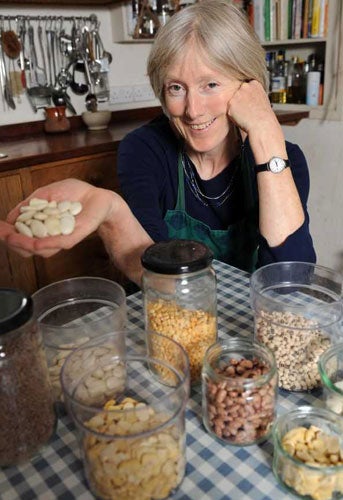
While I found bowls and towels and coaxed my husband and brother up to bed, I continued to rack my brains. Then it dawned on me – it must have been the beans. I admit to having a weakness for experimenting in the kitchen, and that evening had made ta'amia or falafel, from a recipe in Claudia Roden's erudite and revered Middle Eastern Food, except that I didn't have the dried white broad beans found in Greek shops that she recommends. But I did have some dried and soaked Greek butter beans, the ones known as gigantes (because they're are so huge), so I thought I'd use those instead as they looked very similar. Instead of boiling the beans first, then making patties and frying them, this Egyptian recipe uses ground raw beans, which are then deep fried. I made two fatal flaws: I used different beans from those specified in the recipe and I shallow fried, instead of deep frying.
In Israel, the rissoles are known as falafel, and are made with dried chickpeas instead of broad beans, again by soaking the pulse, then grinding it into a paste, then deep-frying the rissoles in hot oil. Sometimes a mixture of dried broad beans and chickpeas are used, both of which have been grown, like lentils, in the Middle East since time immemorial – unlike the kidney beans, butter beans and cannellini beans we know today, which arrived in Europe only with the conquistadores. So the large butter beans I used came from a different family from the ones specified in the recipe, and turned out to have very different properties, too.
The ta'amia tasted delicious, crisply fried and aromatic with cumin and coriander, and flecked with bright green parsley. Everybody enjoyed them, asking for second helpings, even. Within two hours of eating this fateful meal, I was also retching and vomiting, accompanied by the runs, and feeling like death.
From my bed I managed to phone NHS Direct, in the hope of getting reassurance that although severely ill, we would recover quickly and that no treatment was necessary. No such reassurance was forthcoming, and another hour elapsed before I had another go at contacting the outside world, this time phoning our GP's emergency number. Eventually I spoke to a doctor, who was on the phone when my husband moaned that he was vomiting blood. On hearing this, the doctor told me to call an ambulance.
The ambulance arrived an hour later. We live in a remote farmhouse which is hard to find at the best of times, and nearly impossible for ambulance drivers unfamiliar with dark lanes and equipped only with third-hand directions. Although very, very kind and helpful, the ambulance drivers were not paramedics and had no drugs on board. All they could do, was to take us to hospital. When we explained the problem, they contacted a poisons unit in the hope of getting some information about the toxic properties of beans, but this was to no avail. After 20 minutes, the poisons unit phoned back to say they could shed no further light on the condition.
When forced to decide whether to be taken in to A&E, where no doubt we'd spend all night waiting, we separately and collectively chose to remain at home. By now, death seemed preferable to hospital. And anyway, who'd look after the dog?
By the morning we'd all recovered enough to hold down water, and though unable to wake up properly, we knew we were on the mend. Later, research by a doctor friend unearthed information from the US Food and Drug Administration website, which identifies the toxin as a lectin or phytohemagglutinin, found in many species of bean but in its highest concentration in the red kidney bean.
It's widely known that these beans should be boiled vigorously for 15 minutes to destroy the toxin before simmering, but I didn't know that cannellini or white kidney beans also contain this toxin – about one-third of the amount of the red ones. The butter beans I used contain it, too, as, indeed, do broad beans, though the latter only in quantities of between 5 per cent and 10 per cent of those found in red kidney beans. And cooking beans constantly at low temperature, as in a slow cooker, can increase their toxicity five-fold. So by shallow frying my rissoles, rather than deep frying them, as specified in the recipe, I probably made them even more poisonous than if they were eaten raw.
This syndrome is not well known in the medical community, and many cases must be misdiagnosed or never reported, as no figures of reported cases seem to be available. The National Poisons Information Service is available only to health professionals, and members of the public must rely on NHS Direct or their GP. But the database they use doesn't flag up the dangers of white beans as well as red, and what about pink, brown, green or mottled ones?
The message is this: soak any beans, whatever colour, in water for 12 hours, pour away the water, then boil briskly in fresh water for at least 15 minutes before cooking further. And if you do repeat my mistake, and make yourself ill, recovery is usually rapid – three to four hours after the onset of symptoms – and spontaneous.
Join our commenting forum
Join thought-provoking conversations, follow other Independent readers and see their replies
Comments