Full moon: Ill met by moonlight
It makes wolves howl, toads frisky and cats crazy. The full moon also gets the blame for all manner of human bad behaviour. But are these just old wives' tales – or is there a rational explanation? By Roger Dobson
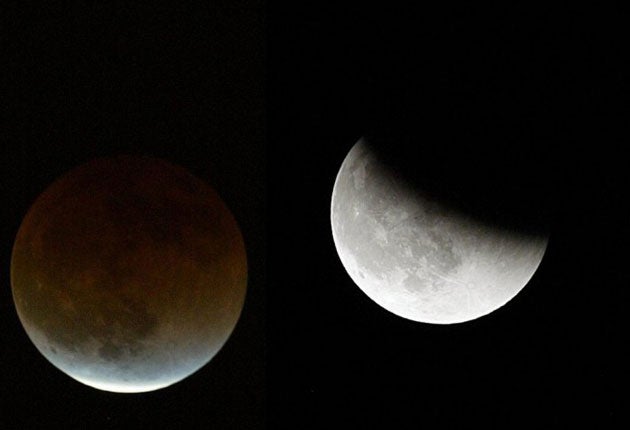
"I see the bad moon arising/I see trouble on the way/I see earthquakes and lightning/I see bad times today/Don't go around tonight ... There's a bad moon on the rise"
(Creedence Clearwater Revival)
It's said to make owls more chatty, toads more frisky, and dogs and cats more aggressive. When the full moon is up, wolves are also more prone to howling, newts to congregating, and mites to keeping a low profile.
Molluscs, crustaceans, insects, fish, birds, mammals and amphibians are all touched by the full moon, according to researchers. And humans too could be at risk of being moonstruck, with reports of increases in seizures, violence, crime, hospital admissions and GP visits, as well as a rise in accidents and a drop in stock market prices during the full moon. Increases in unintentional poisoning and absenteeism are reported too. Is the moon to blame, or are there down-to-earth reasons?
The lunar effect, also known as the Transylvania effect, has long been a source of fascination. Many people – half of university students and 80 per cent of mental health professionals, according to two studies – believe lunar phases can affect behaviour.
Theories advanced to account for such effects include the polarisation of the moon's light, the ozone layer, magnetism, ions, and the moon's gravitational pull on living organisms.
A new study from the Graduate School of Medicine at Kyoto University says it's down to changes in the geomagnetic field. The researchers say geomagnetic activity drops by around 4 per cent for the seven days leading up to a full moon, then increases by a similar amount after.
"We think moonlight increases the sensitivity of animals' magneto reception," they say. "We propose a hypothesis that animals respond to the full moon because of changes in geomagnetic fields." How that affects behaviour is not clear but one suggestion is that changes in the electromagnetic field disrupt the nocturnal production of melatonin in the pineal gland. Melatonin helps regulate other hormones and maintains the body's circadian rhythm – the "internal 24-hour clock" – and its production is affected by light.
A number of studies have shown that the behaviour of animals, birds and fish does change around the full moon. Researchers at Estació* Biológica de Doñana in Spain discovered that eagle owls communicate using a patch of white throat plumage only visible during vocal displays. This explains why owls are more vocally active on full moons when the high levels of nocturnal illumination make it the optimum time to show off their plumage.
The light provided by a full moon – some 12 to 16 times greater on cloudless nights than at other lunar phases – may also explain the activity of wolves and other predators. Studies have suggested that wolves howl more and roam less, perhaps because they find it more difficult to locate prey, which tends to keep a low profile on well-lit nights. Research at Fundação Zoo-Botânica in Brazil found that wolves remain more static – satellite tracking reveals they cover as much as 1.88km less – during nights lit by the full moon when compared to the new moon.
Scientists have shown that common toads arrive at breeding sites, mate and spawn more frequently around the time of the full moon. "There is a lunar effect on many animals," says biologist Rachel Grant, who studied the effects for the Open University and monitored the effects at sites worldwide.
"In many cases it is a reaction to the increase in light intensity around the time of the full moon," she says. "The light makes it a good time for predators to spot prey, but it is also a good time for the prey to hide. As a result we see all kinds of changes in animal behaviour. But there are less obvious changes too. Some frog and toad species gather to mate under a full moon. It is not a direct effect of light, because they gather before the moon rises, and on cloudy nights too when the moon is not visible. We think it is because there is some kind of internal rhythm that programmes the amphibians' reproductive cycle to the time of the full moon.
"Possibly, they were programmed earlier in the year by the light of a full moon and that set the rhythm. It is important because these species of mainly terrestrial toads and frogs are scattered and need to congregate for breeding. We now have evidence of lunar cycles affecting amphibians in widespread locations. We think moon phase has been an overlooked factor in studies of amphibian reproductive timing."
Other changes which appear to have no reason can be explained. One team of researchers, according to a report in the British Medical Journal, found that "animals' propensity to bite humans accelerates sharply at the time of a full moon". The figures were obtained from hospital statistics. But it may not be the animals' behaviour that changed. Perhaps people are more likely to be out on a well-lit night and are therefore more likely to get bitten.
The changes in human behaviour have attracted the most interest and produced some of the most controversial research findings. Epilepsy, depression, crime rates, hospital admissions and GP consultation rates, dieting success, heart and bladder problems, fertility, spontaneous abortions and thyroid disease have been investigated for lunar effects.
GP consultation rates rise by 3.6 per cent during the full moon according to research at Leeds University. Gout and asthma attacks peak during the new and full moon, according to researchers at the Institute of Preventive and Clinical Medicine, Bratislava, who analysed attacks over a 22-year period. Changing "cosmogeophysical environments" were blamed.
A study at the Royal Liverpool University Hospital found that emergency urological admissions were affected. "Our study assessed whether the gravitational pull of the moon generated a tidal wave of increased emergency urological admissions," said the researchers. "Emergency urological admissions were higher on full moon days. The new moon had a calming effect."
Why? Theories include the idea that hormone production or water flow through the body is affected by the moon's gravitational pull. But some experts dismiss the idea. "In the popular imagination, influences on the human mind are often ascribed to the moon's gravitational effects," say researchers from Toronto University. "But the moon exerts no influence on smaller bodies of water such as lakes and some seas, and the difference between a person's weight in the presence of the moon's gravity and his or her weight if there were no moon is less than a mosquito on one's shoulder."
It's been suggested that a full moon's light could explain some of the findings with humans as well as animals. Studies have found that seizures increase, prompting various lunar effect theories. But light at night and resulting sleep loss could be to blame. A Swiss study found that the length of sleep varied with the lunar cycle, from six hours 41 minutes at full moon to seven hours at new moon.
And a study at the Institute of Neurology, London, looked at seizures on cloudy and non-cloudy nights during a full moon, which controlled for the effects of light. "Results suggest it is the contribution the moon phase makes to nocturnal luminance, rather than the moon phase per se, that may influence the occurrence of epileptic seizures," it concluded.
Other findings from lunar effects research defy a clear-cut explanation, such as the effect on stock market prices. The University of Michigan looked at stock returns in 48 countries and found them lower on the days around a full moon. The difference was 3 to 5 per cent. One theory is that mood changes linked to sleep deprivation or depression may be implicated.
Despite scientific findings, belief in the Transylvania effect continues. It may be down to selective recall, or the perception of an association that does not exist. If something untoward happens on the night of a full moon, we are more likely to make a link than on other days. Imagination and superstition have also been proposed as reasons.
As the Toronto University researchers say, citing the philosopher-poet George Santayana: "Men become superstitious, not because they have too much imagination, but because they are not aware that they have any."
Join our commenting forum
Join thought-provoking conversations, follow other Independent readers and see their replies
Comments
Bookmark popover
Removed from bookmarks