Get fit quick: The fast track to fitness
Thirty-second bursts of intensive exercise may be just as beneficial as hours at the gym, scientists say. Is this the ultimate time-saving workout? Jimmy Lee Shreeve reports
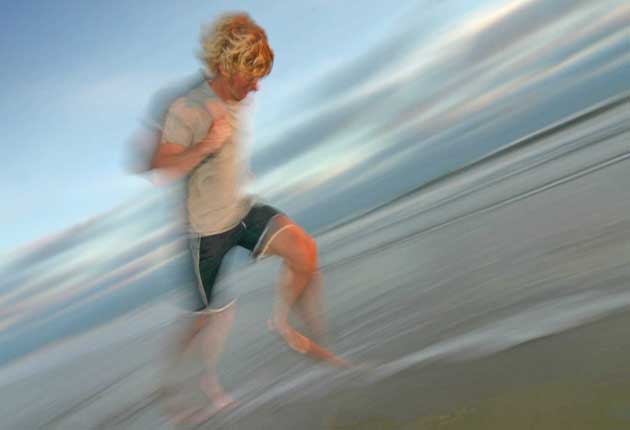
Think you don't have time to exercise and stay in shape? Think again. You've clearly not heard of high-intensity interval training (HIT). Devised by a team of exercise biologists at a Scottish university, the routine amounts to a measly four minutes of pedal-to-the-metal activity, two or three times a week.
Compared to the government recommended five or six hours a week to keep fit, this looks like a cinch – and might even get confirmed couch potatoes springing into action. Not only will it keep you trim (in conjunction with a healthy diet), but it will apparently keep cardiovascular disease and diabetes at bay too.
But is it too good to be true? Not according to Professor Jamie Timmons, who led the research at Edinburgh's Heriot-Watt University. "Our study shows that by doing the right type of training – intensive for very short periods – it is plausible for young, and most probably middle-aged, adults to reduce their future risk of developing diabetes without spending five to six hours each week involved in exercise programmes."
Type 2 diabetes has become a scourge of the modern world – affecting some 246 million adults worldwide and accounting for 6 per cent of all global deaths. It causes the body to gradually lose the ability to use insulin to convert food into energy. At worst, the condition can lead to heart disease and strokes and is closely linked to inactivity – the norm for many of us today.
Because Timmons' system takes so little time, yet produces measurable benefits, he believes it could have a big impact in reducing cases of diabetes – after all, even the busiest of people ought to be able to spare 10 minutes a week for exercise.
Workouts can be done on an exercise bike (as was used in the study). Or you could run upstairs or even sprint flat out on the spot. Literally anything will do as long as you push yourself to the max.
"The key," says Timmons, "is to do four 30-second sprints on an exercise bike at your maximum effort, with short rests in between bursts. The whole thing should take about four minutes. Doing this, even just twice a week, will bring clear benefits."
For the study, Timmons and his team – whose findings were published in the journal BMC Endocrine Disorders – monitored 16 average and relatively sedentary 20-year-old men before and after a two-week training period. "They did their four-times-30 seconds of sprint cycling three times each week, making a total of six exercise sessions," explains Timmons.
After training, the young men were given a glucose drink and the way their bodies processed it was monitored. When the two weeks were up, the men had a 23 per cent improvement in how effectively they used insulin to remove glucose from their bloodstreams. "In two cases, it was up to a 35 per cent increase, which is dramatic," says Timmons. What's more, the effect appears to last up to 10 days after the last round of exercise.
Timmons adds that similar ongoing studies in Canada are showing that the risk of heart disease could also be cut. "The exercises reduce all the things we know that cause cardiovascular disease," he says.
The bottom line is this: four bursts of flat out exercise, two or three times a week, appear to be more effective in preventing diabetes and related conditions than half-an-hour spent jogging six times a week. "Even sprinting or lifting weights are not so good as they often lead to muscle damage, which impairs insulin function," says Timmons.
It might fly in the face of current government guidelines on exercise, but Timmons thinks his system could translate into big saving for the NHS. "This novel approach may help people to lead a healthier life, improve the future health of the population, and save the health services millions of pounds simply by making it easier for people to find time to exercise."
But Frank Forencich, the international natural fitness expert and founder of ExuberantAnimal.com, is not wholly convinced by the study. "It may motivate some people to better health practices, which is great," he says. "However, we have to think of it in context. In our natural state, as hunter-gatherer tribes, the vast majority of physical movement was walking, which involved scouting and gathering. This would have been broken up by occasional periods of rest or intense physical movement – hunting or being hunted."
But for modern people, the predominant activity is sitting, so suddenly leaping into strenuous action might not be the best policy.
"Adding short and intense bouts of movement to a sedentary lifestyle might be beneficial to some, but it is certainly not natural," continues Forencich. "My feeling is that the best approach is to emphasise sustained walking first, then add bursts of high energy activity as desired. That way, people will enjoy two levels of benefit."
Another potential failing of high-intensity interval training is it only burns up about 250 calories a week. That said, there is evidence to suggest that interval training could trigger a mechanism that helps the body burn more fat than steady aerobic exercise. While Professor Timmons insists his system is "absolutely not" a path to painless weight loss, he does accept that people are more likely to keep up an exercise system that takes a few minutes rather than an hour or more a day. This in itself could have an impact on the obesity epidemic.
Timmons would like to see high-intensity interval training offered in the workplace. "The exercises make your muscles tired, but you don't really sweat, so workplaces could introduce exercise bikes for their workers, or even steppers," he says.
Every second counts: How to get fit quick
* The Heriot-Watt University study used exercise bikes for its high-intensity interval training (HIT). But any activity that can be performed to the max would have the same effect – from running upstairs to sprinting on the spot. Here's what you do:
* Warm up. Ride your exercise bike, or jog on the spot, slowly at first, picking up to moderate activity. Stretch and limber your muscles. Do this for a couple of minutes.
* With a watch or clock in front of you, go flat out for 30 seconds, and don't stop. (Be warned: pushing it to the max for even this short time will make you breathless.)
* Drop down to slow warm-up levels of movement. Rest for up to a minute.
* Repeat the process two or three times.
Join our commenting forum
Join thought-provoking conversations, follow other Independent readers and see their replies
Comments