Unpopular children: Why don't they like me?
A new theory claims that being an unpopular child is a learning difficulty, just like dyslexia – and the good news is that it can be treated
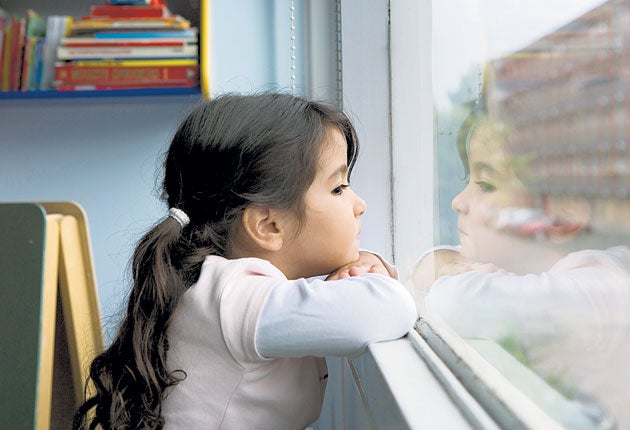
At the age of nine, Victoria is the type of child who the other girls in her class describe as "a bit weird". There's something about her body language – and the way she "hovers" at the edge of their games, but doesn't join in – which makes them uncomfortable.
From time to time, Victoria also pipes up with "funny" things at unexpected times in lessons. Her teacher recently complained at parents' evening that she started volunteering where she was going on holiday in the middle of a maths class.
Behind her back, although never to her face, the other children complain that Victoria is a "show-off" because she talks "at" them instead of listening to what they say. So at break-time, Victoria often finds she has no-one to play with.
For Victoria's mother, Amanda, it's painful to watch. "Because Victoria is bright, I used to think she was just grown-up for her age, preferred talking to adults and that she'd grow out it. But now it's so heartbreaking to see her being left out of all the parties and sleepovers I know are happening in Year Four. She tells me she prefers adults and she doesn't care what people think of her, but I feel like I am a failure. I worry for her future, too. Girls her age can be very judgemental – and once you get labelled as weird it's hard to escape that tag."
Every parent wants their child to be popular. And whatever they may say, deep down every child wants friends. But much more than just being a popularity contest, all the research – including a recent study for the Children's Society – has found that having good relationships with peers is one of essential elements for self-esteem, happiness and success in life.
Yet until now, it's always been assumed making friends is something that young people should learn to do by themselves – even if some are naturally better at it than others. Now that idea is being turned on its head by a new approach that treats problems forming social relationships in the same way as a learning difficulty, like dyslexia. Just as those children can't make sense of the letters they see on a page, unpopular children also have problems understanding and interpreting social cues others use. Considering that 55 per cent of communication is facial expression and body language and 38 per cent is voice tone and volume, it can leave them at a serious disadvantage. Because while it takes an average youngster three seconds to work out those signals, children with social deficits take longer.
But in the same way as techniques have been developed to help with those with academic learning difficulties, there are now skills that can aid children with poor social interaction, according to American child communication expert Michelle Garcia Winner, who first devised the Social Thinking programme to teach "bright but socially clueless students" at high schools in California. Her methods aim to help children become aware of how to act "acceptably" to others. Her ideas are rapidly gaining currency here and are being taught to teachers and parents at the New Learning Centre in North London.
Crucially, Social Thinking is not just used not just to help children on the autistic spectrum, but also less popular youngsters, who have not been diagnosed with any problem but who, without guidance, may never learn the rules of friendship. Garcia Winner says: "Concepts like how to share, how to co-operate and when to say the expected thing are complicated and sophisticated ideas. Some children may need more help understanding these concepts than others. Their brains may not be making all the connections. They know why they like other children, but they may not realise what they are expected to do for other children to like them back in return. Yet even if they don't get it by intuition, we can teach children how to be 'social detectives' – to think about how others see them and to use their eyes, ears and brains to learn what is expected from them."
With Social Thinking techniques, youngsters are taught that in the same way that they can be smart at maths, computers, music or English, they can also have "social smarts", which can be improved through practice. Part of the approach is to teach children that if they act in ways that make others feel awkward, such as speaking at the wrong times, or becoming obsessive about certain subjects, others will avoid them. Parent educator Noel Janis-Norton believes it is revolutionary because it actively teaches children how to make others comfortable around them. She believes the approach will help "a sizeable minority" who are social outsiders.
Janis -Norton says: "Having poor social skills is a learning difficulty that needs to be addressed. These kids are also wrongly seen by teachers as deliberately obstructionist in class – for example, because they don't understand that a suggestion is actually an instruction. In fact the part of their brain that is supposed to interpret these signals is wired differently. When they realise this, both teachers and parents often feel very guilty that they once got so angry or impatient with them. But it's like getting angry with someone with a limp. Luckily the brain is very malleable. Whenever we learn, we are changing the brain. It can be as simple as teaching children the best way to use eye contact or what body language to use in the playground.
"For example, many of these kids will be left on the fringes of games because they will be looking away from the group they want to be part of, instead of registering their interest. Simply teaching kids to turn their body and shoulders towards the group can be enough to let others know they want to be accepted."
Looking back at our own schooldays, most of us remember the loner in our class who nobody wanted to play with at break-time. But Janis-Norton is hopeful it's a curse that shouldn't befall future generations. "It's tragic how many children have been ostracised because of this neurological trait in the past. Yet so many other children can be spared from suffering in the same way."
For further reading on Social Thinking, Michelle Garcia Winner's books 'You Are A Social Detective' and 'Thinking About You and Thinking About Me' are available from thinkingbooks.co.uk. For more information log onto www.socialthinking.com. For information about Social Thinking courses, contact New Learning Centre www.tnlc.info
Join our commenting forum
Join thought-provoking conversations, follow other Independent readers and see their replies
Comments