'Why I'll never take the Pill again'
When Holly Grigg-Spall realised her contraceptive was causing low moods and anxiety, she decided to investigate – and found she’s not the only sufferer
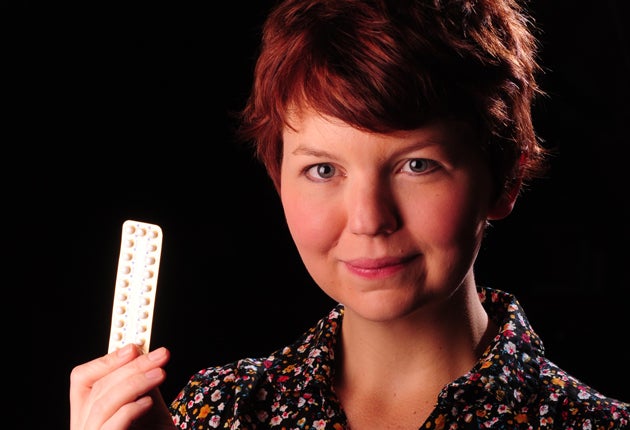
Since it was released 50 years ago, the Pill has become a by-word for liberation. I was on the Pill for a decade – from 16 to 26. I would not describe my experience as liberating. In a blog, Sweetening The Pill, I have detailed how this tiny tablet made me feel – trapped, silenced, suppressed, stagnant. The Pill made me feel as though I were held hostage, and later, as though I were an addict. I know I am not the only woman who had, or is still having, problems with the Pill, because I hear from women with stories similar to mine every day.
I am left out of the Pill’s birthday celebrations; I can’t even thank it for turning me into a women’s health writer and activist. It wasn’t until I stopped taking this drug that I developed the needed energy, motivation and clarity of thought to write about why I had to stop.
Discussing the arrival of the birth control pill, science-trained financial analyst James Balog, working for Merck Pharmaceuticals in 1960, remarked: “The issue then was whether any woman would take a pill every day to prevent the chance she might get pregnant. They believed nobody’s going to do that, not when they’re not sick, and they’re not sick!”
The articles printed in celebration of the anniversary of this event paint the Pill as a cure-all for every female problem, biological or social. An editorial in The Huffington Post calls it “small, safe and effective”, arguing that there has only been one issue with this miracle drug – it liberated women, an issue only to those who don’t want women liberated.
One night in 2008 my best friend and I were talking about how we had both been feeling very down and detached. My friend said her interest in life was draining away. A “nothingness” is how I described it – this flat-lining, empty, dulled nothingness. Our shared despondency included a loss of libido, and it was this detail that made us wonder if the Pill had caused the change in mood.
In the past year, on top of the depression, I had been experiencing intense anxiety and paranoia that over time developed into a constant sense of dread. Explosions of rage came about from my unease, causing arguments with my boyfriend. The smallest disagreement slipped me into a cycle of anger and hopelessness. I felt I was losing my mind.
I was taking the brand Yasmin, which I had requested from my doctor after reading in magazines about its amazing skin-clearing and weight-loss side effects. My sisters and many of my friends were also taking it. Yasmin was marketed aggressively in the US, and news of its supposed benefits spread quickly to young women in the UK. The New York Times recently described Yasmin as the “go-to drug brand for women”, which has been sold as a “quality-of-life” treatment. Last year the American FDA, in a landmark move, ordered Bayer Pharmaceuticals to produce a retraction commercial that qualified its claims. According to Dr Doug Bremner, author of Before You Take That Pill, Yasmin became the most complained-about drug on medications.com, which monitors the side-effects of popular drugs. Its unique element, the synthetic progesterone drospirenone, which has been linked in 74 lawsuits held against the manufacturer to serious physical side-effects such as blood clots, could also cause extreme mood changes.
The concern over one popular brand had the benefit of provoking conversation between women and highlighting the complex impact of all brands of Pill on women’s bodies. I’d always avoided Dianette, a type prescribed specifically for skin problems, as a few years earlier it had hit the headlines for increasing the risk of depression. Now I am off the Pill, in retrospect I can see that each of the four kinds of Pill I’d used had negatively affected my wellbeing. All contain the synthetic oestrogen ethinyl estradiol plus one of a variety of synthetic progesterones. All can have negative repercussions on mood as they stop ovulation, flatten natural hormone fluctuations to create a very low unchanging level, produce a deficiency in B vitamins and meddle with the workings of the pituitary gland. I’ve discovered mood changes can occur after six months, two years or a decade of taking it, as every woman responds differently.
The Pill enacts a very crude, wide-reaching impact on the body. As Barbara Seaman stated in The Doctor’s Case Against The Pill, it is “like tinkering with nuclear bombs to fight off the common cold”. The reproductive system is shut down. When we talk about the Pill preventing pregnancy, we should also mention it does this with a whole-body effect. The monthly hormone cycle is integral to many of the body’s central functions, including the metabolic, immune and endocrine systems.
After 10 years of Pill use, I showed signs of nutrient deficiency, low hormone levels and immunity suppression – with bleeding gums, urinary tract infections, hair loss, poor circulation, hypoglycaemia and rounds of flu-like fatigue, as well as the effect on my emotional state. As Alexandra Pope and Jane Bennett state in, The Pill: Are You Sure It’s For You?: “The Pill alters at least 150 bodily functions andaffects all your organs.” Pope calls the ensuing problems “quality of life-threatening”.
I’d been popping a drug every morning for years knowing only what my doctor had said: the Pill “regulated” my periods. I had always backed it up with condoms. I had taken it through my teens when I wasn’t having sex.It was an unthinking habit. It took one lastswitch to another brand, an eye-opening two month break, then six months back on the Pill to make me realise what it had been doing to my body and my mind throughout my adult life. I came to understandwhy I felt so very sick.
There are only a handful of studies regarding its effect on mood, but they suggest potentially around half of all Pill-takers experience a negative impact. A 1998 study from the University of North Carolina, a 2001 Kinsey Institute study, a 2005 Monash University study and 2008 Lakehead University research show dissatisfaction with the Pill is widespread.
There’s research that reveals the health benefits of continuous ovulation, showing consequentially the dangers of cycle suppression. Yet the Pill is prescribed and taken without care. This drug accounts for close to half of the $16bn women’s healthcare market and 96 per cent of birth control education for doctors in US medical schools focuses on it. Last year the NHS introduced a pilot scheme in some London boroughs to provide the Pill without prescription. Pill use is positively pushed.
At a time when we are more concerned about what we eat, wear and use to clean the toilet than ever, we are celebrating millions of otherwise-healthy women taking a powerful medication every day, for years. James Balog is right: these women are not sick, they’re fertile and for just a few days a month. The Pill is on so high a pedestal that alternatives are undermined in comparison. Pill-mania has eroded the fundamentals of reproductive rights – choice, freedom and education.
The Pill is handed out to women with acne, PMS, irregular periods, heavy periods. The Pill has developed into a medication for the disease of being female. In place of changing society, society decided to fix women. On the 50th anniversary of the Pill we should stop celebrating the fictionalised revolution of the Sixties and turn our attention to the rebellion underway today. Young women are ditching the Pill in droves. They have come to see that the Pill can be harmful, as is the sugar coating used to make us swallow.
Alternatives to the Pill
The diaphragm, aka the cap
This method gave women sexual freedom long before the Pill and has seen a resurgence of interest. The type currently available requires a doctor’s appointment for a fitting, but there are two companies – Silcs and ReProtect – developing redesigned one-size-fits-all diaphragms.
The female condom
A new version of the female condom has recently launched in Chicago. The material has been improved and the price lowered.
The male condom used with spermicide
The effectiveness of all barrier methods can be improved on by using spermicide at the same time. There are many kinds of male condom on the market, including hypoallergenic.
The non-hormonal IUD
The IUD has gathered a bad reputation as a result of the problems surrounding the 1970s version, the Dalkon Shield. But the modern design, the ParaGuard, is very popular within Europe for its high rate of effectiveness and convenience.
The fertility awareness method
Not to be mistaken for the rhythm method, fertility awareness involves a woman charting her cycle through measurements of temperature, cervical mucus and position of the cervix to determine when she is fertile. This option is popularly used in conjunction with barrier methods.
Join our commenting forum
Join thought-provoking conversations, follow other Independent readers and see their replies
Comments
Bookmark popover
Removed from bookmarks