Clamour grows for heroin on the NHS
Experts call for national network of 'shooting galleries' after hailing successful trials
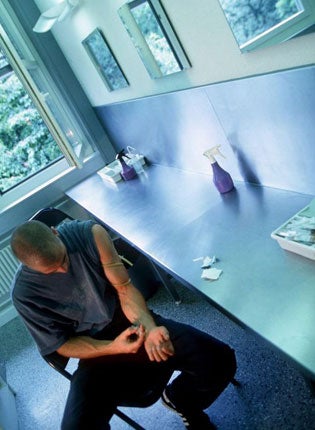
A group of government-appointed drug experts will call for a nationwide network of "shooting galleries" to provide injectable heroin for hardened drug addicts across the country.
A pioneering trial programme prescribing heroin to long-term addicts has shown "major benefits" in cutting crime and reducing street sales of drugs. Results of the programme are to be presented at a conference in London tomorrow. An expert group set up by the National Treatment Agency for Substance Misuse to assess the programme has concluded that the approach should be adopted nationwide.
The prescription of heroin to hardened addicts is one of the most controversial in medicine. Giving addicts drugs such as heroin on a maintenance basis, rather than weaning them off them, turns existing policy on its head and presents a challenge to ministers.
Critics say giving addicts the drugs they were previously scoring on the street is not "treatment", and the cost at £15,000 a year per head cannot be justified when NHS patients are being denied the latest cancer drugs. But addiction experts say this is about "harm reduction", not cure.
Long-term heroin users are among the hardest addicts to treat and impose huge costs on the medical and penal systems. Ten per cent of drug addicts commit three-quarters of all acquisitive crime in the UK, official figures show. The existing government drugs strategy includes a commitment to roll out the clinics, subject to the findings of the trial programme.
The trial started three years ago and yielded benefits within months. Early results showed crimes committed by the addicts dropped from about 40 to six a month, after six months of treatment. A third of the addicts stopped using street heroin and the number of occasions when the rest "scored" dropped from every day to four to five times a month.
The programme was modelled on one in Switzerland where introduction of injecting-clinics "medicalised" heroin use, removing its glamour and transforming it from an act of rebellion to an illness requiring treatment. Last year, Swiss voters backed the scheme in a referendum, proving it could be a vote-winner. Similar clinics have also been established in France, Germany and Canada.
The first British injecting clinic, run by the Maudsley Hospital, opened on a south London high street in 2005. Heroin addicts who had failed on all other treatments and served repeated prison sentences for shoplifting and other crimes attended twice a day and received a dose of diamorphine (pharmaceutical grade heroin) which they injected themselves, under supervision.
Two further clinics were opened, in Darlington in 2006 and in Brighton in 2007. For the trial, 150 addicts received drugs at the clinics, one third of them heroin. Their experience was compared with two other groups who received either oral or injectable methadone under the same conditions.
The strict rules allow no "take-away" from the clinics, to avoid the users selling their drugs on the streets. All injections are witnessed at the clinic. The approach introduces routine and drudgery by forcing the users to attend for their twice-daily fix.
There are an estimated 280,000 drug users in the UK, most taking heroin and crack cocaine, and about 2,500 deaths a year. The scheme, targeted at the 3,000 to 6,000 long-term, hardcore addicts, operates seven days a week, 365 days a year.
Professor John Strang, head of the National Addiction Centre at the Maudsley, who led the study, said the findings had sent a ripple of excitement through the addiction treatment community, which is unused to seeing progress with hardcore heroin addicts. He would not comment yesterday on the panel's recommendations, but before, speaking about the early successes of the trials he said: "This is genuinely exciting news. These are people with a juggernaut-sized heroin problem and I didn't know whether we could turn it around. We have succeeded in people who looked as if their problem was unturnable, and we have done it in six months.
"It is 'intensive care' for drug addicts, more expensive than standard treatment but a third of the cost of sending them to prison at £44,000 a year. And they become re-addicted on release. We are dealing with a profound drug hunger and trying to medicalise it to break the link with street heroin use and crime."
War on drugs: The liberal experiments
*BRITAIN
Doctors have been allowed to prescribe heroin since the 1920s but very few do so. Most prefer to prescribe methadone, a heroin substitute, which is taken orally once a day. Its effects are longer-lasting but duller. Many addicts continue to buy heroin. There are currently three "shooting galleries" operating across the country which may now be extended.
*SWITZERLAND
Throughout the mid-1990s the Swiss were at the forefront of trialling prescription heroin schemes and the country has seen a major reduction in crime and better rehabilitation success rates. For years the main "shooting gallery" was in Zurich but last year Swiss voters approved a nationwide rollout of prescription heroin in a referendum.
*PORTUGAL
Portugal has the most liberal drugs policy in Europe. In 2001, it took the radical step of abolishing criminal penalties for drugs. Anyone caught with drugs was referred through the civil, rather than criminal, courts and either fined or put into treatment. Critics predicted that narcotics use would spiral out of control but addiction rates fell.
Join our commenting forum
Join thought-provoking conversations, follow other Independent readers and see their replies
Comments
Bookmark popover
Removed from bookmarks