Junk food could be addictive 'like heroin'
Rats became 'hooked' on sausage and cheesecake in same way as drug abusers
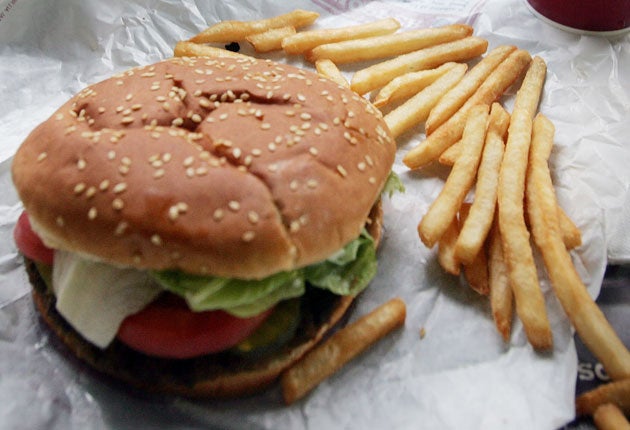
Junk food may be addictive in the same way as heroin or cocaine, according to a study showing that laboratory rats will endure painful electric shocks to satisfy their craving for high-calorie snacks made from sausages, bacon and cheesecake.
Scientists have found that a "café-style" diet of fatty, sugary food results in compulsive overeating among rats and causes neuro-chemical changes to the brain that mimic the sort of alterations in the human brain brought about by addiction to heroin and cocaine.
The findings lend support to the idea that certain types of energy-intensive foods can trigger compulsive overeating and obesity in humans, leading to a form of food addiction that is almost impossible to overcome by dieting.
The researchers found that rats offered junk food quickly became so attached to it that they would endure painful but harmless electric shocks to their feet in order to eat it. They would even prefer to starve themselves rather than eat the "salad bar option" of the typical rodent food eaten by rats that had never had junk food.
When the scientists analysed the brains of the junk-food rats they found that a key pleasure-reward system known to be involved in triggering drug addiction in humans was overstimulated, causing the animals to eat more and more food in order to enjoy the same chemical "high" felt in their brains.
"It presents the most thorough and compelling evidence that drug addiction and obesity are based on the same underlying neurobiological mechanisms," said Professor Paul Kenny at the Scripps Research Institute in Jupiter, Florida.
"The animals completely lost control over their eating behaviour, the primary hallmark of addiction. They continued to overeat even when they anticipated receiving electric shocks, highlighting just how motivated they were to consume the palatable food."
The three-year study, published in the journal Nature Neuroscience, tried to reproduce a diet for rats based on the sort of high-calorie, high-fat food known to contribute to human obesity. The scientists found that it was easy to accustom the rats to eating such delicacies as sausages and cheesecake.
"They always went for the worst types of food and, as a result, they took in twice the calories as the control rats. When we removed the junk food and tried to put them on a nutritious diet – what we call the 'salad bar option' – they simply refused to eat," Professor Kenny said.
"The change in their diet was so great that they basically starved themselves for two weeks after they were cut off from their junk food."
Rats showing an addiction-like behaviour towards junk food also had fewer dopamine D2 receptors in a part of the brain called the striatum compared to ordinary rats. These receptors are responsible for triggering a response to dopamine, a neurochemical that transmits signals between certain brain cells involved in the feeling of pleasure towards things like food, sex and drugs.
Fewer D2 receptors in the striatum of the human brain are associated with drug addiction, as well as a genetic predisposition towards obesity. In the case of the rats, they compensated for the fall in receptors by eating more junk food in order to stimulate the less-sensitive pleasure-reward pathway in the brain, Professor Kenny said.
"It was the animals that showed the 'crash' in brain reward circuitries that had the most profound shift in food preference to the palatable, unhealthy diet. These same rats were also those that kept on eating even when they anticipated being shocked," he said.
"When the animal overstimulates its brain pleasure centres with highly palatable food, the systems adapt by decreasing their activity. However, now the animal requires constant stimulation from palatable food to avoid entering a persistent state of negative reward.
Professor Kenny added: "These findings confirm what we and many others have suspected, that overconsumption of highly pleasurable food triggers addiction-like neuroadaptive responses in brain reward circuitries, driving the development of compulsive eating."
When normal rats had their dopamine D2 receptors thinned out by a virus, they immediately showed the same kind of addiction-like behaviour seen in rats given junk food. "Common mechanisms may therefore underlie obesity and drug addiction. [It is] as far as we know the strongest support for the idea that overeating palatable food can become habitual in the same manner and through the same mechanisms as consumption of drugs of abuse," Professor Kenny said.
Join our commenting forum
Join thought-provoking conversations, follow other Independent readers and see their replies
Comments
Bookmark popover
Removed from bookmarks