New pain-free way to test for bone marrow donors
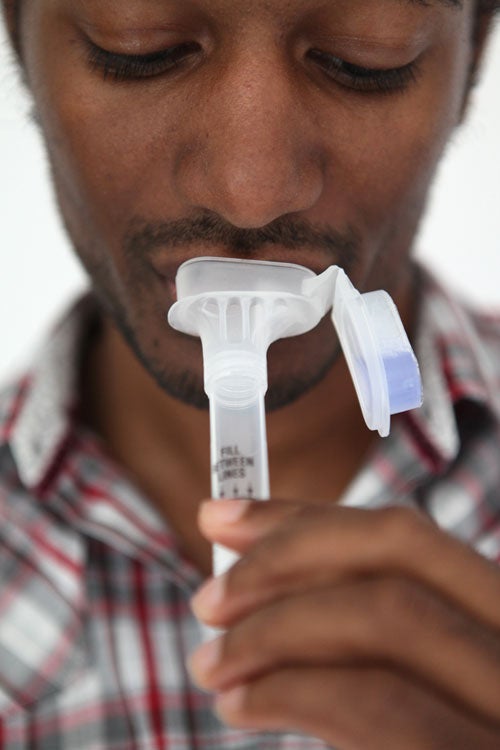
Britain's leading leukaemia charity has invented a painless new way to test whether someone is a match for a bone marrow transplant.
The Anthony Noland Trust has developed a saliva DNA kit which will allow doctors to match transplant candidates and patients without having to take any blood samples.
There are currently 1,400 people waiting for a bone marrow transplant, which is often their last chance of survival. Most patients who need a transplant are suffering from leukaemia, autoimmune diseases and various blood disorders.
Until now the only way to comprehensively test tissue type has been to take a blood sample with a syringe, something which doctors have long feared stops many people from signing up to bone marrow registries.
The new saliva test will allow people to sign up and place their details on a bone marrow register from home, rather than needing to attend a doctor's surgery or a recruitment drive. Those wanting to sign up to the register will now be able to spit into a test tube and then post it back to the Trust where specialists will analyse the DNA to look for potential matches. DNA specialists only need 0.5ml of saliva to run tests.
Anthony Nolan has been piloting the new saliva kits since December 2009 and over 5000 people joined the register using the new method. They hope that the new test will eventually double the number of people who sing onto bone registries every year.
Henny Braund, chief executive of Anthony Nolan, said, "We're really excited about the switch to saliva testing. Ultimately, this is about saving more lives. Anthony Nolan provides two potentially lifesaving transplants every day, but there is an equal number that we can't currently help. We urgently need to increase the number of people on our register, and saliva testing will help us do that much more quickly and effectively."
Some donor registries in the United States have begun to use mouth swabs to test for tissue compatibility but Anthony Noland trust says their new saliva test is more reliable because it has a longer shelf life.
The tests have been developed by DNA Genotek, a Canadian firm which has invented a way of preserving saliva so that the DNA samples can be held for up to two months at room temperature before they begin to decay.
"Saliva gives large, intact DNA fragments just like you find in blood," explained Alasdair McWhinnie, a research scientist at Anthony Nolan. "But the problem with blood is that you generally have to store it in a refrigerator or freezer if you need it for more than a couple of days."
There are also hopes that the new saliva tests will encourage more black and Asian people to sign up to the transplant registers. To decide if a potential donor's bone marrow will be compatible with a patient, doctors have to find matching tissue types. Each person's tissue type is made up of a series of antigens. There are hundreds of antigens and thousands of tissue types, some of which more commonly found within certain racial or ethnic sections of society.
Black and minority ethnic (BME) patients are currently much less likely to find a bone marrow matches because they are woefully underrepresented on the two national bone registries, one of which is run by the Anthony Nolan Trust, the other is run by the NHS.
According to the Afro-Caribbean Leukaemia Trust, which specialises in finding matches for black patients, of the 690,000 people on the two registries there are currently just 25,000 black and 12,600 Asian donors.
While a white person has a one in three chance of finding a donor, Asian and black patients have just a one in 125,000 chance.
Beverley De-Gale, founder of the ACLT, said: “Saliva tests will help dispel the apathy and reluctance in these communities, radically speed up bone marrow registration and renew the public’s enthusiasm to help save lives.”
Join our commenting forum
Join thought-provoking conversations, follow other Independent readers and see their replies
Comments