The Big Question: Is changing our diet the key to resolving the global food crisis?
Why are we asking this now?
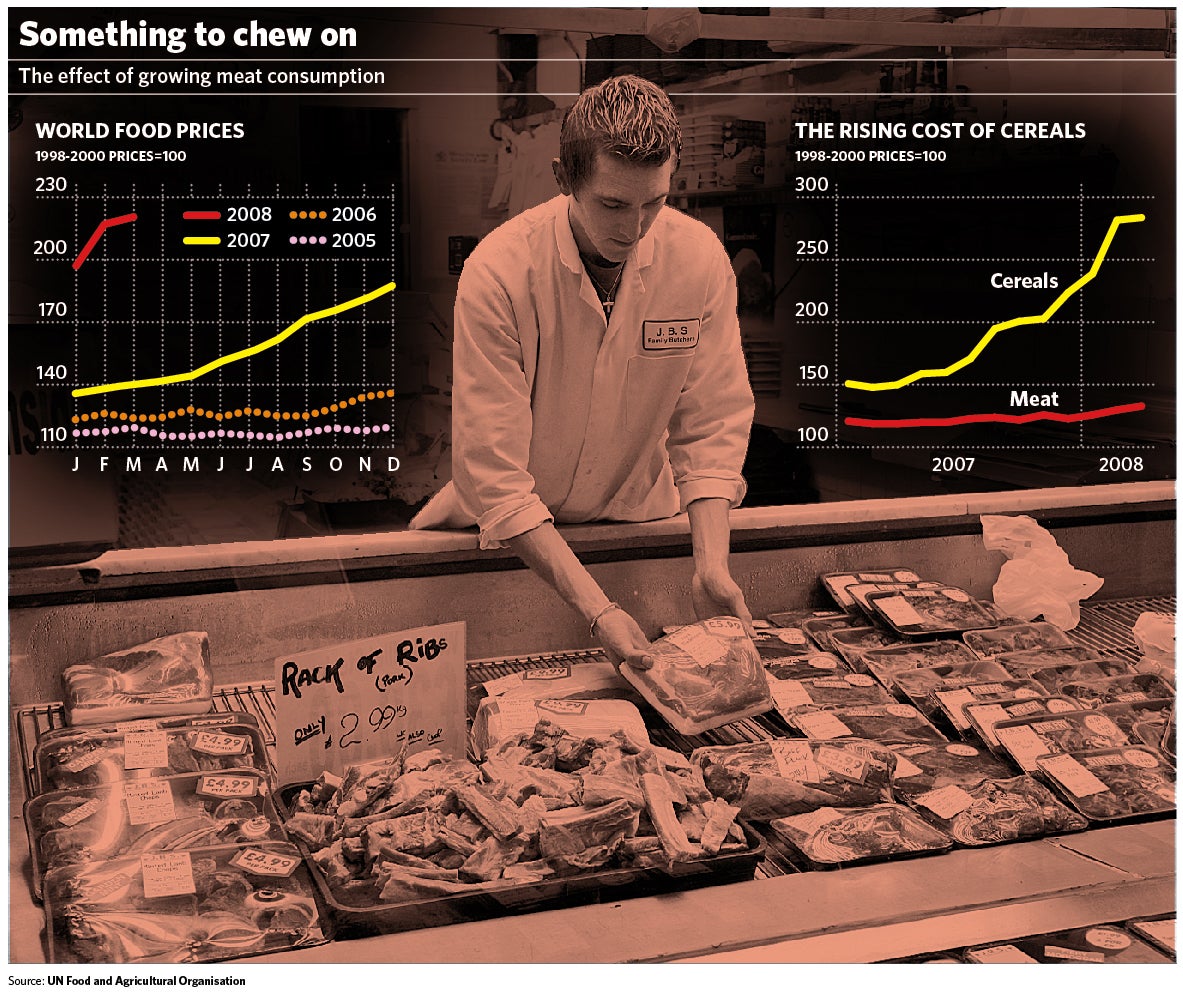
People are dying because of the global food shortage, which has sparked a sudden surge in food prices. The global food bill has risen 57 per cent in the last year, the price of rice is up by three quarters, and wheat has more than doubled. The head of the UN's Food and Agriculture Organisation, Jacques Diouf, warned this week that riots in Egypt, Cameroon, Haiti and Burkina Faso over soaring prices could spread.
World grain stocks have fallen to a 25-year low of 5 million tons, enough for two to three months, and World Food Programme officials say 33 countries in Asia and Africa face political instability as the urban poor struggle to feed their families. "The world food situation is very serious," Mr Diouf said.
Are we growing too little food to feed the world?
Bizarrely, no. There was a record global grain harvest last year. It topped 2.1 billion tons, up 5 per cent on the previous year. The problem is that a diminishing proportion of it is being turned into food. This year less than half the total grown – 1.01 billion tons – will find its way on to people's plates, according to the United Nations Food and Agriculture Organisation. And this crisis is hitting before world food supplies are further damaged by climate change.
So where is the grain going?
There are two reasons why the record amount of grain is proving insufficient to feed the world. First, a large amount is being diverted to make biofuels. From yesterday, all transport fuel sold in the UK must be mixed with at least 2.5 per cent biofuel made from crops. As our front page explained yesterday, the Government's idea is that this will make Britain's 33 million cars greener.
But the consequence is that there is less grain available for food. This year global production of biofuels will consume almost 100 million tons of grain – grain that could have been used to feed the starving. According to the UN, it takes 232kg of corn to fill a 50-litre car tank with ethanol – enough to feed a child for a year. The UN last week predicted "massacres" unless the biofuel policy is halted. Jean Ziegler, the UN's special rapporteur on the right to food, said biofuels were "a crime against humanity", and called for a five-year moratorium.
Would cutting car use solve the food crisis?
Not on its own. Of course we should be reducing our reliance on the car, and on jet travel and other profligate uses of energy, for environmental reasons. Cutting car use, and reducing energy demands overall, would cut demand for biofuels, leaving more grain available for food. But while 100 million tons of grain are being diverted to make fuel this year, over seven times as much (760 million tons) will be used to feed animals. The world's passion for meat is a much bigger cause of global hunger than its passion for the car.
How does eating meat cause hunger?
Because it is a very inefficient way of producing food. It takes 8kg of grain to produce 1kg of beef, and large tracts of forest have been cleared for grazing land that might have been used to grow crops. Chicken is more efficient to produce – it takes 2kg of feed to produce 1kg of meat. To maximise food production it is best to be vegan. According to Simon Fairlie, in his magazine The Land, it would take just 3 million hectares of arable land to meet Britain's food needs, half the current total, if the population were vegan.
Isn't it completely unrealistic for Britain to go vegan?
Of course. Vegans number 0.4 per cent of the population, vegetarians 3 per cent, and most people will not take readily to a diet of green leaves, pulses, fruit and nuts. This is about the direction we should be moving in, not the ultimate destination. We should be aiming to reduce our meat and dairy consumption, and increase consumption of fruit and vegetables.
We are eating 50 per cent more meat than in the 1960s, and global consumption is forecast to double by 2050. More of the extra is chicken, and we eat less red meat than in the past (and a lot less than the Americans). But in terms of overall meat consumption, we are not even going in the right direction.
What about the rest of the world?
China, India and other parts of the developing world are behind the soaring demand for meat. Eating meat is a mark of affluence, and as societies in the east grow wealthier they are demanding the same benefits of a diet that the west has enjoyed for more than a century. In China meat consumption has risen from 20kg a head in 1980 to 50kg a head today. As meat consumption rises there is less grain for (human) food, adding to the pressure on grain prices
Food export controls have been imposed by Russia, China, India, Vietnam, Argentina and Serbia in response to the crisis. Last week the Philippines had to hunt for grain supplies after China withheld shipments, prompting the US to step in to guarantee grain supplies. Tensions are growing not only over energy, but now over food.
Are there other reasons for cutting back on meat-eating?
Yes. The largest study of the link between diet and health published by the World Cancer Research Fund last November concluded that animal flesh occupies too big a place in the western diet, contributing to high rates of cancer and heart disease. There are also environmental benefits from cutting down on meat. Each of Britain's 10 million cows produces more greenhouse gases in the form of methane per day than the average 4x4 on a 33-mile drive. Giving up meat could have a comparable impact on climate change to giving up flying.
Finally, there could be animal welfare benefits. The less meat we eat, the more we can afford to pay – and farmers selling fewer animals at higher prices should be able to provide them with better conditions.
So what diet should we be aiming for?
One that does not eschew meat altogether – if that seems too difficult – but that puts more emphasis on the vegetarian elements. In many countries meat is regarded as a relish, with the bulk of the meal coming from carbohydrates – corn, rice, pasta or potatoes – and vegetables.
We should get used to thinking of meat as a treat – it could help to save the world's poor from starvation.
Should we be trying to cut out meat to help save the world's poor from starvation?
Yes...
* Producing meat is less efficient than growing grain – it takes 8kg of corn to produce 1kg of beef
* Growing crops to feed animals means there is less land on which to grow crops for humans
* There is a shortage of grain for human consumption, and global food prices have leapt by 57 per cent in a year
No...
* It is not realistic to expect people to switch to a vegan diet of vegetables, pulses, fruit and nuts
* China and India should not be denied the same diet that we have enjoyed as they grow wealthier
* An alternative way of tackling the food crisis would be to reverse the policy of diverting grain to make biofuels
Join our commenting forum
Join thought-provoking conversations, follow other Independent readers and see their replies
Comments