The unstoppable march of the tobacco giants
How the industry ruthlessly exploits the developing world - its young, poor and uneducated
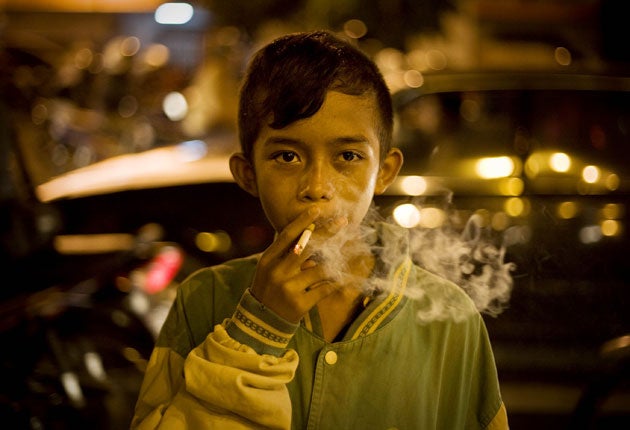
More than half a century after scientists uncovered the link between smoking and cancer – triggering a war between health campaigners and the cigarette industry – big tobacco is thriving.
Despite the known catastrophic effects on health of smoking, profits from tobacco continue to soar and sales of cigarettes have increased: they have risen from 5,000 billion sticks a year in the 1990s to 5,900 billion a year in 2009. They now kill more people annually than alcohol, Aids, car accidents, illegal drugs, murders and suicides combined.
On Tuesday, people around the globe will mark World No Tobacco Day – a distant hope.
The West now consumes fewer and fewer of the world's cigarettes: richer countries have changed – from smoking 38 per cent of the world total in 1990, they cut down to 24 per cent in 2009. Meanwhile, the developing world's share in global cigarette sales has increased sharply, rising to 76 per cent in 2009.
An investigation by The Independent on Sunday reveals that tobacco firms have taken advantage of lax marketing rules in developing countries by aggressively promoting cigarettes to new, young consumers, while using lawyers, lobby groups and carefully selected statistics to bully governments that attempt to quash the industry in the West.
In 2010, the big four tobacco companies – Philip Morris International, British American Tobacco, Japan Tobacco and Imperial Tobacco – made more than £27bn profit, up from £26bn in 2009.
The price of their profits will be measured in human lives. In the 20th century, some 100 million people were killed by tobacco use. If current trends continue, tobacco will kill a billion people in the 21st century.
In striving for greater profits, the big tobacco firms have pushed the average price of cigarettes up in rich countries such as Britain – where 20 cigarettes now cost more than £6 a pack – while hammering down the price paid to tobacco growers in poorer countries such as India and Malawi. Although around 77 per cent of the price of a pack is tax, the amount charged by tobacco companies has also increased.
A major investigation by the Office of Fair Trading last year found that a dozen tobacco manufacturers and retailers in the UK had colluded in price fixing, ensuring that packs remained at higher prices to maximise profits. The largest fine was one of £115m for Imperial Tobacco, makers of Lambert & Butler and Golden Virginia. The fine made a minimal dent in its profits for 2010, which topped £4.39bn.
Meanwhile in Malawi, where tobacco farming is heavily relied upon for the economy, the country's anti-corruption bureau has accused tobacco companies of colluding to keep prices paid to farmers for the raw product low. Tobacco auction rooms have become a battleground between government and industry, as a kilo of leaves plummeted from an average of £1.06 per kg in April 2009 to 47p per kg this year. The knock-on effect of this on farms is near-slave wages for workers and a temptation to use cheap (or free) child labour.
Anna Gilmore, professor of public health at the University of Bath, said: "What most people don't realise is that, although sales are falling in the West, industry profits are increasing. These companies remain some of the most profitable in the world. This is thanks in part to their endless inventive ways of undermining and circumventing regulation. They're trying to reinvent their image to ingratiate themselves with governments, but behind the scenes it's business as usual."
This year's World No Tobacco Day is focusing on persuading more countries to sign a global treaty drawn up by the World Health Organization to ensure public health protection from smoking. Although 172 countries have signed up to the Framework Convention on Tobacco Control since it was produced six years ago, 20 per cent of them have still done nothing at all to implement its recommendations, and major countries, including the US and Indonesia, are still not even signatories.
In Indonesia alone there are 21 million child smokers. There is little to stop companies promoting cigarettes to young people. In countries such as Nigeria, Ukraine and Brazil, tobacco companies have sponsored club nights or parties aimed at attracting new young users. In Russia, attempts to entice women smokers have included packaging made to look like jewel-encrusted perfume bottles and even selling cigarettes branded by the fashion house Yves Saint Laurent.
Dr Armando Peruga, programme manager for the WHO's tobacco free initiative, said: "We need to do more. We need to stop the tobacco industry promoting themselves as normal corporate citizens when they are killing people every day. We are lagging behind in establishing comprehensive bans on advertising, marketing, promotion and sponsorship."
When countries in these emerging markets try to clamp down on tobacco, the battle often ends up in the court room. In Uruguay, for example, the government had been leading the way under President Tabaré Ramón Vázquez Rosas, a former oncologist. In 2006 it became the first in the region to ban smoking in public places and now it wants 80 per cent of every pack of cigarettes to be taken up with health warnings.
In response, Philip Morris has sued the government. It is thought that the company will demand at least $2bn in damages if Uruguay loses.
Courtroom bullying like this has a broader intimidatory effect on other governments in the region, which were already less inclined towards legislating further against smoking.
Laurent Huber, director of the Framework Convention Alliance on tobacco control, said: "In countries like Uruguay, the tobacco industry uses its vast wealth to tie up public health measures in court battles. Win or lose, this has a chilling effect on other governments."
These tricks are by no means confined to the less-regulated emerging countries. In Australia, which will become the first country to introduce plain packaging for cigarettes by law, the industry has been accused of scaremongering against the measures by threatening to flood the market with cheap fags.
In Britain, the industry is also prone to taking any measures necessary to keep regulation at bay. This autumn a group of tobacco companies is taking the Government to court over its proposals to ban cigarette displays in all shops.
More often in the UK, though, Big Tobacco's attempts to alter public opinion are more subtle. A study from Action on Smoking and Health (ASH), out this week, scrutinises the credibility of economic arguments used by the industry to fight back against legislation. For example, when Christopher Ogden, chief executive of the Tobacco Manufacturers Association, said in 2010 that the smoking ban had severely threatened the pub and bingo industry because of lost jobs and livelihoods, the reality was a little different. Data from the Office for National Statistics shows a net increase in the number of people visiting pubs since the smoking ban. When England went smoke-free in 2007, the number of premises licensed for alcohol increased by 5 per cent, and it has continued to grow every year since.
Deborah Arnott, chief executive of ASH, said: "In line with our international treaty obligations, the UK government has not only banned advertising and put health warnings on packs, but also committed to protect public health policies from the commercial and vested interests of the tobacco industry. To get round this, the industry uses front groups to covertly lobby politicians, arguing that smoke-free legislation has destroyed the pub trade, and that putting tobacco out of sight in shops will both be ineffective and put corner shops out of business.
"The next big battle is over putting cigarettes in plain packs. Already the same arguments are being used. The evidence is thin or non-existent, but no matter, the danger is that policy makers will be misled that where there's smoke, there's fire."
See letter, Sunday 18 September
The winners...
Louis C Camilleri
CEO of Philip Morris
Made £12.4m last year. Recently told a nurse that cigarettes "weren't that hard to quit".
Nicandro Durante
CEO, British American Tobacco (BAT)
Paid £2.4m last year. Formerly led Souza Cruz SA, BAT's Brazilian unit, and also headed BAT's African and Middle Eastern businesses.
Alison Cooper
CEO, Imperial
Paid £1.9m last year. Former sales and marketing regional director for western Europe.
The losers...
Sean Nicholson, 43
From Jarrow, Tyne and Wear
"I started smoking when I was 11. I worked in the shipyards for 15 years and always smoked. I was diagnosed with chronic obstructive pulmonary disease at 34, and later on it turned out I had emphysema too. The specialists said I was the youngest case they had ever seen. Soon I couldn't breathe if I walked a few steps. The consultants said I had the lungs of a 90-year-old. Seven weeks ago I had a double lung transplant. Now I can breathe again and I can't stand the sight of people smoking. It took getting new lungs to realise how silly I'd been."
Ryan Gamble, 17
From Chester-le-Street, Durham
"I've smoked for about six years. I started because my friends were doing it and I just kept the habit going. I hated it at first, I choked. I smoke about 10 or 15 a day and it's hard to quit. I work in a chip shop and half of my wages go on that [smoking]. I wish I'd never started. You wake up coughing and you can't run anywhere."
Sharon Gould, 53, and her son Ben, 10
From Whetstone, Leicestershire
"I started smoking when I was 14. I quit when I was pregnant with Ben but then I started again. I used to smoke in the house when he was in another room, or smoke in the car with the window down. Ben was around two when we discovered he had asthma. I understand what I've done and I want to put it right. I gave up three years ago. It's too late for Ben, but I want to help other parents not make the same mistakes. It could be genetic, but statistics say that I am partly responsible for my son's asthma. It was Ben that made me stop. Ben didn't like smoking and I don't blame him. He used to say 'Please mummy, don't smoke, it's horrible.'"
José Carlos Carneiro, 64
From Rio de Janeiro, Brazil
"I began to smoke when I was 15 years old, influenced by tobacco advertising and wanting to make a good impression with girls who studied at my school. I had both my legs amputated in 1983 thanks to Buerger's disease [associated with smoking]. If I had not been a smoker I would have a fantastic life."
Join our commenting forum
Join thought-provoking conversations, follow other Independent readers and see their replies
Comments