Ambassador or slave? East Asian skeleton discovered in Vagnari Roman Cemetery
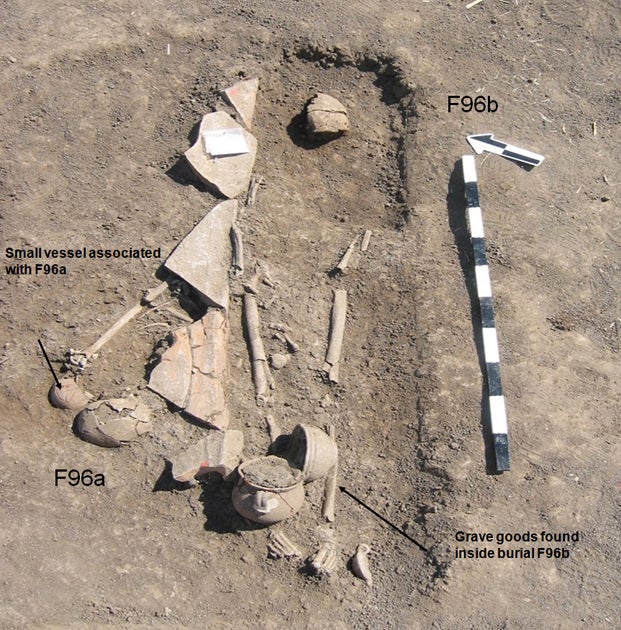
A team of researchers announced a surprising discovery during a scholarly presentation in Toronto last Friday. The research team, based at McMaster University in Hamilton, Canada, has been helping to excavate an ancient Roman cemetery at the site of Vagnari in southern Italy. Led by Professor Tracy Prowse, they’ve been analyzing the skeletons found there by performing DNA and oxygen isotope tests.
The surprise is that the DNA tests show that one of the skeletons, a man, has an East Asian ancestry – on his mother’s side. This appears to be the first time that a skeleton with an East Asian ancestry has been discovered in the Roman Empire.
However, it seems like this contact between east and west did not go well.
Vagnari was an imperial estate during this time. The emperor controlled it and at least some of the workers were slaves. One of the tiles found at Vagnari is marked “Gratus” which means “slave” of the emperor. The workers produced iron implements and textiles. The landscape around them was nearly treeless, making the Italian summer weather all the worse.
The man with East Asian ancestry may well have been a slave himself. He lived sometime in the first to second century AD, in the early days of the Roman Empire. Much of his skeleton (pictured here) has not survived. The man’s surviving grave goods consist of a single pot (which archaeologists used to date the burial). To top things off someone was buried on top of him - with a superior collection of grave goods.
Much of the cemetery has yet to be excavated, but indications so far suggest that his contemporaries were mostly local individuals. Archaeologists have dug up 70 skeletons from the Vagnari cemetery and oxygen isotope tests have shown that more than 80 per cent of the people were born at or near this estate.
“How this particular individual ended up down in Vagnari is an intriguing story and that’s what makes this find very exciting,” said team member Dr. Jodi Barta, who analyzed the DNA.
DNA Testing
The researchers determined his ancestry by analyzing his mitochondrial DNA – material that is passed down from mother to offspring.
As DNA is passed down from generation to generation there are mutations. People who are related to each other will have similar changes – allowing researchers to put them into broad “haplogroups,” that tend to relate to geographical areas.
This technique has been used to map the spread of humans throughout the world.
The man found in the cemetery has DNA that belongs to what scientists called haplogroup D. “The haplogroup itself has this East Asian origin, it’s not something that’s found in past European populations - the origin of this haplogroup is East Asia,” said Dr. Barta.
This technique does have limitations. Because it only tests DNA from his mother's side, his paternal ancestry is not known. The team also cannot say where specifically in East Asia his mum’s ancestors are from. There “is absolutely no way that you can put that fine a point on it” with the evidence at hand said Barta. “Unless we can extract nuclear DNA and add that to the line of evidence that we’ve got,” said Professor Prowse.
Also the scientists cannot say how recently he, or his ancestors, left East Asia. He could have made the journey by himself, or it could be that a more distant ancestor, such as his great-grandmother, left the region long before he was born.
“We have no way to put a clock on that,” said Barta.
Trade Between China and Rome
At first glance it’s tempting to link this fellow to the silk trade that flourished between China and Rome. The trade picked up during the 1st century BC, with traders following an arduous 8,000 kilometre route across Central Asia.
However, while the silk was made in China, it’s generally believed that the people who plodded this route were intermediaries. In fact there is not much evidence that anyone from China, or the areas nearby, ever got to Italy in ancient times.
Dr. Raoul McLaughlin, of Queens University Belfast, has studied ancient Sino-Roman relations and wrote in the publication History Today that-
“The surviving Classical sources suggest that the Romans knew very little about the ancient Chinese. Most of what they knew came in the form of rumours gathered on distant trade ventures.”
Adding, “as far as we are aware, they never realized that on the edge of Asia there was a vast state equivalent in scale and sophistication to their own.”
There are references, however, to a people called the “Seres” whom some scholars believe could be Han Chinese or people from nearby areas. Plinius's association between the Seres and silk production adds weight to that theory. He wrote: 'Send out as far as to the Seres for silk stuff to apparel us'.
Strabo also wrote about the Seres, describing their incredible longevity: "The Seres who, they say, are long-lived, and prolong their lives even beyond two hundred years". According to Florus, embassadors came from this land to meet Augustus.
It seems unlikely that the man found at Vagnari was any kind of embassador – if he was why would he be working on an imperial estate? Did he make a really bad impression on Augustus?
I asked both Prowse and Barta if they knew of any other skeletons with East Asian ancestry near Rome. They both said that they don’t.
“Most of the research that has been done... is really related to early population development, such as humans out of Africa, the migrations of humans from Asia to North and South America,” said Professor Prowse.
“To my knowledge I don’t know of any specific example of this kind of haplogroup.”
Prowse is hopeful that more DNA research will come out as people realize its value.
“It may actually prompt other people to start looking through, and not just rely on the archaeological remains but also trying to look at the skeletal remains to try and answer some of these questions.”
10 Best Ancient World Exhibitions Coming up in 2010
Join our commenting forum
Join thought-provoking conversations, follow other Independent readers and see their replies
Comments