Archaeologists discover Britain's oldest home
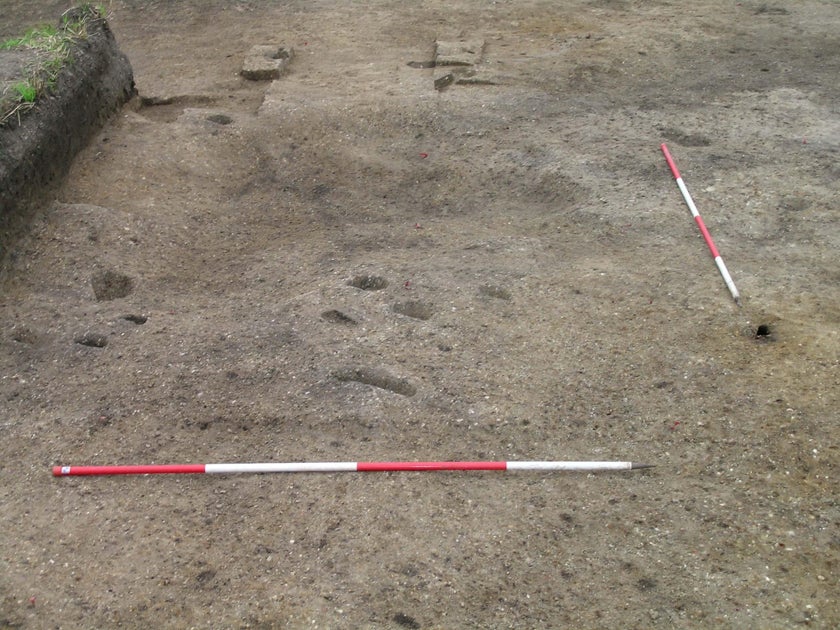
Archaeologists have found Britain's earliest house - constructed by Stone Age tribesmen around 11,000 years ago. The discovery is likely to change the way archaeologists view that early period.
Just 3.5 metres in diameter, the circular post-built house pre-dates other Stone Age buildings in the UK by up to a thousand years.
Located at one of Britain's most important prehistoric archaeological sites, Star Carr in North Yorkshire, the newly discovered building may have been home to a Stone Age hunter - or conceivably even a prehistoric priest or shaman.
Ethnographic parallels elsewhere in the world suggest that, in hunter-gather societies, well-built structures of this kind were often the homes of shamans.
It's also known from previous excavations that the site as a whole was probably used, at least partially, for ritual activity. Back in 1950, archaeologists there discovered 21 Stone Age head-dresses made of modified deer skulls and antlers - which were almost certainly used for ceremonial hunting-related rituals, possibly dances. High value beads - made of amber, shale and deer teeth, and elsewhere associated with ritual activity - have also been found on the site.
And, over recent weeks, archaeologists at the site - on the edge of a now long-vanished prehistoric lake - have been uncovering the remains of a well-built wooden platform which they believe may have been used as a ritual location from which Stone Age tribesmen threw high value objects into the water as offerings to their deities or ancestral spirits.
Careful excavation - by archaeologists from the universities of Manchester and York - has revealed that the walls of the newly discovered house consisted of up to 18 upright posts, each on average around 20 centimetres in diameter. However it's not been possible to ascertain the shape of the roof - and it could have been either flat or conical.
Inside the house, which was built sometime between 9200 and 8500 BC, the occupants had created a living/sleeping area - a 20-30 centimetre thick layer of moss, reeds and other soft organic material deliberately placed in a shallow 2.5 metre diameter man-made depression. The presence of burnt flints inside the house suggests that the building also had a small hearth.
Current and previous excavations at the site - near Scarborough - reveal that the inhabitants were hunting, processing and eating a wide range of animals - including red deer, roe deer, elk, aurochs (now extinct giant cattle), beaver, wild boar, badger, hare and pine marten. The inhabitants also appear to have used small boats. A wooden paddle was found in an earlier excavation.
So far, only a small percentage of the site has been excavated, funded by the British Academy, English Heritage, the Natural Environment Research Council and the local Vale of Pickering Research Trust. However, archaeologists are hopeful that more Stone Age houses and other structures will be unearthed in the future. The archaeological team has been excavating, studying and dating the building for the past two years - and its discovery and early date was finally announced yesterday.
The unearthing of this 11,000 year old house - a relatively sophisticated permanent structure rather than a temporary wigwam-style building is helping to change archaeologists' view of this early period.
Up till recently, most scholars regarded the people of this period, the Mesolithic era, as exclusively nomadic - but the new discovery suggests that they may also have had relatively permanent, if small, seasonal settlements.
"The discovery changes our ideas of the lives of the first settlers to move back into Britain after the end of the last Ice Age," said Manchester University archaeologist Dr Chantal Conneller, co-director of the excavation.
"We used to think they moved around a lot and left little evidence. Now we know they built large structures and were very attached to particular places in the landscape," she said.
Join our commenting forum
Join thought-provoking conversations, follow other Independent readers and see their replies
Comments
Bookmark popover
Removed from bookmarks