Fakes and forgeries go on display at the V&A Museum
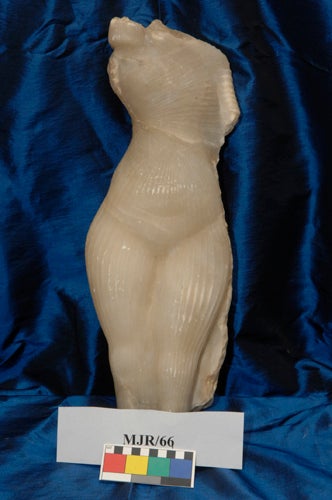
This Saturday the Victoria and Albert Museum in London will open a show that is all about a fake, in partnership with Scotland Yard. The exhibit, Metropolitan Police Service's Investigation of Fakes and Forgeries, will explore the work of counterfeit mastermind Shaun Greenhalgh, and reveal some of the techniques used by the police to spot fakes.
Over a 17 year period Greenhalgh created fake art pieces that fooled museum experts and sold for sums as high as six figures. Sentenced in 2007 he is currently serving a four year prison sentence. His parents Olive and George Greenhalgh, who assisted in his activities, were given suspended sentences – they were both in their 80s when tried.
Shaun Greenhalgh’s fakes encompassed both the ancient and modern worlds. These include Assyrian reliefs, Thomas Moran paintings and a Barbara Hepworth sculpture.
The Greenhalghs melted down genuine Roman coins in order to create a forged Rizley Park Lanx - a Roman serving plate described in detail by William Stuckley. The art world tentatively accepted it as an original, and the lanx was sold at auction in 1992 for £100,000, before being donated to the British Museum.
But perhaps his most remarkable criminal achievement is that of the so-called 'Amarna Princess' that was sold to the Bolton Museum in 2003 for £440,000. It’s a headless 52 cm alabaster statue that shows what appears to be an Egyptian princess.
Now, this is no ordinary fake. Amarna art is a very unique artform in Egyptian history. It was only practiced for about 20 years – during and shortly after the reign of the pharaoh Akhenaten.
As pharaohs go Akhenaten was a total rebel. When he came to power he threw out Egypt’s polytheistic religion, focusing Egyptian beliefs around the worship of one entity – the Aten, a sun-disc. He built an entirely new capital called Amarna out in the desert and he brought in a new and utterly strange style of Egyptian art.
Unlike the formal prose of earlier pharaohs, art from his reign shows the human body with long spindly fingers, cone shaped heads and intimate scenes such as Akhenaten kissing one of his daughters.
Two years after Akhenaten’s death Tutankhamun came to the throne and art returned to its traditional formal style which is seen so beautifully in the artefacts from King Tut’s tomb. It has been suggested that Akhenaten suffered from a medical condition, such as Marfan's syndrome, that affected his appearance and caused him to bring in this new art-style.
So the fact that Greenhalgh was able to create such a convincing fake of a royal – from such a unique time period of Egyptian art history – is quite remarkable.
The Bolton Museum said in a statement that the rarity of the item actually made it more difficult to out as a fake:
“There were few comparable objects to compare the statue to, apart from a statue in the Louvre Museum in Paris. For this reason the statue’s provenance (ownership history) played an important part in the authentication of the statue,” they said in a release on their website. “Experts at the British Museum also concluded that it was a genuine piece.”
To help peddle the fake, Greenhalgh’s father played the role of front-man. The elder Greenhalgh told the museum a story about how it had been bought by his great-grandfather at an 1892 auction of items from 4th Earl of Egremont’s collection.
Shaun Greenhalgh’s Slip-up
The success of the Amarna Princess appears to have gone to Greenhalgh’s head. In 2005 his father (again playing front-man) tried to sell three faked Assyrian reliefs to the British Museum. They depicted ancient battle scenes and at first glance appeared to be genuine. But the work that Shaun Greenhalgh had done on the details was sloppy.
The errors were numerous. The artwork showed what appeared to be 20th century harnesses on the horses, and there was a spelling mistake in the cuneiform inscription. To top it off, this time the Greenhalgh's cover story about how they came about the artefacts didn't add up.
Museum curator John Curtis told the journal Art and Antiquites that the condition of the reliefs “just didn't fit the story that the piece had been hidden in their garage for decades." While Iraqi deserts may help preserve Assyrian reliefs, car garages in northern latitudes don’t.
Scotland Yard was called and before long the Greenhalghs were exposed.
Their story of fakery was widely reported in the press and the BBC dramatized it in 2009 with a play called the The Antiques Rogues Show.
The Metropolitan Police Service's Investigation of Fakes and Forgeries runs from 23 January – 7 February 2010 at the V&A Museum, rooms 17a & 18a. Admission free.
Other famous and possible fake artefacts on display in museums
Interview with Paul Denis on Fakes & Forgeries: Greek Coins, Zapotec Artefacts and the Internet
Join our commenting forum
Join thought-provoking conversations, follow other Independent readers and see their replies
Comments
Bookmark popover
Removed from bookmarks