Is Boudicca a poster girl for intolerance and British nationalism?
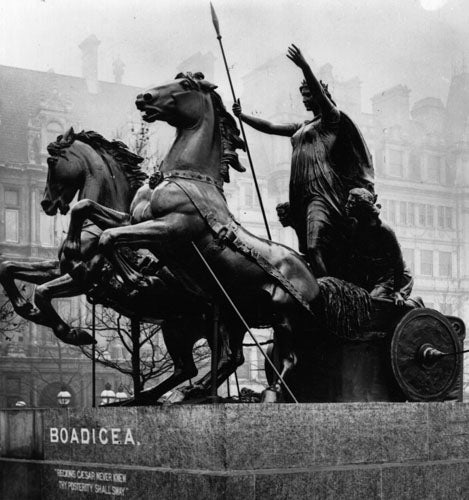
Re-invented by the Victorians, under the name of Boadicea, Boudicca was presented as an idol of nationalism, of British warrior tradition and, somewhat incongruently, as a figurehead of imperialism, even though this was the thing she had fought against.
Her statue sits directly opposite Big Ben and the Houses of Parliament, overlooking the River Thames at the very heart of London. There she stands in her chariot looking over the city like some kind of fierce guardian angel for the British. But what is she doing there? Should we really be touting Boudicca as a hero? Or does she represent the kind of nationalism and xenophobia that we should rail against?
Rebel Woman
In 60 and 61 AD the mighty Roman empire was attacked by a coalition of British rebels, led by a woman, a Celtic Queen who had been tortured, and her daughters raped, by the Romans. Driven by anger and revenge she lead her followers on a rampage through the heartlands of Roman Britain. Her name was Boudicca - in her Celtic language it meant 'victory', and she subjected the Roman IX Legion to a defeat that was rare even for the most elite soldiers in the ancient world. Her goal was clear: to get the Romans out of the lands her husband had ruled, and then out of Britain all together. She came close to succeeding, according to some accounts. The Emperor Nero was shaken enough to consider withdrawing from Britain, though ultimately he chose to stay but adopt a more 'hearts and minds' approach, as modern terminology might put it.
Kill Boadicea!
Boudicca was an historical figure - Boadicea is a created one, and I say it is time for us to kill off Boadicea, leaving only Boudicca open to historical scrutiny.
Boadicea has corrupted how we view Boudicca, giving Boudicca a heroic sheen that I don't think she deserves. She was a freedom fighter, we cannot doubt that. The Romans had defiled her (and her young daughters) in the worst way possible and the Roman governor had declared that her kingdom (ruled her late husband) the property of Rome, without thought for the welfare of those within it.
She faced a choice between slavery, rebellion, or exile. It was justified, then, to lead an army against the Roman forces in Britain. The Romans were an occupying force, with a presence of less than 20 years on the land which had brought the Britons their livelihood for many generations. Boudicca gathered together rival tribes and formed a liberation army. If the motives of this force were good at first, they did not long remain so, and soon there was a dishonourable descent from a freedom fighting force into a looting mob. This took place ostensibly under her command - we have no reason to think it was not upon her orders that this change of tactic took place.
The city of Camulodunum (Colchester) was set ablaze, but not before widespread plunder, rape and slaughter occurred. The same treatment was given to the populous centres of London and Verulamium (St. Albans). How ironic is it then that in the centre of our houses of parliament, cited as the symbol of civic freedom and welfare, that we have a statue dedicated to the woman who wanted to 'ethnically cleanse' the British isles and to raze the burgeoning city that now commemorates her. It is as perverse as having a statue to the leaders of the fourth crusade erected in Constantinople, now Istanbul, or to Slobodan Miloševi? in Vukovar. We should also ask ourselves what benefit Boudicca brought to Britain. When we weigh that against what the Romans did for us, wouldn't it be more appropriate to have a monument to Suetonius Paulinus, the then governor of Britain, who matched Boudicca in cruelty but at least stimulated the development of civilisation on these shores?
A Sack Too Far?
Boudicca's barbarians, as they entered London, were not the same force which stormed and liberated Camulodunum - London had never been their land. They did not make the distinction between native Briton and Roman immigrant as they looted and plundered. It seems as if we (English or British) have thrown our colours in with the Iceni tribe without stopping to consider the Atrebates or other tribal peoples victimised by Boudicca.
Ultimately Boudicca's rebellion was brought to halt with a crash by a force of 10,000 Roman troops, even though her force was much larger and fighting 'on home soil'. The battle is called the Battle of Watling Street, named after the Roman road somewhere along which it is thought to have taken place. Those in her command were a disorganised rabble, ill-equipped and ill-prepared for the tactics of the Romans. Boudicca was suddenly out of her depth and her failure on the battlefield ended in disaster for her army. Caught between the Romans and their own wagon train, they died in a bloody, gory crush. Tragically, their families in the wagon train were not spared.
There is, then, no logical reason I can see to celebrate her so much as the English/ British do (I'm English, by the way, if you hadn't guessed). She is presented as our William Wallace, our underdog fighting against the big bad empire and doing that thing we love more than anything else - failing ('but she 'ad a bloody good go').
Is Boadicea a Symbol of British Nationalism?
I suggest the word to explain the love of Boadicea is xenophobia. A red-haired, milk-skinned dame leading an army of men in tweed and woad against Jonnius Foreignus. She represents the now outdated mentality that our island is our castle and those who come here from abroad are to be repelled. She is often dragged out by ill-informed British nationalists as the poster girl for their hostility - amusing given they talk of themselves as Anglo-Saxons. How would Boudicca have reacted to the arrival of the Saxons I wonder?
The Boadicea statue in Westminster was placed in 1902, designed by Thomas Thornycroft, it is a beautiful and thrilling work of art; but it is becoming rapidly out of date against our modern sensibilities. Britain is now a country which welcomes guests from abroad and co-operation with other nations. It would be a tragedy if that statue was lost and little kids no longer asked parents “Who is that?”. But perhaps now it would be right to move it elsewhere, where it does not cast its shadow of violence and xenophobia onto the home of our government. Perhaps a better place would be back in Boudicca's native Norwich or on the site of her great final battle, should we ever find it. There it could live solely as a reminder of a compelling historical figure, a wife and mother, who briefly bested the might of Rome.
Boudicca, the Battle-axe of Britain
Join our commenting forum
Join thought-provoking conversations, follow other Independent readers and see their replies
Comments
Bookmark popover
Removed from bookmarks