New discoveries hint at 5,500 year old fratricide at Hamoukar, Syria
Five years ago, archaeologists found the “earliest evidence for large scale organized warfare in the Mesopotamian world.” Using slings and clay bullets a – likely Uruk – army took over the city of Hamoukar, burning it down in the process. Now, new discoveries at a nearby settlement shed more light on the 3500 BC battle – and raise more questions. If the invading army was from Uruk, did they kill their own people? If so, why?
Hamoukar is a city that flourished in northern Syria since at least 4000 BC. They traded in obsidian and in later times copper working became increasingly important to the city’s economy. Thousands of clay sealings – once used to lock doors or containers and impressed with stamp seals – were found at the ancient site. They tell of a bureaucratic system that was almost as complex as our own.
Uruk was a massive city, located to the south in modern day Iraq. Unlike Hamoukar it was lacking in natural resources such as timber and metal. Yet, despite this lack of resources, its people were on the move. “This Uruk culture from the south started expanding all over the Middle East,” said Professor Clemens Reichel, of the University of Toronto and Royal Ontario Museum, who is leading the excavation at Hamoukar. His team’s work is being supported by the Department of Antiquities in Syria and the Oriental Institute of the University of Chicago.
One of these colonies was located just outside Hamoukar. It’s a small site, probably occupied by no more than a few hundred people. Its pottery remains were scattered over a hectare. When researchers analysed the pottery they found that much of it consisted of Uruk pottery. “It’s the same stuff that you would find in Southern Mesopotamia, almost 700 km to the south,” said Reichel.
Researchers believe that this colony was there to facilitate trade, but was probably not controlled by Uruk’s rulers. “I’m tending more to them being sub-state entities,” said Reichel, private entrepreneurs, perhaps like the British East India Company of more recent colonial times.
In 3500 BC Hamoukar was destroyed by a violent attack. Slings and clay bullets were the force’s primary weapons. While incredibly crude, by today’s standards, these weapons could do a lot of damage. The archaeologists tested the slings' effectiveness by creating their own bullets and attacking their own dig house.
“The impact is quite remarkable,” said Reichel. At one point he was accidentally hit in the head by a colleague who was practising. “He wasn’t very good at that point, but by god I felt it,” he said. “Once he got really good, the speed, the velocity, that those guys get, is amazing... I’m virtually certain it can be fatal.”
While Professor Reichel survived his encounter, many people at Hamoukar did not. The attackers broke inside the city’s three meter thick city wall, the fighting continued and buildings were set on fire.
Artefacts from Hamoukar which postdate the battle, are similar in style as items created at Uruk. This makes an Uruk army the likeliest attackers. "If the Uruk people weren't the ones firing the sling bullets, they certainly benefited from it. They took over this place right after its destruction," Reichel told the New York Times back in 2005.
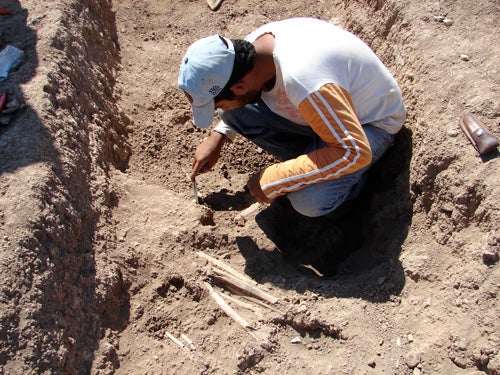
Now, it appears the Uruk colony was destroyed in the conflict too. Pottery remains discovered at the settlement suggest the two events happened at the same time. “We found evidence of burning, we found sling bullets... and we found some remains of human bodies,” said Professor Reichel. He added, “this is highly preliminary, and more work needs to be done on that. But the fact that we have dead bodies, some destruction and sling bullets, suggests that these guys put up some resistance,” said Reichel.
Which brings us to the big question – if Uruk troops destroyed Hamoukar why would they have gone after their own people living in the nearby colony?
One possibility is that the soldiers were not aware that they were attacking their own people, a sort of “shoot first ask second” action. Another option is that that the Uruk colonists tried to stay out of the conflict but were regarded as “traitors” by the invading army. “Maybe they did stay out – maybe the attacking army said, well, look at those traitors – those bastards – let’s get even with them,” said Reichel.
A third theory, and the most tantalizing, is that the people of the colony sided with Hamoukar against the intruders – a dicey situation if indeed the invading army came from Uruk. This is not such as far-fetched an idea as it seems, the colonists appear to have been profiting from their trade. If Hamoukar was taken over by anyone, who is going to stand to lose from that?
“They were the intermediaries between goods from foreign lands and the mothership back south, and they profited from that position,” said Reichel. As such, “it would have been advantageous for these guys, of the Uruk colony, to side with the locals, to maintain the status quo, and not support a takeover of the site by anyone. Certainly not by their own people if that’s what happened.”
“Then and now it might have been the same story – just because you speak the same language and come up from the south doesn’t mean that you’re my friend,” said Reichel. “You may be my brother but not necessarily my friend.”
In the end, regardless of what decision the colony made, it seems to have paid the same price as the city of Hamoukar.
Did Uruk soldiers kill their own people? 5,500 year old fratricide at Hamoukar Syria
Dear me, I've wandered onto Salisbury plain. Syria's Stonehenge
Join our commenting forum
Join thought-provoking conversations, follow other Independent readers and see their replies
Comments