New pyramid discovered in Peru linked to ancient copper industry
A team of archaeologists who uncovered a 1,400 year old pyramid in Peru say that the finding is particularly unusual. The flat-topped pyramid, which was built by the Moche culture, was used for the living rather than just for the dead, and contains a wealth of artefacts, murals and human remains.
The pyramid was discovered at Huaca Colorada, which translates as ‘coloured hill’. Excavation leader Professor Edward Swenson, of the University of Toronto, describes how he suspected that the area may be archaeologically significant. “I knew it was more than a natural hill – this was modified.”
Swenson’s hunch paid off. With the pyramid so far only partially uncovered, archaeologists have already made remarkable discoveries. “Our biggest surprise was that at the top of this pyramid construction we found elite residences”, said Prof Swenson, who added that it is very unusual to find pyramids used in this way. The Moche are known to have used pyramids for burials and ritual activity rather than everyday living.
The living complex would have housed no more than 25 people, and was complete with patios, a kitchen, and stands for ‘paica’ – large vessels for storing water and corn beer. The team also identified a bin used to hold guinea pigs: “The preservation was so good that we actually came across guinea pig coprolites (faeces).”
Several murals covered the corridors at the pyramid's summit. The best-preserved of these depicts a Moche warrior - who Swenson describes as looking “like a Smurf” - carrying a club. Other murals include a depiction of what appears to be a cactus with two mountain peaks and a rainbow, and a representation of two litter-bearers carrying a person.
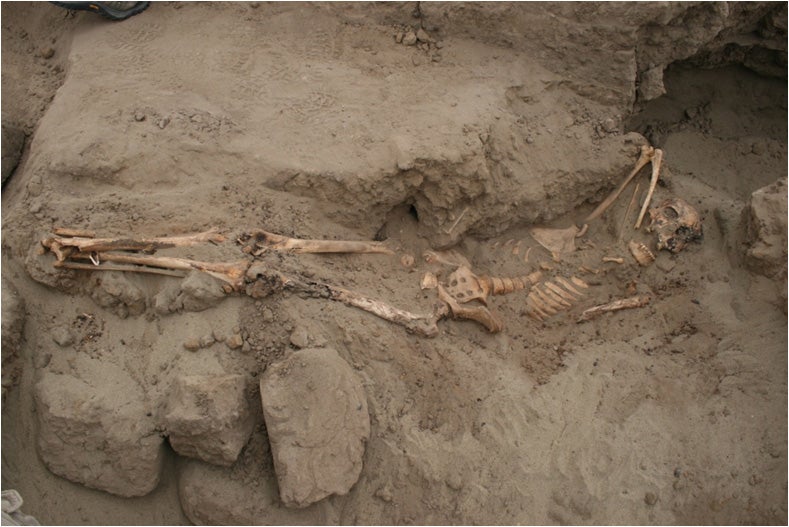
Evidence of ritual sacrifice was also discovered at the site. The skeletons of three adolescent girls, and body parts belonging to four other individuals, were found on a platform at the top of the pyramid. The girls were buried with beads around their neck and their feet were close together, suggesting that they had been bound. Charring on the girls' knees indicate that their bodies were subject to “ritualistic burning.”
This evidence raises the possibility that the girls were sacrificed as part of a ritual, something not uncommon among the Moche. However physical anthropologists examining the skeletons could find no evidence of trauma. This means the girls either died naturally or were killed in such a way that no evidence was left on their bones. “It’s possible they were sacrificed but we don’t know,” adds Prof Swenson.
To the south of the pyramid the team found a large number of copper artefacts including spatulas, knives, smelting receptacles and ornaments. “I’ve never found such a high quantity of copper,” says Swenson. “The power of these elites could very much have been grounded in control of copper production.”
Huaca Colorada is near the coast of Peru where copper is scarce, so the site’s rulers would have had to trade with people living in the mountains, at least 200km to the east. Swenson speculates that the rulers “may have been considered lords – but lords of a particular kind – in transforming ore into finished products”. Alternatively, says Swenson, there could have been a “corporation of co-operating but high status practitioners.”
Huaca Colorada appears to be undefended. Swenson said the team found “no walls, no sling-stones... unlike many of the sites built on the coastal hills.” The area surrounding the settlement was mostly flat, and would have offered little resistance from invaders. There was certainly warfare in the Moche world, but perhaps, for some unknown reason, Huaca Colorada and its pyramid were off-limits to invaders. “It’s kind of like (the) open city of Rome in World War II,” says Swenson. “I don’t know exactly what’s going on.”
Excavation work continues at the site, and researchers will conduct a GPR survey on the pyramid this summer to determine its size.
Images of the earliest known Mesoamerican pyramid tomb discovered in Mexico
Join our commenting forum
Join thought-provoking conversations, follow other Independent readers and see their replies
Comments