Queen Eadgyth's remains discovered in Germany
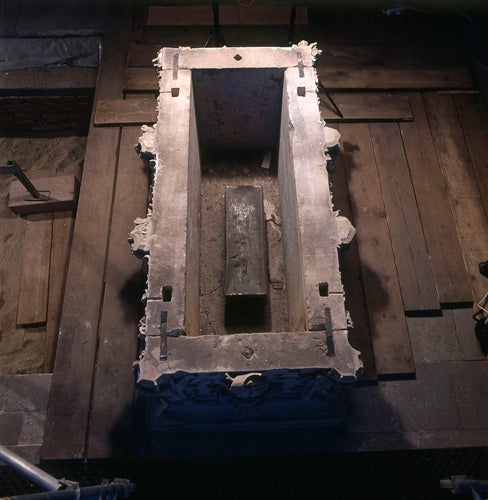
Remains of one of the oldest members of the English royal family, Edith of England, have been located at the Magdeburger Dom in Germany. A lead coffin was discovered, bearing the name Eadgyth, the old spelling for Edith. Inside the coffin, a nearly complete female skeleton was found, wrapped in silk.
Queen Eadgyth, the sister of King Athelstan and the granddaughter of Alfred the Great, King of Wessex became the wife of Otto I, the Holy Roman Emperor in 929. She lived in Saxony and bore Otto at least two children, before her death in 946 at the age of 36. She was then buried at the Monastery of Mauritius in Magdeburg, Germany. Her tomb was later marked in the Cathedral by an elaborate sixteenth century monument, thought to be a cenotaph. If bones were to be found here, they would have had to been moved to this later tomb.
Dr Harald Meller of the Landesmuseum fur Vorgeschichte in Saxony Anhalt, who led the project said: "We still are not completely certain that this is Eadgyth although all the scientific evidence points to this interpretation. In the Middle Ages bones were moved around as relics and this makes definitive identification difficult."
Apart from the fragmentary bones - wrapped in textiles - inside the lead coffin, other finds included soil sediments and entire beetles. All the findings and the lead coffin itself are being studied and conserved by a team of scientists including osteologists, archaeologists, archaeometallurgists, specialists in medieval textiles, forensic scientists, pedologists, biologists, art-historians and epigraphers.
As part of the research some small samples are being brought to the University of Bristol for further analysis. The research group at Bristol will be hoping to trace the isotopes in these bones to provide a geographical signature that matches where Eadgyth is likely to have grown up.
Professor Mark Horton of the Bristol University's Department of Archaeology and Anthropology, who is coordinating this side of the research, explained the strategy: "We know that Saxon royalty moved around quite a lot, and we hope to match the isotope results with known locations around Wessex and Mercia, where she could have spent her childhood. If we can prove this truly is Eadgyth, this will be one of the most exciting historical discoveries in recent years."
Eadgyth is likely to be the oldest member of the English royal family whose remains have survived. Her brother, King Athelstan is generally considered to have been the first King of England after he unified the various Saxon and Celtic kingdoms following the battle of Brunanburgh in 937. His tomb survives in Malmesbury Abbey, Wiltshire, but is most likely empty. Eadgyth’s sister Adiva - also offered to Otto as wife, but he choose Eadgyth instead - was also married to an unknown European ruler, but her tomb is not located.
The discovery of Eadgyth’s remains illustrates the close links between European states in the early medieval period and how in the formation of both England and Germany intermarriage between the emerging royal houses of Europe was commonplace and has left a lasting legacy in the present royal families of Europe.
Genetic Britain: How Roman, Viking and Anglo-Saxon Genes Make up the UK's DNA
Dave Simmonds of Birmingham Museum on the Staffordshire Hoard
'Sutton Hoo-Standard' Saxon Skull and Brooch 'Belong to Sixth Century Princess'
Join our commenting forum
Join thought-provoking conversations, follow other Independent readers and see their replies
Comments
Bookmark popover
Removed from bookmarks