Rubber balls used in Mesoamerican game 3,500 years ago
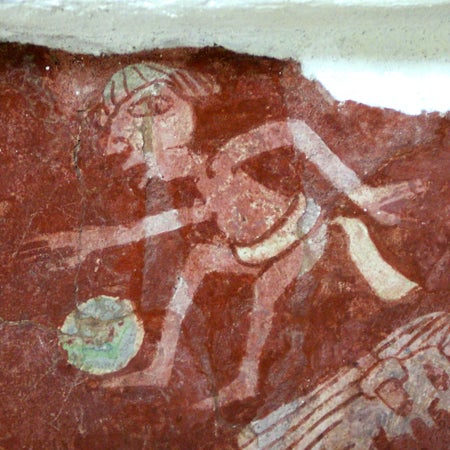
Stable rubber may have taken until the 19th century to reach the Old World, but ancient Mesoamericans had been playing ball with the stuff since 1,600 BC. And new research suggests not only were they the world's first polymer scientists, but they could also mix and match rubber compounds for different uses.
American Charles Goodyear was the first westerner to invent vulcanisation in 1839. But 3,500 years previously rubber in Mesoamerica, an area comprising Mexico and several neighbouring states, was used to make any number of items, from decorative arts to sandals – and, of course, their famous rubber balls. Measuring anything between a few inches and a foot, the balls are among the region's most famous ancient artefacts. “They were really spectacular, really enormous,” says Prof Dorothy Hosler of the Massachusetts Institute of Technology (MIT), who alongside Michael Tarkanian has been studying Mesoamerican rubber for over a decade.
Hosler, Tarkanian and former colleague Sandra Burkett had already discovered in 1999 how ancient civilisations such as the Maya, Mexica and Olmec created rubber by blending sap from local latex trees (Castilla elastica) with juice from Morning Glory vines (Ipomoea alba species). Since then Hosler and Tarkanian have been collecting samples from Mexico and mixing them in different quantities at MIT, before testing their qualities (surviving examples are too decayed for their makeup to be studied). They claim the Mesoamericans did this too, producing different rubber for different products.
The pair found a three-to-one compound creates the most durable rubber, ideal for making sandals. Though no original sandals have ever been discovered they were noted by amazed Spanish Conquistadores after their 1521 invasion. There's also clear linguistic evidence: The Mexica used a compound word that combines the words for “rubber” and “sandals.”
A 50-50 mix, on the other hand, results in bouncy rubber – ideal to make balls for the legendary Mesoamerican ballgame whose 'I' shaped courts have been discovered all over the region. The game varied across regions including goal-based versions and others with raquets. The most common, though, was fought out between two teams who tried to keep the ball up without leaving the court, a bit like a netless volleyball.
While England's footballers will arrive in South Africa next month feeling the weight of a nation on their shoulders, it's nothing compared to the price of failure in the ancient game: matches were commonly ceremonial, ending in human sacrifice. Even death may have been a relief after full time: some balls measured weighed eight pounds – about the same as a watermelon. The game was an important religious and political rite: it was even used to settle border disputes.
Just like football today the Mesoamerican ballgame commanded its own industry: Hosler and Tarkanian claim up to 16,000 balls were churned out by special out-of-town rubber factories per year, which were then shipped to capital cities like Chichen Itza as a form of tax payment. The balls, and rubber in general, are thought to have been ancient fertility icons, and were frequently – and luckily for archaeology – ritually buried or laid in sacrificial pools.
Top 10 Ancient Sports: Why Football is Chinese and Sumo is Sexy
Join our commenting forum
Join thought-provoking conversations, follow other Independent readers and see their replies
Comments
Bookmark popover
Removed from bookmarks