The best historical pranks and hoaxes
Emperor Constantine had a splendid sense of humour for a Roman, but he couldn't stand criticism. When in the fifth century one of his court jesters boasted that fools and jesters of the court could rule the empire better than the Emperor himself, Constantine decreed that the fools would get their chance at proving this claim.
The ruler set aside one day in the year upon which a fool would reign the great Roman empire. The first year, Constantine appointed a jester named Kugel as rule, who immediately ordained that only the absurd would be allowed on that day. This yearly tradition of celebrating of all what is ludicrous, nonsensical and utterly derisory was a huge success, and so the tradition of April Fools' Day was born. Or was it?
Actually, the Ancient Roman origins of April Fools' Day is actually a prank itself, and a very successful one. Pitched in 1983 to a journalist by Professor Joseph Boskin, the story was released on the Associated Press news wires and followed up by many reputable news outlets. A few weeks later, Boskin admitted that the whole story was a hoax.
Boskin’s prank is just one of many to have fooled archaeological scholars and museums over the years. In fact The Independent had its own archaeological prank on April 1st 1993 when the newspaper announced the discovery of the 3000-year old village of cartoon heroes Asterix and Obelix, complete with Asterix-period pottery and Iron Age standing stones. The village, said to be 3000 years old, was reportedly found at Le Yaudet, near Lannion, France - almost exactly where author Rene Goscinny placed it in his books. Professor Barry Cunliffe of Oxford University and Dr. Patrick Galliou of the University of Brest were credited with its finding.
Not all hoaxes are as playful as these examples; the antiquities market is plagued with fakes and forgeries. It can be difficult even for experts to determine whether an artefact is genuine, as the ongoing debate over the authenticity of the Bust of Nefertiti can attest, and if an artefact is deemed genuine, it has the potential to command a high price.
One of the most successful hoaxers was British was Shaun Greenhalgh. His Amarna Princess sculpture - named after the Egyptian capital under the reign of Akhenaton - is the most famous 'fake' in Britain. The 52cm alabaster statue was believed to be that of an Egyptian princess related to King Tut. Considered a rare find when offered for sale (the Amarna art style was only practiced during the reign of Pharaoh Akhenaton) the Princess fetched £440,000 and was put on display at Bolton Museum. The museum later said the rarity of the item made it more difficult to identify the statue as a fake and added that experts at the British Museum also believed it to be genuine.
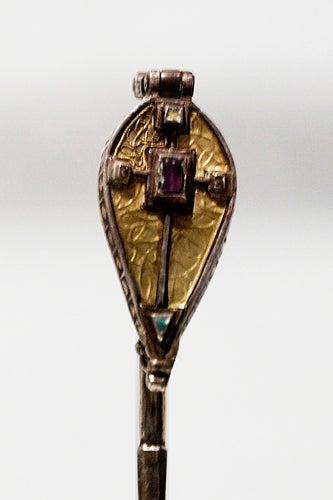
Other 'ancient' forgeries by Greenhalgh included the Rizley Park Lanx (a serving plate that he created by melting down genuine Roman coins) which was accepted as genuine for years, and a 10th century brooch. Greenhalgh's run of good luck came to an end when in 2005 he and his father tried to sell three faked Assyrian reliefs to the British Museum. He was caught out by spelling errors in the cuneiform inscriptions and what appeared to be 20th century harnesses on the horses. Scotland Yard was called and before long Greenhalgh was exposed.
Other remarkable hoaxes include a report published by Biblical Archaeology Review in 2002 that claimed an amazing discovery: a stone box with a contemporary inscription confirming the existence of Jesus of Nazareth and his brother, James the Just. If authentic, the ossuary would have been the first archaeological evidence that Jesus existed aside from the manuscript tradition. In 2003, the Israeli Antiquities Authority published a report concluding that although the ossuary and the first half of the inscription were genuine, the second half was a poor forgery. Specifically, it appears that the inscription was added recently and made to look old by addition of a chalk solution. The owner, Oded Golan, has since been arrested, and his forgery equipment and partially completed forgeries have been recovered.
In the US, a number of remarkable quartz crystal skulls, apparently Mayan or Aztec in origin, were recently in circulation. Although several are now housed in museums, including the British Museum, none of the skulls come from well-documented, official excavations and it is now generally agreed that these skulls are 19th century forgeries. Although skull iconography is found in Mesoamerican art, some of the anomalies that give the skulls away as fakes are the rigid linearity of features representing the teeth (contrasting with the more precise execution of teeth on pre-Columbian artefacts) as well as the way these features were carved. Also, a cutting wheel - not introduced until after the Spanish conquest - must have been used in the producting of this skull, ruling out the possibility that they were manufactured during the Aztec period.
The British Museum has decided to hold onto its forged skulls, and it seems that there is a role for forged artefacts in the world’s top museums. Royal Ontario Museum curator Paul Denis claims that, of the hundreds of ancient Zapotec artefacts in the museum, about half of them are fake. Some museums will even go to great lengths to have hoaxes on display. When Peter Dance's book Animal Fakes and Frauds made the hair-covered ‘fur-bearing trout’ famous, National Museum of Scotland’s taxidermist tracked down some rabbit fur and created one to go on display.
Shaun Greenhaugh’s famous fakes
Join our commenting forum
Join thought-provoking conversations, follow other Independent readers and see their replies
Comments
Bookmark popover
Removed from bookmarks