The First Emperor's Terracotta Army recruited outside China
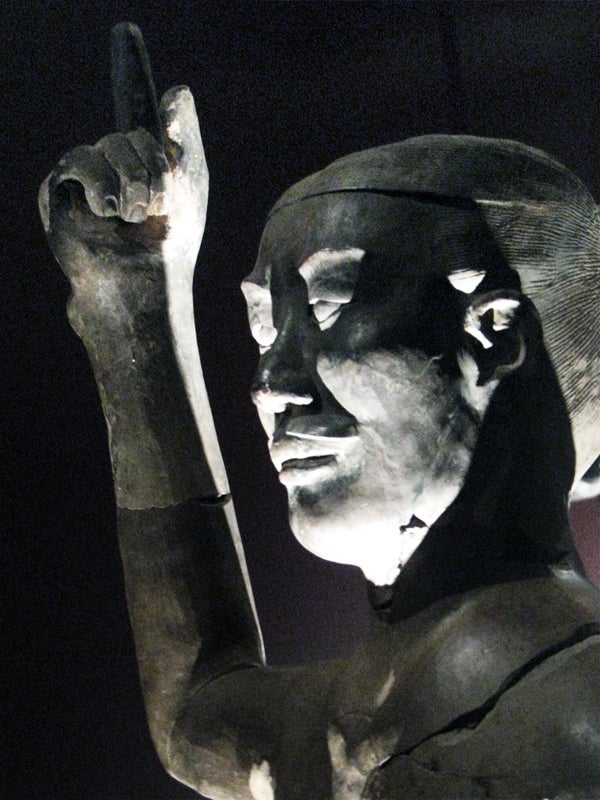
Acrobats from Burma, workers from Central or West Asia, and a mausoleum design inspired by work in the Middle East – the Mausoleum of China’s First Emperor was a cosmopolitan place says Dr. Duan Qingbo, the man in charge of excavating it.
The mausoleum was created about 2,200 year ago and served as a tomb for Qin Shi Huang – the first emperor of China. While the emperor’s tomb is largely unexcavated, archaeologists have found thousands of life-size terracotta figures nearby. It’s believed that this army was created to serve the emperor in the afterlife.
Dr. Duan discussed the cosmopolitan nature of the complex at a lecture at Toronto's Royal Ontario Museum in Toronto, which is currently hosting a Terracotta Warriors exhibition. He doesn’t speak English so his words were translated by Dr. Chen Shen, museum curator and Chinese archaeology expert.
Traditionally scholars have marked the 2nd century BC as the starting point of China’s relationship with the west. The Silk Road was opened for trade at that time, opening up what would become a booming trade.
“Now the evidence shows that the cultural exchange or influence from the western world begins as early as the time of the First Emperor,” said Dr. Duan. In fact the emperor’s “burial structure is probably inferenced from west.”
The First Emperor’s Mausoleum uses a step up structure that “allows the soul to escalate to the top.” Duan pointed out that the Mausoleum at Halicarnassus in Turkey is quite similar, gradually rising up in levels and was built only 100 years before the First Emperor’s life.
“The structure of this tomb mound is very similar to what we find inside the First Emperor’s tomb mound,” said Duan. Also, “on top of this structure (at Halicarnassus) there’s a chariot driven by four horses, we all know that (at) the First Emperor’s tomb complex there also is a chariot with four horses,” he said.
A few years ago Dr. Duan’s team unearthed 120 skeletons of workers who were buried near the Mausoleum. Among the finds were three skulls that were definitely not Chinese. “There’s three skulls that are different from the rest of them which represents the Mongolian type of people,” he said through a translator. The “nose protrude (is) very extensive.”
The first time DNA tests were performed they indicated that the individuals were from “west Eurasia probably like a white people,” however the second DNA test showed they were more similar to Mongolian.
Duan has an idea as what these workers might have been used for. His team discovered that the Terracotta Warriors pits used an interlocking rectangular brick pattern that had not been used in China before the time of the First Emperor. “This kind of bricks has never been found in China, it was the first time used in the Terracotta Warrior pits,” he said. “The style used in the Terracotta Army pits of these rectangular brick (is) probably also inference from West Asia.”
This means that these foreigners may have served as “skilled labour” bringing knowledge of this technology from Central or West Asia – allowing the First Emperor’s officials to implement it.
Another discovery that adds weight to Dr. Duan’s theory is a pit of terracotta entertainers, including strongmen, wrestlers and acrobats.
The acrobats were created in a lifelike way – with their carving conveying a sense of movement. One example, that is now on display in Toronto, has an index finger pointing up, indicating that the figure is trying to perform a balancing act.
Dr. Duan believes that the acrobats the terracotta figures are modelled on, were probably not from China. “According to the way they perform we speculate they are not indigenous to central China, but probably come from the south – probably the Burma area.” This is an idea that – if proven true – will add another ethnic layer to what appears to have already been an ancient cosmopolitan project.
Join our commenting forum
Join thought-provoking conversations, follow other Independent readers and see their replies
Comments
Bookmark popover
Removed from bookmarks