Is this the housing standard of the future?
Energy secretary, Chris Huhne, noted in a speech to the Green Alliance recently that “a quarter of UK emissions come from the home.” Meanwhile, according to the Office for National Statistics, 60% of the UK’s local authorities experienced an increase in domestic emissions between 2007 and 2008, while only 40 percent experienced a decrease.
Search for the perfect furniture with The Independent house and home database, powered by mydeco.
The UK continues to lag behind Europe in terms of energy efficiency, but it’s an extravagance we can no longer afford – neither environmentally nor financially.
While we have all been aware for some time what the penalties are of failing to reduce carbon emissions, the news, post-recession, that energy bills in the UK are set to rise, yet again, by up to £150 a year is enough to make us all feel a little more green-minded. So how can we live more energy efficiently?
The government’s commitment to be the first country in the world to ensure that all new homes are ‘zero carbon’ by 2016 is a noble and ambitious one and in line with EU standards set to come in at this time.
Recently, the housebuilding industry has complained that this is an unrealistic target in a slumped housing market which would struggle to carry the cost. But, while builders gripe about the impossibility of making Britain’s homes green, a German standard for super-insulated housing is beginning to gather pace in the UK.
Passivhaus technology was developed in Germany in 1990 and is now widely used across Europe – particularly in Germany, Austria and Sweden. 90% more energy efficient than any normal home, a Passive House applies a number of strict building standards, which help to conserve heat by utilising heat sources and solar gains.
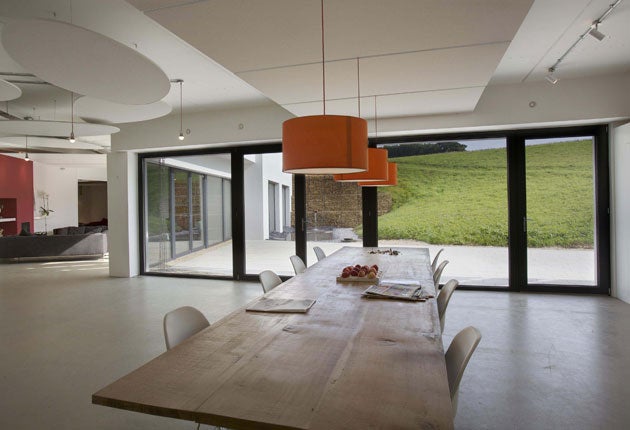
Passive Housing is “absolutely the best tool to achieve what we need to achieve in terms of reducing the carbon emissions in our houses,” says Helen Seymour-Smith, a self-employed architect, whose home, built beneath a 300-year-old derelict barn in the Cotswolds, recently featured on Grand Designs as the first accredited Passive House in England.
Triple-glazed along the south face, the house features solar panels and is earth-sheltered, encased in thick, high-tech concrete insulation and a soil jacket. Inside StoSilent Modular acoustic panels (made from 96% recycled glass) and StoColor Climasan, an odour-eating paint, help to complete a highly minimalist, eco-conscious interior.
“A Passive House is all about investing in the building’s fabric so that, as the building is in use, your carbon emissions will be so much less over time,” says Helen, who sees it as “much simpler” than the “over-complicated” Code for Sustainable Homes rating system, which, she points out, allows you to gain “extra points for putting in a bicycle rack or something and achieve a high level in the code, despite still using electric heating.”
The benefits of Passive Housing have “been proven in over 30,000 projects in Europe,” says Thomas Froelich, who set up The Passive House Centre in Scotland in 2009 as a way of supporting architects and builders in the execution of Passive Housing; educating the general public and housing associations; and certifying that houses conform to the Passive House criteria. “If it works in Germany and Austria, why shouldn’t it work in Britain? The hurdle at the moment is ignorance, but ignorance is slowly but surely coming to an end.”
One of the first myths to debunk about Passive Housing is that of cost. At the moment, says Froelich, you can expect to pay “about 10% more on your envelope to get your home to the passive house standard,” but, he points out, “the saving,” which is significant, "starts straight away.” Meanwhile, it is worth remembering that the Passive House technology, just like laptops and LED lighting, will get cheaper very quickly.
The second myth is that a Passive House has to look as terrifyingly modern and minimalist as Helen Seymour-Smith’s Cotswold home, which is, in fact, down to her and her husband’s own personal taste. This is the biggest misconception, says Froelich. “A Passive House doesn’t have to look like an energy efficient house. It’s just about applying the right materials, the right orientation, the right insulation, mechanical ventilation, heat recovery triple glazing and then you have 80% of the battle won. It’s very, very easy to apply.”
At the moment, there are 30 Passive Houses in the UK and The Passive House Centre in Scotland has many more projects underway. But Passive House standards are not just restricted to new builds. Retro-fit Passive House technology is also possible, and, though the application is often challenging, “it is terribly important that this market be taken seriously,” according to Helen, who points out that “dealing with our existing housing stock is obviously a much bigger deal than dealing with new builds, which are relatively easy to make energy efficient.”
Achieving zero-carbon homes by 2016 will require a leap of faith by housebuilders and developers, and most importantly, the house-buying general public. But, with better awareness and education about what exactly zero-carbon means, we will (and must) get there. As Froelich says, “Britain might be the furthest behind in Passive House technology, but it’s one of the fastest catching up. This is the standard of the future. There’s no other way around it if we want to get our co2 reduction down. We should not buy incentives, but build in the right way.”
Emily Jenkinson is interiors writer for furniture and interior design website mydeco.com.
Join our commenting forum
Join thought-provoking conversations, follow other Independent readers and see their replies
Comments