Subterranean houses: the height of cool
They're discreet, energy-efficient and full of light, says Graham Norwood
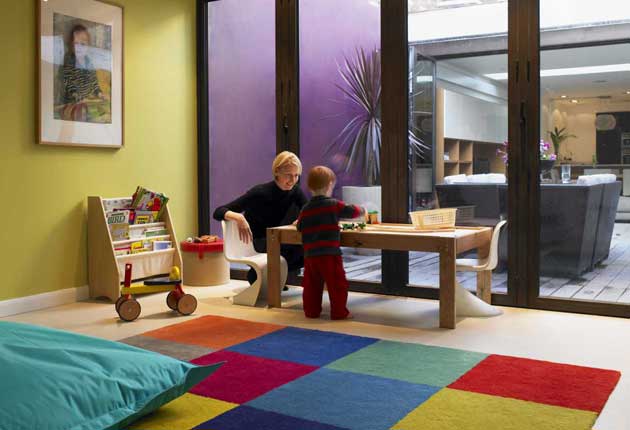
At first sight, 12 Oxford Walk in Cheltenham looks like a tiny, modern house tucked behind a Regency terrace. But walk to the front door and down the steps and it's like an iceberg: the majority of the property lies below the surface.
This is the Underground House, an eco-home with 70 per cent of its floor space beneath street level. "The local planners didn't allow us to build upwards, so we went down," explains Tim Bawtree, who designed the home with his wife, Zoe; it was featured on Channel 4's Grand Designs. "We removed 1,000 tons of sand, used heavy duty steel piles and dug down to a total of four metres."
There are thought to be fewer than 30 underground homes in the UK, each with a unique design and history. The Bawtrees' three-bedroom home is one of the most recent, pioneering the use of hollow polystyrene blocks filled with concrete to form the walls, giving good subterranean insulation, waterproofing and strength.
The couple spent around £30,000 on glass, some of it to form ceilings and floors, allowing the maximum amount of natural light to filter in from ground level to the storeys beneath. "The only downside is that we don't have a natural view, but even so, we've created a private terrace that gets plenty of sun," Tim says. Grand Designs presenter Kevin McCloud described the property as "a magical house whose main living space lies below ground, filled with reflected natural sunlight".
The UK's earliest underground homes were a mixed bag. Underhill, dug into the Yorkshire Moors, was considered Britain's first when it was created in 1978. Designed by Arthur Quarmby, the founder of subterranean living in the UK, it includes a 2,000 sq ft open-plan room, a swimming pool and a glass roof.
This year, Mole Manor, at Tetbury in Gloucestershire, celebrates a quarter of a century of subterranean existence opposite the 600-acre Westonbirt arboretum. It is an oval-shaped palace with classical pillars; there is a swimming pool and an open interior that holds its own with grand homes above ground. The house was built by a local who was refused planning permission to build above ground so close to the arboretum. It certainly does not scar the landscape, but is more modern-day folly than eco-house.
Not so the Hockerton Housing Project in Nottinghamshire, where a terrace of homes has been dug into a hillside. Though now 20 years old, Hockerton remains environmentally cutting-edge. Its five single-storey homes are buried six metres deep, with 19-metre conservatories emerging from the hill, providing them earth-heat on one side and sunshine on the other. The scheme is carbon neutral, with energy from a wind turbine and recycled water.
Being green is only one advantage of living underground. The minimal visual impact of a subterranean home means it can remain discreet and private even in unusual locations, such as national parks. Subterranean homes tend to be more energy efficient; a little artificial insulation, combined with the natural heat of the earth, will give an average temperature of 17C in winter and 25C in summer. With no traditional roof and only one "side" of the property exposed to the elements, there are lower build and maintenance costs. The main disadvantages are that few construction workers are experienced in building underground; the need for large, strong sub-surface walls to prevent a cave-in; and possible difficulties getting a mortgage.
But what's it like to live in these places? "Occasionally a mole burrows down to the roof, but apart from that, it's not a problem," says Gill Marshall-Andrews. She and her husband, the Labour MP Bob Marshall-Andrews, have a home at Druidstone, Pembrokeshire, buried into an 80ft cliff, with views over St Bride's Bay. "The house was built on top of the cliff, with soil shifted to form a hill around and over it to limit its impact on the landscape," she says. "Light is not a problem, because the property is small – three bedrooms, two bathrooms and a large reception room – and almost every room is configured to have one wall at the front, which is glass and looks out to sea. There's nothing between us and America."
At Mole Manor, some of its few narrow windows look out at ground level, allowing those inside to see wildlife face-to-face. At the Underground House, one lively aspect of life beneath the surface is the reaction of visitors. "People are amazed there's so much of our home underground," Tim Bawtree says. "When they come down they're surprised at how bright it is. They expect a tunnel but they get flooded by light."
Despite 30 years of positive feedback from underground home owners, there are still very few. The credit crunch may work in their favour, as gluts of tiny flats in towers remain unsold and canny builders realise that, perhaps, the only way is down.
For more information visit the Sustainable Building Association ( www.aecb.net ) and British Earth Sheltering Association ( www.besa-uk.org )
Join our commenting forum
Join thought-provoking conversations, follow other Independent readers and see their replies
Comments