Motoring

Mostly Cloudy with Showers 14° London Hi 15°C / Lo 8°C

Hydrogen-powered car makes debut
By Peter Woodman, Press Association

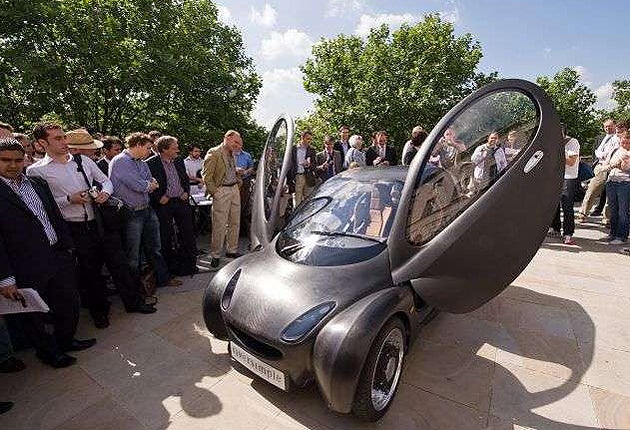
A new hydrogen-powered RiverSimple urban car is pictured outside Somerset House in central London on 16 June 2009.  A new lightweight hydrogen-powered car, capable of speeds up to 50mph, was launched in London on Tuesday. Able to travel 240 miles without refuelling, and weighing just 772lb (350kg), the two-seater Riversimple Urban Car could be put into production as soon as 2013

Leon Neal/AFP/Getty Images

A new hydrogen-powered RiverSimple urban car is pictured outside Somerset House in central London on 16 June 2009. A new lightweight hydrogen-powered car, capable of speeds up to 50mph, was launched in London on Tuesday. Able to travel 240 miles without refuelling, and weighing just 772lb (350kg), the two-seater Riversimple Urban Car could be put into production as soon as 2013

A new lightweight hydrogen-powered car, capable of speeds up to 50mph, was shown off in London today.

Able to travel 240 miles without refuelling, and weighing just 772lb (350kg), the two-seater Riversimple Urban Car could be put into production as soon as 2013.

Before that the project leaders plan to raise funds to build 10 prototypes and try out vehicles in UK cities.

Supported by the great-grandson of car pioneer Ferdinand Porsche, the Riversimple car does the petrol equivalent of 300 miles to the gallon.

The design of the car will be placed online so that production versions can be developed to suit local requirements in urban areas.

The cars will be leased to users rather than sold, with owners getting a maintenance, support and fuel package. The vehicles are expected to have a life span of around 20 years.

The car has four electric motors attached to each wheel and these double as brakes and generate electricity which is stored in a bank of ultracapacitors.

The car is powered by a fuel cell of just six kilowatts compared with the 100kW in some hydrogen prototypes.

The car has been developed over the last three years in a co-operative research programme involving the River Simple development team founded by engineer Hugo Spowers and Oxford University, Cranfield University in Bedfordshire and Horizon Fuel Cell Technologies.

The research has been financed through initial support from industrial gas company BOC, Government grants and the private support of the Piech family including Sebastian Piech, a great-grandson of Ferdinand Porsche.

Mr Piech said: "The Riversimple Urban Car represents a major step towards practical 21st century personal transport and towards the fulfilment of my great-grandfather's ambitions for accessible personal transport, but this time combining his other passions: light weight and high efficiency.

"Now that we have the basic vehicle in place with practical technology the challenge is to begin the development of a fuelling infrastructure to accompany it, to encourage the adoption of the sale of mobility service and encourage broad participation in the open source design to make the already practical technology into a broadly adaptable customer proposition."

Post a Comment

View all comments that have been posted about this article.

Offensive or abusive comments will be removed and your IP logged and may be used to prevent further submission. In submitting a comment to the site, you agree to be bound by the Independent Minds Terms of Service.

Comments

an overdue kick in the teeth for 'big oil'
[info]cronyblatcher wrote:
Tuesday, 16 June 2009 at 07:33 pm (UTC)
but just watch how the development is subverted sabotaged and eventually killed awf by guess who
http://www.youtube.com/watch?v=yTbdnNgqfs8
Wonderful
[info]popskihaynes wrote:
Tuesday, 16 June 2009 at 07:43 pm (UTC)
It will be interesting to see how this evolves, well done all round, it seems a far more viable solution than many we have seen. There is of course the main hurdle which is a refuelling infrastructure to support such vehicles and also the issue of cost in both cash terms and environmental ones in producing Hydrogen.

But all that aside, this seems quite an exciting development and the particularly interesting part being the "open source" aspect which I assume as in software means no copyright ownership but freedom to build further innovations on top of this platform and ad-infinitum .

As much as the basic machine, that aspect will be very interesting to watch in a patent heavy world.
eco cars
[info]pda1 wrote:
Tuesday, 16 June 2009 at 08:57 pm (UTC)
Interesting but is it practical today. To achieve that weight with today's crash requirements would indicate exotic carbon fibre composite construction, which is hellishly expensive. As pointed out above, there is little infrastructure for refuelling. It seems to me that the Vw 1L car using 1 litre of fuel (diesel) per 100 Kilometres (ca. 240 mpg) is a much better prospect. Personally, I think the Volkswagen 1L looks really cool also, with tandem seating just like the Messerschmidt bubble car I owned many years ago. p.s. the 1L prototype is also carbon fibre composite, and it is estimated that they cost 50,000 each. A less expensive material will have to be found to get chassis cost don to ca. 8,000.
One small problem...
[info]lenze_willi wrote:
Tuesday, 16 June 2009 at 09:26 pm (UTC)
Unfortunately there is no hole in the ground from which one can extract hydrogen. It has to be produced, usually by splitting water into its two components. It is expensive to do this, using huge amounts of electrical energy to generate the hydrogen. The best way to view hydrogen is as an energy carrier. It is not a source of energy.

The second problem is that hydrogen, transported as an extremely cold liquid, does funny things to metal. Pipes, tanks and other equipment are not easy to make or maintain, either in the vehicle or in the supply infrastructure.

The third fly in this expensive ointment is that experimental hydrogen based power cells are really old hat. They have been developing them for years. Full of promise, not one of them has actually proved economically useful.

Other than that, what a wonderful idea. Will it still be around in two years, doubt it very much. Put it on the list of other good ideas that have sunk without trace.
"sunk without gtrace" thanks to the in;lfuence of
[info]cronyblatcher wrote:
Tuesday, 16 June 2009 at 10:00 pm (UTC)
Re: "sunk without gtrace" thanks to the inlfuence of guess who
[info]cronyblatcher wrote:
Tuesday, 16 June 2009 at 10:09 pm (UTC)
looked for a surviving link and can't find it, but there was for example a brilliant scheme to extend heavy rail high speed rail services by way of light rail (and 'tram') into every nook and cranny of the country in place of motorways and bus services. There are no prizes for guessing why and how it was killed off http://www.youtube.com/watch?v=yTbdnNgqfs8
H2 car
[info]doomsdaybug wrote:
Tuesday, 16 June 2009 at 10:15 pm (UTC)
1. Retail cost IF ever produced?
2. Energy consumption of Hydrogen production?
3. Carbon footprint of car+maintenance+disposal?
3. Why oh why oh why?
rail v car
[info]cronyblatcher wrote:
Tuesday, 16 June 2009 at 10:26 pm (UTC)
Build and operating/maintenance costs of light rail are about one tenth those of heavy rail.
Tram build and operating/maintenance costs are about one tenth those of light rail.
http://www.youtube.com/watch?v=yTbdnNgqfs8
Hydrogen-powered car makes debut
[info]peter177 wrote:
Tuesday, 16 June 2009 at 10:35 pm (UTC)
Start with 100 kws and with Hydogen you end up with 12.5 Kws at the wheels 25 Kws for petrol and 30 Kws for Deisel and over 40 Kws for Battery electric drive. Hydrogen is a total wast of time and effort.

With battery electric drive even with coal fired power stations it is still half the pollution and CO2 than a petrol engined car.

And where is all the platinum to come from for the fuel cells, it is very rare, we would need to go and mine other planets.

Hydrogen was a solution when only lead acid batteries existed, but with the invention of Lithium ones
it has been left behind. The latest is a Lithium air unit that has a very high power density.

So Hydrogen which seems to make so much sense on face value just does not make sense when all the sums are added up.
keeping the proles misinformed
[info]someofusknow wrote:
Tuesday, 16 June 2009 at 11:05 pm (UTC)
'could be put into production as soon as 2013.'

Or could be abandoned by 2013.

Hydrogen cars have been an elsive 5 years away since 1962 and never qute get there for very important reasons. There is no economically viable source of hydrogen and hydrogen extraordinarily difficult to store.

However, stories like this play an important roles in keeping the proles misinformed and believing in car culture, even when it has no future.


Dirty Hydrogen
[info]billybongus wrote:
Wednesday, 17 June 2009 at 09:51 am (UTC)
Laudable goal but BOC source their Hydrogen from Natural Gas! it would be more honest to just build an economical LPG combustion based engine than wasting the extra energy used in obtaining extracting hydrogen from NG, compressing it and transporting it. It would be a lower carbon footprint as well!
Like electric, the consequences are still 'in another place'
[info]junkkmale wrote:
Wednesday, 17 June 2009 at 10:26 am (UTC)
I actually like the idea of H2, but it's the 'Oh?!' of where it comes from that still concerns me.
Faux solution
[info]bobav wrote:
Thursday, 18 June 2009 at 10:39 am (UTC)
My understnading is that the production of hydrogen fuel uses more energy than it saves after its been put into an automobile.

Also in this section

Article Archive

Day In a Page

Sun | Mon | Tue | Wed | Thu | Fri | Sat

Select date