Renault to unveil new all-electric runabouts
Thirty countries and cities have signed up to provide recharge points
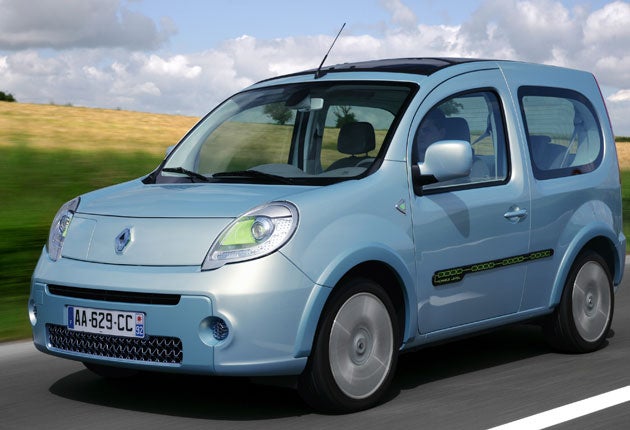
The French car-maker Renault will try to jump the lights on its rivals tomorrow by announcing plans for a commercially viable, non-polluting "car of the future".
Renault and its Japanese subsidiary, Nissan, will reveal details of a range of all-electric cars capable of matching the price and performance of internal-combustion vehicles within two years.
At the start of the Frankfurt motor show, the president and chief executive of Renault-Nissan, Carlos Ghosn, will announce a €1bn (£870m) programme to develop four types of all-electric cars capable of travelling for 100 miles without re-charging their batteries. "We plan to be the world leader of the 'zero-emission', 100 per cent electric car," Mr Ghosn said yesterday.
The four models will be a large family car, rather like the Laguna, called the Fluence; a futuristic version of the Clio; an electric version of the Kangoo van; and a two-seater city runabout. All will sell at about the same price as their petrol, diesel or "hybrid" equivalents and be capable of matching the same levels of performance.
Previous attempts to develop fully electric, mass-market cars have ended in economic calamity. Motorists were unwilling to buy the cars until there was a wide network of "electric service stations" where they could recharge or change the batteries. No one wanted to invest in such a network until electric cars were purring along the roads in great numbers.
Renault believes that it has found a way to solve this conundrum. It has completed negotiations for the creation of car re-charging networks with 30 cities or countries, and is continuing talks with 30 others.
There would be three ways to "fill up" after each 100 miles. A motorist could drop into a service station and swap lithium batteries, use a fast-recharge point which would take 30 minutes, or re-charge the car, like a mobile phone, from any electric socket for up to eight hours.
"The battery would be rented for a little less than €100 a month. The cost of electricity, plus the battery rental, would be less than the equivalent cost of petrol," Mr Ghosn said in an interview with Le Journal du Dimanche yesterday.
Until new generations of lithium batteries are available with a longer life than 100 miles, Renault accepts that electric cars will mostly be attractive to urban drivers and suburban commuters. "If you live in the suburbs and drive into town every day, you can charge up your car in the garage at night," a Renault source said. "The problem is that the motorist might also want to take the same car on his holidays." The French government is in talks with Renault about the possibility of providing subsidies for a nationwide system of recharging and battery-switching points. A number of small European countries and Israel, have already agreed to create such networks in principle.
As part of its drive to become a world leader in cutting carbon emissions, the French government plans to ask for tenders in the next few months for up to 50,000 small electric cars and vehicles for official use.
Questions are already being asked, however, about how "green" an all-electric car would really be. Renault has admitted that a car charged with electricity generated by coal-powered fire stations has a carbon foot-print only marginally smaller than a petrol-driven car. But when nuclear and renewable sources of electricity are taken into account, Renault argues, the all-electric car is significantly cleaner.
Other political and ecological problems arise about the supply of lithium that would be required to make the necessary millions of high-performance car batteries. Two thirds of the world's supplies of lithium come from Bolivia and most of the rest from China.
Join our commenting forum
Join thought-provoking conversations, follow other Independent readers and see their replies
Comments