Vauxhall Ampera
Put the old-style 'green' cars out of your mind, this extended-range electric vehicle – E-REV for short – is something else
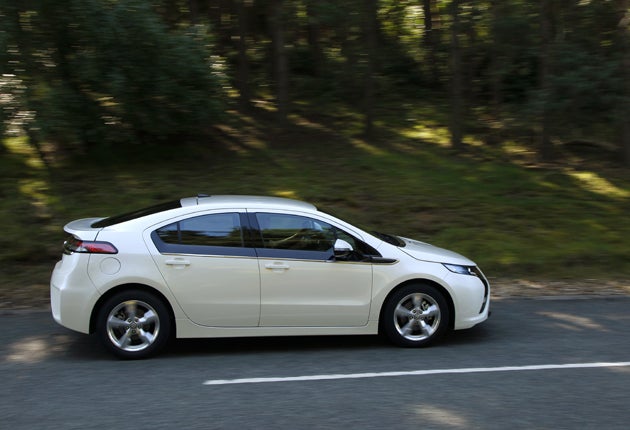
I've driven the future and it's, well, normal.
It could very easily not have been, because the Vauxhall Ampera is anything but normal in its mechanical make-up. That it feels as familiar as it does is a tribute to its creators, who will be relieved that those who will buy this car in their droves in two years' time will not have been frightened away after their first test drive.
The Ampera is technically a hybrid, but a hybrid of a sort so far not seen in production. It's a plug-in hybrid, which means that the battery that powers its electric motor can be charged from the mains as you would a pure electric car. Toyota has tentatively released a plug-in version of the Prius, but the Ampera goes a stage further in its electricalness. It is moved along purely by its 151bhp electric motor and not by an engine.
It does have an engine – a 1.4-litre petrol engine. But this is never connected to the driving wheels – it's used purely to drive a generator. To paraphrase the nursery rhyme, this is the engine that drives the generator that charges the battery that powers the motor that moves the car that Vauxhall built.
And this poses a big communication problem. In purist automotive engineering terms, the Ampera is a hybrid because it uses both petrol and electricity. But in the minds of the public, a hybrid is moved primarily by its engine with help from an electric motor at times and entirely by its electric motor just occasionally, slowly and briefly. Vauxhall needs to distance the Ampera from "regular" hybrids, so it has coined a term that approaches the problem from a more electrical, futuristically exotic direction. That term is "extended-range electric vehicle", or E-REV.
This is the whole point of this car. It's an electric car that frees you from "range anxiety", the fear of running out of battery power with no means of recharging it and/or no time to wait. There's enough energy in the hefty lithium-ion battery (T-shaped, it sits in the central tunnel and under the back seat) for about 40 miles at open-road speeds. It's limited to 100mph and will reach 60mph in nine seconds, and once the engine has joined in after that 40 miles there's another 310 miles' worth of petrol-fuelled driving potential. If your daily commute is less than 40 miles, and you recharge the battery each night, you could easily never use the engine at all. But that would do it no good, and the petrol would go stale, so from time to time the Ampera will ask you if you would like to run the engine for a short time. If you refuse, eventually it will start anyway.
The Ampera advises you to recharge the battery when about 30 per cent of its energy remains, and charging continues until, when new, it is about 80 per cent charged. That percentage rises as the battery ages, so its performance remains constant, and a recharge typically takes about three hours from a domestic socket. Higher-amperage sockets, such as those being introduced in the UK's urban centres, along with tag-activated automatic billing systems, can complete a charge in half that time. The battery pack is guaranteed for 10 years or 150,000 miles, and at the end of its car-life it can be used in a scheme to store energy produced by wind farms.
Fine. The Ampera is green and it's practical. It also fares particularly well in the official fuel-consumption tests, because the way they are configured credits the Ampera with 175mpg and less than 40g/km of CO2. You need to add the electricity to that, but clearly the Ampera will be very cheap to run.
So, how good is it at actually being a car? It's based on an Astra structure but it looks very futuristic. The production version, which is likely to be built at Ellesmere Port, will be very similar to the late prototype you see pictured, with touch-sensitive minor controls and a hi-tech display screen.
Press the start button, move the central lever to Drive, press the accelerator and you're off. There's just the hum of the electric motor and the thump from a suspension whose tuning is some way from the final version.
The Ampera accelerates briskly and smoothly; it brakes progressively despite using regenerative electrical braking, and it steers like a normal Astra. There is not much battery charge left when I start my drive, so soon the engine comes to life. It, too, is unexpectedly quiet. It neither idles nor reaches high, noisy speeds, but moves discreetly between three pre-set speeds at which it is tuned to run very efficiently. Press the accelerator harder and the revs rise to the next level to enable the generator to keep up with the demand for electricity, so, to a degree, the sound matches the action.
Here, it seems, is our best shot yet at practical, minimal-emissions motoring. The Ampera is roomy, lively, interesting to drive and futuristic to look at. And with a £5,000 grant available to subsidise plug-in hybrids (if hybrid it is), it should sell for about £25,000. As the Americans would say, sounds like a no-brainer to me.
Join our commenting forum
Join thought-provoking conversations, follow other Independent readers and see their replies
Comments
Bookmark popover
Removed from bookmarks