Fuelling transport's revolution
As we use up the world’s natural resources, we have no choice but to embrace alternative ways to power cars
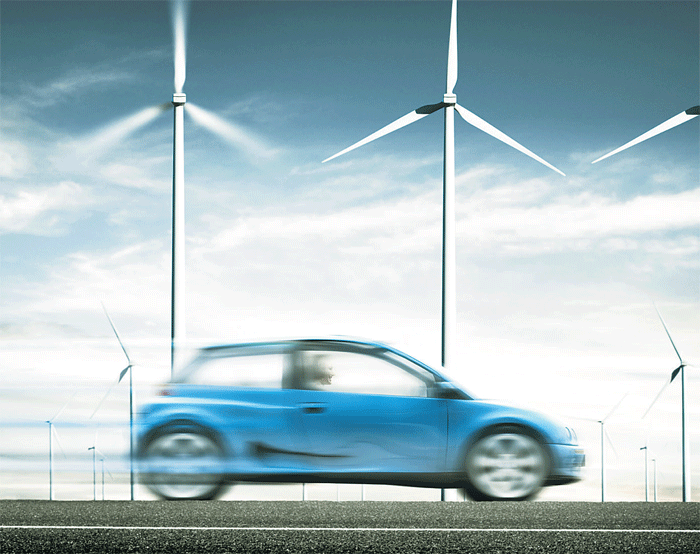
Fuelling of transport is dominated by fossil fuels. However, over the next few decades, there are a number of alternatives, which will first challenge this dominance, and then displace it. This is inevitable, and it’s not hard to work out why if you know what to look for. First, as a society, we are increasingly becoming aware of the reality and consequences of climate change, and this is driving most governments to legislate reductions in greenhouse gas emissions, and burning fossil fuels is clearly not helping. Second, fossil fuels are unsustainable, and no one would disagree that we will be producing less oil in 2050 than we consume now. In contrast, demand for mobility globally is expected to treble by 2050 as developing countries emerge with large middle classes demanding the way of life we have come to expect. This is not to say that fossil fuels will not have a large part to play – indeed, it’s not possible to replace them quickly, and will take decades – but clearly we can’t go on as before. Economies would stagnate, or worse shrink, and the billions of people we have raised out of poverty over the past century would sink back. If you look at it like this, then the alternatives aren’t just a vision dreamt up by environmentalists; they are crucial and necessary for all of us, everywhere.
Electrification of transport is probably the most important alternative. We can produce electricity from anything – wind, solar, tides and waves, nuclear, fossil fuels – and because of this, electricity is considered the universal energy-carrier. Even with our current electricity-generation mix, mostly based on natural gas, electric vehicles would reduce emissions by roughly 40 per cent if charged at the correct time. Moving forward, with increasing amounts of renewable electricity they become zero-emission, but the most important point is that there are no limits to the expansion of electricity production.
Chemical fuels will still be important, and in 2050, we will still be able to produce considerable amounts of fossil fuels if we want to, but alternatives such as biofuels, solar fuel and hydrogen could become major players. Biofuels are likely to be cheap to produce, and although modern biofuels based on crop wastes or saltwater agriculture minimise competition with food production, land availability will always impose a natural limit on production. Solar fuels could be important, converting carbon dioxide and water directly into fuels using solar energy. We can also convert electricity into hydrogen via electrolysis of water.
Powered by hydrogen, fuel cells are already commercially viable in some niches, such as in fork-lift trucks. They are scheduled to emerge in the mass market in 2015. Hydrogen production could initially limit their penetration into the mass market, but in the future, they are likely to be more fuel-flexible, and could ultimately occupy significant niches where electrification is challenging, such as with heavy vehicles and long distances, and as costs come down they could even challenge the dominance of the internal-combustion engine with their higher efficiency.
The internal-combustion engine will be with us for a long time, and we still haven’t reached its technical limits. Downsizing and turbocharging could give us up to 40 per cent improvement, and series hybridisation, operating as a range extender for an electric vehicle, could double efficiency.
However, aviation and shipping are likely to need most, if not all, of the chemical fuels we can produce, so an astute observer will still ask how all the cars will be powered. Again, the answer is electrification.
Many countries have already recognised this. For example, China has more than 50 million electric vehicles. This is for a number of reasons: air quality in cities was probably the trigger, but considering that the only way for China to consume more oil is to displace demand from developed countries, electrification of vehicles is becoming increasingly attractive for economic and energy-security reasons, as it should be for us.
Although the number of vehicles in the world is predicted to treble by 2050, the availability of the raw materials to make them could limit our ability to achieve this. However, most vehicles are currently used only 5 to 10 per cent of the time. New-ownership models, car clubs, for example, combined with new autonomous vehicles, mean that we could meet our expectations of mobility, point-to-point on-demand travel, with a fraction of the number of vehicles, and eliminate congestion. You send a request via your iPhone app; a minute later, a car picks you up and drives you wherever you want, at a fraction of the cost of owning your own vehicle. Those who are wealthy enough may choose still to own a car, but most of us probably won’t mind if the benefits are obvious.
The next decade is going to be a period of change; although many won’t notice it, investors should. From 2020 onwards, many of these alternatives will begin to emerge at scale. We’re talking millions of vehicles a year. When this happens, change could happen faster than any of us can imagine. When something better comes along, and it’s cheaper, cleaner, faster, and fun, history teaches us that the old way disappears much faster than we anticipate. m
Dr Gregory Offer is an EPSRC career|acceleration fellow at Imperial College London. As part of the Energy Futures Lab, Dr Offer conducts research into sustainable fuel production and sustainable transport, including electric, hybrid-electric and fuel-cell vehicles.
Join our commenting forum
Join thought-provoking conversations, follow other Independent readers and see their replies
Comments
Bookmark popover
Removed from bookmarks