Dental costs – Brits who put less money where their mouth is
Julian Knight joins the swelling ranks of cash-conscious teeth tourists in a waiting room in Budapest
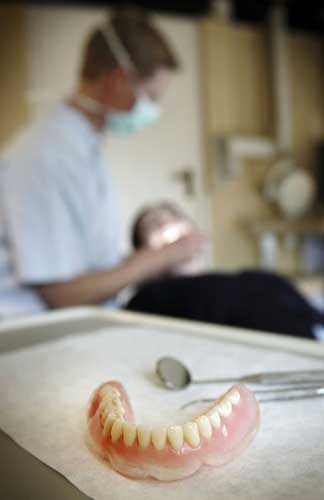
It's light years away from any dentist's waiting room I have ever been in. There's an espresso coffee machine, soft leather designer furniture and big LED screens. The only familiar item is a well-thumbed copy of Reader's Digest, but there's something different about this too: it's this month's issue and not years out of date.
So just where is this distinctly modern dentist's waiting room? London's Harley Street perhaps? Just off the fashionable Kings Road in Chelsea? No, it's in a sleepy suburb of Hungary's capital, Budapest.
Nevertheless, the waiting room at the Vital Europe clinic is chock-full of Britons eager to save perhaps thousands of pounds on their dental work.
The last available figures, for 2006, show that around 35,000 Brits travelled abroad to get dental work done, from braces and crowns to multiple implants. The main destinations of choice were in Eastern Europe – Hungary, Poland, Croatia and Bulgaria. But countries such as Thailand also featured.
This is against the backdrop of an NHS dental care system that is patchy at best and downright poor at worst. An estimated two million British people can't find an NHS dentist and are forced to go private. And going private can be expensive: check-ups cost around £50 a time, a porcelain crown will set you back some £700 and something more complex, such as an implant, can cost upwards of £2,000 a tooth. No wonder that research from the British Academy of Cosmetic Dentistry (BACD) reveals that less than half of the UK population visit their dentists regularly.
Even when someone can find an NHS dentist, the service they receive may not be of a high standard. "The bog-standard NHS treatment is not good in the UK – it's barely enough to get people by," says Tif Qureshi, marketing director at the BACD.
"Patients, though, are wrong comparing this NHS treatment with what's on offer for a fee in Eastern Europe. A more legitimate comparison would be looking at the treatment between private practice in the UK and Eastern Europe."
I met Susan Wenden, 60, from Lyne in Surrey, in the Budapest waiting room of Vital Europe, which also offers consultation and treatment in London. Ms Wenden has done the maths on where she should have her teeth looked at. "My husband had two implants done in the UK and it cost him £5,500. I needed one doing after having an emergency extraction," she explains. "My NHS dentist referred me to a specialist and he was quoting me similar money. That's when I researched going overseas.
"I had a consultation with Vital Europe in London and agreed to fly out to Hungary. I was seen all the way through by the same dentist. I was a little unsure but my husband came too and we made a week of it. Budapest really is a beautiful city and I could even eat normally in the evenings after treatment."

Get a free fractional share worth up to £100.
Capital at risk.
Terms and conditions apply.
ADVERTISEMENT
Get a free fractional share worth up to £100.
Capital at risk.
Terms and conditions apply.
ADVERTISEMENT
Ms Wenden saved more than 50 per cent on the cost of treatment – even when factoring in flight costs and accommodation in one of the clinic's own apartments in the city centre. "The money I've saved I'm going to use to visit my children, who now live in Australia."
And Ms Wenden is far from alone. Vital Europe reckons it is treating around 200 patients a month from the UK and is considering opening another consultation room in Manchester.
For those who don't want to fly abroad just for the sake of their teeth, there is the option of having the treatment done in London by Hungarian dentists, who are registered to work with the UK's General Dental Council (GDC). That will cost around 20 per cent more than going to Budapest, but the total savings on UK treatment can still be considerable.
"We use exactly the same materials as the UK dentists and at the same cost. The key difference is in staff expenses. We have offices in the UK so we know how much practitioners charge and it's way over the odds, but the cost of living is so high," says Paula Szorfi, marketing manager at Vital Europe. "We fly our dentists to the UK from Hungary and all the construction work takes place in our Budapest laboratories. This keeps overheads down."
But for complex treatments such as implants, Ms Szorfi advises people to make the trip out to Hungary. "The advantage is that if something doesn't fit and needs adjustment, we can do it here on site and make sure the patient is satisfied before their departure. Coming here reduces any unnecessary delays."
And this is a bustling industry, with 14 dentists and 11 hygienists, as well as a dozen or so laboratory workers producing the casts and enamelling behind the scenes.
"We know people will have preconceived ideas about Eastern Europe, so we look to produce the highest standards of care and use the latest technology," says Ms Szorfi. Post- treatment care is also in place, with patients asked to attend the London clinic for check-ups, and all work is guaranteed as long as those check-ups are kept.
Timea Milovecz from rival firm Dentists Abroad reckons that the industry in Eastern Europe could actually be considered more advanced than in the UK: "Hungarian dentists, for example, have to attend university for five years; in the UK, it's only four. What's more, they have to spend three years as a junior in a practice – a little like the period spent being a junior doctor in a hospital."
"The truth is, the UK is just plain expensive. It's costlier than even comparable countries like France and Germany, and you have to ask why that is."
Ms Milovecz adds that patients sometimes face a backlash: "We have seen cases where UK dentists refuse to see their patients again if they have gone abroad or have been slow to forward case notes.
"You can sort of understand that they don't want to lose business this way."
However, dentists' bodies in Britain grind their teeth at the suggestion that people can not only get cheaper work done abroad but of a higher standard too. "The idea that somehow the UK is behind these countries is nonsense. The reverse is true," says Mr Qureshi at the BACD. "We have a 1,000-strong college of cosmetic dentists; there is no such thing in Eastern Europe. Teaching and training are now so advanced that we are a centre of excellence – we have people from America come over to learn our techniques."
Mr Qureshi has concerns about patients going abroad. "The work could be rushed to fit in with flight schedules," he says. "Serious dentistry can take months to complete and involve many appointments. If these clinics were to follow such schedules, the customer would soon find the saving would disappear in flights and accommodation."
"We've also heard of instances where customers have been persuaded to undergo less specialist work than they need, presumably because it's more convenient for the clinic," adds Mr Qureshi. "Crucially, if you go to a UK dentist, you do have a comeback through the GDC, which will investigate complaints. What would you do in Poland, Bulgaria or Hungary?"
Insurers seem to share some of his misgivings. Generally they won't finance treatment abroad. "We don't fund dental tourism as we can't be 100 per cent sure as to the qualifications and accreditation of the dentists," says Abby Bowman at HSA.
But such issues do not worry Ms Wenden as she sits in the waiting room at Vital Europe. "The service I've received has been first class and I have been telling all my friends," she says. "Why pay over the odds in the UK when you can get the work done here and enjoy a nice holiday too?"
Brushing up on Hungary: 'Whether or not you get a good dentist in the UK is a bit of a lottery'
Lynne Smith, 49, an administrator for the Civil Nuclear Constabulary in Edinburgh, took a little persuasion before choosing to have her dental work done at Vital Europe's clinic in Budapest.
"I had read all about it but had some issues with the idea of travelling abroad and the question of language. But then my husband went over after he was quoted £5,500 in the UK for just two implants, and he had a good experience. So I thought, why not?"
Lynne has been out to Budapest twice for treatment and has had work done on a grand total of 17 teeth. "It has cost me £3,500 and I reckon I have saved around two-thirds compared with what it would have cost in the UK," she explains. "It's also been nice being out here. We have toured all around the city and we are off to Vienna for a few days before my final treatment.
"I feel that in the UK, whether you get a good dentist or not is a bit of a lottery."
The only problem experienced by Lynne has been with the travelling – to London as much as Hungary. "I have to get there for check-ups and there are also relatively few flights to Budapest from Prestwick. It would be good if they could open an office in Scotland to make it more convenient."
Join our commenting forum
Join thought-provoking conversations, follow other Independent readers and see their replies
Comments
Bookmark popover
Removed from bookmarks