You've seen the unrest, now don't invest
The recent social and political discord in Thailand has made the country an unattractive proposition for those wishing to make a profit, writes Annie Shaw
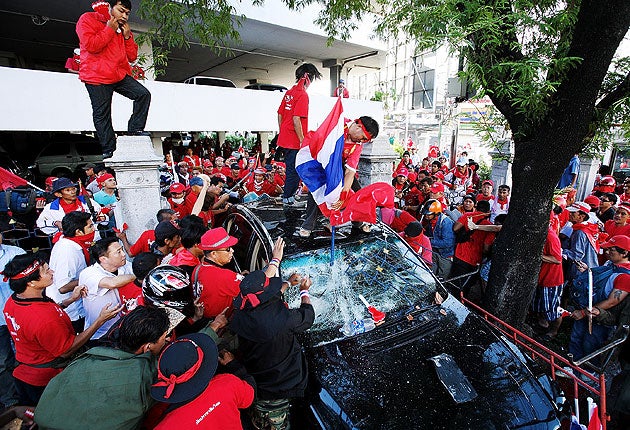
Anyone who has visited Thailand on holiday will be deeply shocked by the scenes of violence that have played out in the streets of Bangkok in recent days a sharp contrast to the image of palm trees and sunny beaches that the "Land of Smiles" usually evokes.
The social and political unrest that erupted on to the streets of the Thai capital last weekend, forcing the government to declare a state of emergency, has, however, left UK investors largely unmoved although elsewhere around the globe the reaction has been rather more negative.
A three-week siege of the prime minister's office, which culminated in rioting and the cancellation of a summit meeting of the Association of South-east Asian Nations (ASEAN), were a humiliation for a country which as recently as the 1990s was one of the South-east Asian Tigers. Now, like so many other nations around the world, it is struggling to stimulate its economy into some semblance of recovery in the face of contracting output and trade and a civil revolt.
The return of a right-wing government last December has so far done nothing to revive the country's ailing fortunes and it is supporters of the former leftist prime minister Thaksin Shinawatra who have provoked the current crisis by bringing their grievances on to the streets.
The battle lines have been drawn up between the "yellow shirts", who back the current prime minister, Abhisit Vejjajiva, and mainly comprise royalists, the military and the city-dwelling middle classes, and the "red shirts", who are mostly the rural poor. The latter support the self-exiled Thaksin, who was removed from power in a 2006 military coup.
Despite his absence from the country, Thaksin has continued to pull political strings remotely, and his ideological heirs were returned to power in 2007. However, last December they lost an election to Abhisit Vejjajiva, in a vote that Thaksin's supporters say was rigged by the army.
So far, so unsurprising. Mark Mobius, executive chairman of Templeton Asset Management, says: "Thailand is not new to political turmoil. Political uncertainties and changes in government have been a way of life for the Thais since absolute monarchy was abolished in 1932.
"The current power struggle is effectively a clash between two groups of lites one backing the middle class, especially in Bangkok, and the other the rural masses. The latest news indicates that the protesters have abandoned their siege at Government House and that the current stand-off has ended."
The infighting is hardly conducive to economic recovery. Thailand is fighting the worst recession in the region since the 1997-98 Asian crisis, with the World Bank forecasting that the Thai economy is set to shrink by as much as 3 per cent this year.

Get a free fractional share worth up to £100.
Capital at risk.
Terms and conditions apply.
ADVERTISEMENT
Get a free fractional share worth up to £100.
Capital at risk.
Terms and conditions apply.
ADVERTISEMENT
Thailand's finance minister, Korn Chatikavanij, believes that contraction could be as much as 4.4 per cent, although he is predicting a modest growth of around 1.4 per cent in 2010.
This dramatic shrinking of Thailand's economy, for the first time in more than 11 years, is in sharp contrast to the 1990s, when GDP was growing by as much as 10 per cent a year, giving it pride of place among the Asian Tigers.
On account of the recent disturbances, Thailand has now been given a negative outlook by the ratings agencies Standard & Poor's, Moody's and Fitch, all of which warn that further downgradings could follow if the unrest persists, and domestic and overseas investments are damaged further.
Also in the past week, Standard & Poor has lowered Thailand's domestic currency rating from A to A-minus, while the baht has already fallen 2 per cent against the dollar this year.
Tourism is an important foreign exchange earner. The industry, which employs two million people, has survived other setbacks, such as the Asian Sars outbreak, the tsunami of 2004 and the coup in 2006. Now, however, it appears to be in crisis, as at least five countries, including Britain, have warned their nationals not to visit Thailand, and those already there to avoid Bangkok and other trouble spots.
S&P credit analyst Kim Eng Tan says: "We believe that investor confidence has been damaged significantly as a result of the latest developments, while in the near term, inbound tourism will also be affected negatively.
"It could lead to increased investment outflow from Thailand. Tourism can rebound, but investor confidence will be very hard to get back. Investors are now likely to factor in the negative implications of political uncertainty in making their decisions."
Matthew Hildebrandt, an economist for JPMorgan in Singapore, also has concerns about a possible lasting effect of recent events. "The big issue is whether this will affect general investment in Thailand, especially in the automotive industry," he says. "For foreign companies already operating there, they may think twice about expanding. For companies not there already, they may think twice."
Credit Suisse was last week advising investors to "take profit" on Thai investments. Analyst Dan Fineman said that gains in global markets in the past month offered investors a chance to sell their Thai holdings, including property stocks.
He said in a report: "A return to the dark days of the second half of 2008 is not inevitable, but the risk of prolonged political tensions is high. We now suggest taking profit in key stocks and sectors we had previously liked."
Andrew Beal, manager of the Henderson TR Pacific investment trust since 2005, takes a different view. He thinks those with holdings in Thailand should hold fire as long as their portfolio is sufficiently diversified. "The TR Pacific fund is a diversified Asia ex-Japan fund, with only about 5 per cent of its holding in Thailand," says Beal. "Because the holding is part of a diversified portfolio I am still happy to take the risk."
The government plans to spend 1,570 billion baht (30bn) over three years on infrastructure projects, to create jobs and boost economic activity. It has already spent 116.7 billion baht on an introductory stimulus package, which has included a range of tax breaks, although finance minister Korn Chatikavanij has conceded that Thailand might now need to borrow more to pay for further stimulus measures in the wake of last week's events.
Like Beal, Templeton's Mobius is positive about Thailand's prospects. He says: "Since the end of absolute monarchy in 1932, Thailand has experienced 21 coups [of which 14 were successful], 22 general elections, and a government life span averaging just two years. As long as the nation's current monarchy system remains stable, we are optimistic that eventually a resolution will be reached."
Mobius adds: "Since the last coup, on 19 September 2006, Thailand's stock market declined by 29.5 per cent in the period to 31 March 2009. This performance was better than that of some key Asian markets, such as South Korea and Taiwan, and has come despite Thailand having six prime ministers, a general election, an airport shutdown, and numerous street protests and demonstrations, all within this period.
"We remain positive on Thailand's longer-term outlook and fundamentals. Thailand has natural resources, a diversified export base, a resilient domestic economy and a large population."
What seems to have taken some investment pundits by surprise is the extent to which the South-east Asian economies are linked to those of the West. Most now accept that they are totally interdependent, and there is no "decoupling" whereby Eastern economies, particularly China, can improve or deteriorate separately from their Western counterparts.
John Greenwood, chief economist at Invesco, warns that the American and European economies are likely to be key to recovery in South-east Asia, not least because of the volume of Chinese exports on which Thailand is also dependent. He says: "Talk of China decoupling from the developed economies is misguided.
"It is often commented that intra-Asian trade has become more important for Asian economies, suggesting a reduced dependence on the US. For example, Thailand's exports to China are about as large as its exports to the US, both representing around 15 per cent of total exports.
"However, many of Thailand's exports to China are then re-exported to the US after processing. This is a phenomenon for many Asian economies. Taking this into account, the exposure of many Asian economies to China falls sharply, with a corresponding rise in the dependence on the US."
Henderson's Andrew Beal says: "Thailand is an extensive exporter of agricultural products and commodities to China, and its trade is doing well. Thailand competes in the labour market as a cheap manufacturing centre, and still remains an important manufacturing base, although Vietnam and Indonesia have been grabbing market share."
Recovery of the tourism industry could also take some time. Beal comments: "Now that the protests have died down, continued threats of violence even though they have tended to be confined to Bangkok and have not generally affected tourist areas won't help the tourist industry. The risks have definitely risen, and there could be further violence, but the government is not likely to fall."
Independent financial adviser Malcolm Simpson of Cheltenham-based Ashley Law Cotswold says of investing in Thailand: "It really comes down to the client's attitude to risk and the motivation behind the decision.
"I would not recommend that somebody has all their money tied up in Thailand, but still see this as one of the strong economies in Asia. I believe that Asia generally is a good long-term investment for most people and see no reason why Thailand should not form part of a well-balanced investment portfolio."
Mobius remains sanguine: "We have been investing in Thailand for over 20 years and have seen Thailand go through numerous changes. Through these years, the country, its people and businesses have learnt to work through political uncertainty. Templeton's focus on value and company fundamentals puts us in good stead to manage through these uncertainties."
Join our commenting forum
Join thought-provoking conversations, follow other Independent readers and see their replies
Comments
Bookmark popover
Removed from bookmarks