Around the world, miners scramble for coal
Deal activity in the coal sector is being driven by growing demand from China and India. Nikhil Kumar reports
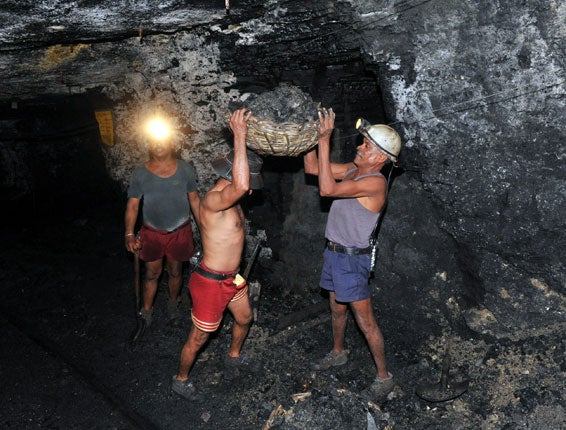
Even before we heard of Rio Tinto's $3.5bn (£2.2bn) approach for Mozambique-focused Riversdale Mining, the coal sector had seen more than a thousand mergers and acquisitions announced this year. If you are keeping count, Rio's approach takes the tally to 1,004, against 100 or so in 2004 and 60 at the turn of the century, according to figures from the research firm Dealogic.
The great coal rush of 2010 comes against the backdrop of rising demand from China and India, both of which are burning copious amounts of the black stuff to power their economies. China, for example, imported 34 million tons of coking coal – a key ingredient in the production of steel – in 2009, up almost fivefold on the year before. In India, total coal imports stood at more than 73 million tonnes this year, compated to less than 60 million tonnes in 2009.
Overall, Asia currently accounts for 66 per cent of global coal consumption, according to figures from Standard Chartered, whose analysts are eyeing a "massive" mismatch between supply and demand in years ahead. The global deficit, they say, could be as large as 30 million tonnes by 2018. Demand is such and the auguries so good that the bank expects the global coal market to nearly double to 12.8 billion tonnes by 2030. Given these and other forecasts, "miners who used to be satisfied with the capacity they had now feel under pressure to expand in this area," Olivetree Securities analyst Christian Georges said.
Mr Georges said there were two parts to Asia's appetite, namely thermal coal for power stations and coking or metallurgical coal for steel production. "There is a clear perception that the demand for metallurgical coal is expanding," he explained, highlighting China's role as both a major producer and consumer of steel, something that is confirmed by recent industry data.
Crude steel production stood at around 1.6 million tonnes per day over the first 20 days of November, according to figures from the China Iron and Steel Association, while output for the year is expected to climb to 624 million tonnes, up more than 8 per cent on last year's figure.
Looking ahead, the growth in global steel demand is forecast to slow to 5.3 per cent in 2011 – but still climb to a record 1.34 billion tonnes, according to figures from the World Steel Association. The key drivers? China, India and other fast-growing economies.
This potential no doubt provided the spur for Walter Energy's recent $3.3bn bid for Canada's Western Coal, AIM's largest company, which specialises in metallurgical coal.
The merger puts US-based Walter on track to become the world's number three producer of steel-making coal, leaving it well placed to cash in on increasing demand from China and elsewhere.
"Our combined production capacity and geographic footprint leaves us extremely well positioned to benefit from favourable sector dynamics driven by increased steel production in markets such as China, India and Brazil," Walter's interim chief executive, Joe Leonard, said when the merger was agreed earlier this month.
"Bottom line, this is the right transaction at the right time."
The appetite for thermal coal is also forecast to swell in coming years. The vast majority of China's energy needs are serviced by thermal coal plants, while more than half of India's electricity plants depend on coal. Beyond that, sector watchers point to the scope for expansion in the wider world as cash-strapped governments seek cheaper alternatives to atomic energy.
"There is a renewed expansion of atomic energy, but it's expensive and more dangerous," Mr Georges said, pointing out that thermal coal technology was well understood and much cheaper than nuclear. The case for coal has also been helped by improvements in ways to treat exhaust fumes and by innovations in carbon storage, he added.
Like steel-making coal and Walter Energy, the strength of the thermal coal market provides a useful context for another recent deal. Earlier this month, Vallar, the London-listed cash shell led by the financier Nat Rothschild, unveiled a complex $3bn transaction that will see it join forces with Indonesia's powerful Bakrie family to form a new venture that by 2013 is set to become the largest supplier of thermal coal to China.
Of course, Walter, Vallar and Rio are just three of the more than 1,000 deals announced this year. Back in July, Thailand saw its biggest overseas acquisition when coal producer Banpu agreed to buy Australia's Centennial Coal for $2bn, gaining an entry in the island nation's vast resources sector.
Weeks later in August, Australia's Linc Energy agreed to sell its Galilee coal project to India's Adani Enterprise in a cash and royalty deal worth a cool $2.7bn. In October, hopes were raised when Coal India said it was putting aside a $1.2bn war chest to fund overseas takeovers.
And so on and so forth until the Rio approach came to light this week.
Mozambique's resources
* Rio Tinto's approach for Mozambique-focused Riversdale Mining has thrown the spotlight on the former Portuguese colony, which holds vast, largely untapped, coal reserves.
Australia is world's the biggest producer of coal, making up for around 60 per cent of global consumption, according to Christian Georges, metals and mining analyst at Olivetree Securities. But he said: "At this point, [Mozambique] probably offers the cheapest and most widely available coal outside Australia."
Though large, the country's deposits of coal and other natural resources account for less than 5 per cent of GDP. But that figure is expected to rise as production picks up, with the mining minister, Esperança Bias, hoping to see a contribution of more than 12 per cent in the future. "I hope from 2011, the mining sector can contribute more than 5 per cent and maybe in the next five years, I would like to see the contribution being more than 12 per cent," she said last week. Coal production, for example, stands at 500 tonnes a year, but is set to climb to more than2 million tonnes next year, with future output forecast to peak at 10 million tonnes a year.
The Mozambique mining sector has attracted investments totalling $1bn this year, according to Ms Bias, with mineral exploration taking up more than half of that sum.
"Our doors are open... we are trying to improve our infrastructure so that when the mining companies want to export, the facilities will be there," she said, adding that the government had issued 1,000 mineral exploration licences.
Eyeing the country's potential, analysts expect Rio to face competition for Riversdale, which is 24 per cent-owned by India's Tata Steel. Besides Tata, Brazil's Vale, London-listed Xstrata and Anglo American are seen as possible rivals for the company, whose Zambeze project boasts one of the largest undeveloped coking coal resources in the world.
David Quinlivan, chairman of the AIM-listed Churchill Mining, said Mozambique was "strategically very important" for the coal industry, not least because of its location, with an easy supply route to India.
"India is investing in infrastructure, in ports, which makes it easier to supply from Mozambique," he said. Olivetree's Christian Georges said: "It all boils down to costs. Producing coal in the UK or northern Europe is two to three times more expensive than Australia," he explained. "Mozambique is much closer to Australia in production costs."
Join our commenting forum
Join thought-provoking conversations, follow other Independent readers and see their replies
Comments
Bookmark popover
Removed from bookmarks