Canada in danger of booming tar sands backlash
Experts warn that Alberta's success story could unravel in face of falling oil prices as investors weigh up whether to pull the plug on lucrative projects
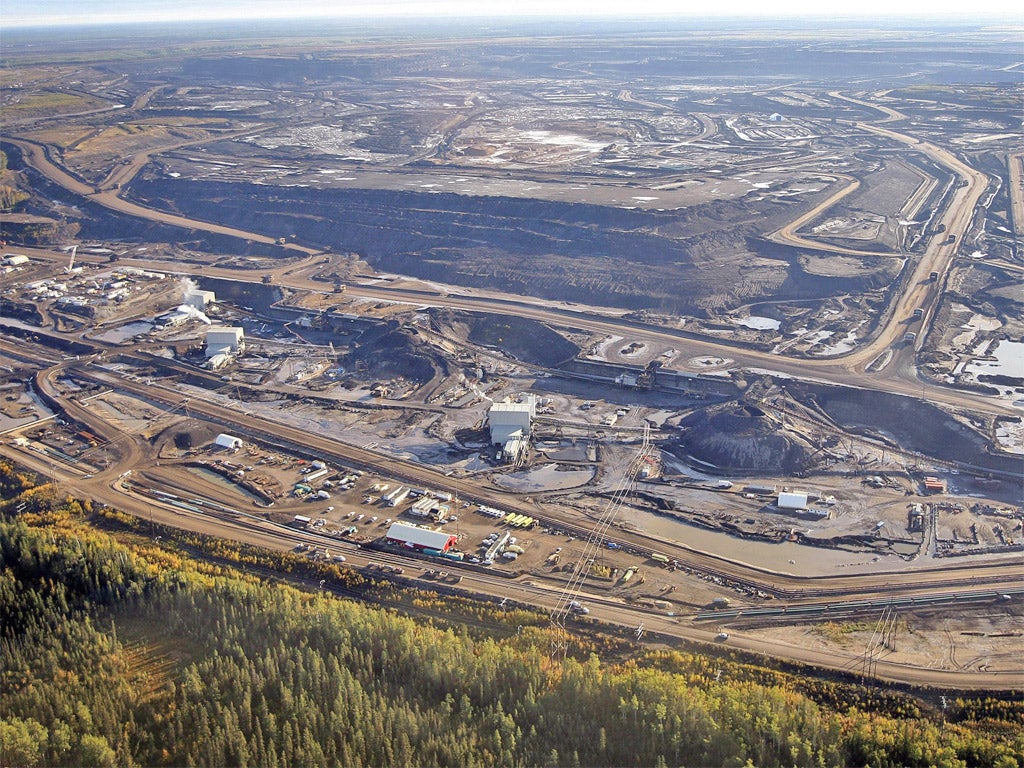
Six weeks ago Canada's booming tar sands industry was growing so fast that it looked possible it might one day overtake every major oil-producing nation except for Saudi Arabia.
With West Texas Intermediate crude trading at more than $105 a barrel there was no question the vast, but costly to extract, reserves of oil contained in the tar sands of the Alberta province would yield a huge profit.
Just how vast an economic opportunity this presented for Canada was laid bare in BP's latest statistical review of world energy, published yesterday.
This showed that while Canada's tar sands-dominated crude production stood at 4.3 per cent of global output last year, the country actually houses 10.6 per cent of the world's proven, recoverable oil reserves. This is the third largest reserve of any nation – in other words, even after a decade-long boom, Alberta was only warming up.
After two years of sustained high oil prices, investors had regained the confidence that was shattered when the financial crisis pulled oil below $40 a barrel and prompted them to shelve $80bn of planned developments in 2008 and 2009.
An unprecedented 16 projects were scheduled to come on stream over the next four years, increasing the output of bitumen – a heavy form of crude – by 1 million barrels a day to 2.6 million.
But a lot has changed since the beginning of May. West Texas crude has tumbled by about a fifth to hover around $80 a barrel and there are fears of a continued decline that threatens the viability of large swathes of Canada's biggest industry.
Last week, Wood Mackenzie, the oil experts, came out and said what many in the industry had increasingly been fearing. Noting the tar sands' high-energy extraction process meant production costs were among the highest of any oil fields in the world, Wood Mackenzie warned that falling – or simply volatile – prices "could result in operators delaying or cancelling unsanctioned projects."
While this may not feed through into reduced production straight away, in the longer term output could be hit substantially, Wood Mackenzie warned. "There is little scope to adjust near-term production, due to the amount of capital already sunk. However, if the external environment proves to be unattractive, companies do have the option to significantly change the longer-term production outlook," Wood Mackenzie said.
Wood Mackenzie points out that a quarter of planned tar sand projects scheduled to begin production between 2015 and 2018 are still "unsanctioned" – meaning their financing is yet to be finalised and making them particularly vulnerable to delay or cancellation in the coming months if the oil price is dragged down further.
In the longer term, a persistently lower oil price could hit tar sand investment far harder. Although Albertan oil production dates back to the 1960s it has only taken off in the last decade and the cost of production has soared in line with increased competition for labour and machinery, pushing prices up far more than in the economy at large.
Competition from the US mid-West, Canada's main market, is rising rapidly as new extraction techniques have greatly increased the amount of oil that can be produced from shale rocks in North Dakota.
This has created a glut of supply, which has pushed the tar sands oil price down to about $64 a barrel in recent days, well below even the price of declining West Texas crude.
To put this into perspective, it now costs between $80and $100 a barrel to break even on new Canadian oil sand mines where the sands are dug up with giant mechanical digging trucks that have hydraulic and electrically-powered shovels and transported to an extraction plant in 320 tonne trucks. The bitumen is extracted from the sand, water and clay by blasting it with hot water and separating it from the resulting slurry. Less than five years ago, the figure was just $30 a barrel.
For deeper reserves, the so-called steam-assisted gravity drainage drilling method – which injects steam underground and pumps the bitumen to the surface – costs about $60 a barrel.
Investors also have concerns about a lack of pipelines to transport the growing volumes of oil to foreign markets. A number of key pipelines have yet to gain approval because of environmental concerns. The best known is Keystone XL, which would run, via the Mid-West, all the way to the Gulf of Mexico, connecting the Canadian tar sands to international markets.
Just how dire the need for additional pipeline capacity is illustrated in the huge disparity that has opened up in the West Texas and Brent crude oil prices. "The differential between Brent and West Texas Intermediate reached a record premium (in $/bbl) due to infrastructure bottlenecks driven by rapidly-rising US and Canadian production," said yesterday's BP report. Yesterday, Brent crude was fetching about $97.50 a barrel, compared to around $83.50 for West Texas.
Several oil sands projects have recently come on to the market. Just last week, it emerged that the billionaire Koch brothers in the US are hoping to sell stakes in six tar sand properties which analysts estimate could fetch up to $2.9bn, while Shell put Orion, a small steam-driven project in north-eastern Alberta, on the block.
Although it produces just 5,000 barrels a day, it has been granted regulatory approval to expand that to more than 30,000. These offerings come after ConocoPhillips put a multi-billion dollar package of Canadian tar sand assets up for sale. "We are definitely at that point where if the price of oil comes off much more oil sands will lose their attractiveness. They will be the first area of global production to come under pressure," said Sanford Bernstein analyst Iain Pyle.
Furthermore, companies are rejigging plans to expand existing projects rather than building expensive new ones, Mr Pyle adds. Shell, for example, said last week it planned to increase production by up to 90,000 barrels a day at its Athabasca oil sands project at Alberta by "debottlenecking" – or improving the efficiency of – its existing development.
However, the FTSE 100 oil giant insisted it would also press ahead with a proposed new development of its Jackpine Mine in the Athabasca oil sands – the world's biggest known reservoir of crude bitumen – but was still waiting on regulatory approval.
The long-running environmental battle is also set to escalate in the coming months. Canada has been battling the EU since 2009 when Europe proposed a measure called the Fuel Quality Directive, which sought to reduce the level of greenhouse gases emitted by vehicles by labelling tar-sands generated fuel as "dirty". Virtually no tar sands fuel reaches European refineries from Canada but Ottawa is concerned a European ruling will influence other markets, including the US, where most of its oil ends up.
A stalemate in February had 12 EU nations voting for, eight against and seven (including Britain) abstaining. Another vote was planned for this month but has now been postponed until next year after Joe Oliver, Canada's natural resources minister, demanded an extensive study into the validity of the EU proposal.
With Canada's vast tar sand oil reserves forecast to contribute C$2.1 trillion to the nation's economy over the next 25 years, that letter is but the tip of the industry lobbying iceberg.
However, the Canadian Association of Petroleum Producer forecasts that oil sands production will double from 1.6m to 3.2m barrels a day by 2020 and more than triple to 5.0m by 2030 – backed up by Canada's political stability, the relative ease of its extraction, the certainty of the volume and location of the oil and the fact that global demand is only going to go up in the longer term. It's just the growth could be a good bit lower than many may have forecast six weeks ago.
Energy boost in crude health
Rising crude prices and improving extraction techniques have increased the volume of economically viable oil reserves in the world by 60 per cent in the past two decades, according to BP's latest statistical review of energy.
The volume of global reserves hit 1.65tn barrels of oil in 2011, according to new BP figures, as the crude price hit its second highest inflation-adjusted price ever, after 1864.
This, combined with technological innovation, has made extraction of hydrocarbons from tar sands, rocks and deep water increasingly common.
Although fears that the declining oil price may hit some high-cost projects, such as in the Canadian tar sands, production is likely to remain historically high for the foreseeable future.
BP's report also revealed that the amount of coal consumed across the world jumped by 5.4 per cent last year to its largest share of global energy consumption in more than four decades, dealing a blow to hopes of hitting key carbon emissions targets.
China's voracious appetite for coal-generated electricity saw it burning 9.7 per cent more of the black stuff than in 2010, according to BP's latest statistical review of energy.
Join our commenting forum
Join thought-provoking conversations, follow other Independent readers and see their replies
Comments
Bookmark popover
Removed from bookmarks