Inside Job: filming the financial crash
The perpetrators of the financial crash meet their match in an Oscar-nominated documentary. Nick Hasted talks to the director
The Matt Damon-narrated film Inside Job could be a sequel to All the President's Men. But its director, Charles Ferguson, makes it painfully clear that corruption in America now goes higher, and the President has been brushed aside. Inside Job has the icy fascination of a thriller as it investigates exactly who was responsible for the banking crash we are living in the rubble of, and how they got away with it. Ferguson, a software millionaire and business academic with the ear of the US government, acts as his own Woodward and Bernstein, confronting Wall Street chiefs and White House advisers (usually the same person) with forensically marshalled, killing questions.
His cool accumulation of facts made me as angry as I've felt in a cinema. But he is a very different director to Michael Moore, whose neglected masterpiece Capitalism: A Love Story last year waded into the lives of the crash's working- and middle-class victims, roping off Wall Street with crime scene tape in a spirit close to despair. Moore clearly wanted to wash the whole dirty system away. Ferguson keeps his head, pulls no stunts. His perspective is from among America's ruling class. It's the film Wall Street: Money Never Sleeps should have been, made by a rich man who thinks greed is wrong. Whether you want a derivative explained, or sweeping aerial shots of the mansions of the guilty, Inside Job delivers. It should light the fire under finance that An Inconvenient Truth did for ecology. That's if Ferguson can get it seen.
"We put a lot of care into the look of the film," he tells me in London. "The aerial cinematography, the way we filmed the interviews, the use of widescreen, the locations. We wanted the movie to be fast and interesting, and there's humour in it. We tried very hard not to make it a two-hour lecture on economics, but a movie."
Inside Job begins in Iceland. Walking down Reykjavik's high street three years ago, I remember being amazed at the wealth and high-end shops in a country with the population of Coventry. Asking how this could be, I was told of the "Vikings", super-bankers their countrymen were proud to see rampaging, longboat-style, through world markets. An Icelandic minister tells Ferguson that the country had loans ten times its economy's size then. Ten years of financial deregulation led to this catastrophe, a microcosm of 30 in America. Ferguson's j'accuse is that the investment bankers he shows pleading bafflement when called to moral account by Congress are lying.
"Some of these people were perfectly aware that they were doing something wrong," he says. "You were seeing pretty good actors."
So it's immorality, not amorality?
"Immorality, yes. A lot of people who did it knew perfectly well that this was a bubble that was going to end badly. One way you could tell was how they behaved with their personal income." He tells me about Angelo Mozilo, who as CEO of Countrywide made his business borrow billions to prop up its stock price, while he sold $140m of his shares the year before it went bankrupt. "So he knew," Ferguson concludes. It's the sort of unanswerable tale he builds his film on. He also shows us Wall Street as a real place, more seedy and hysterical than Oliver Stone or Tom Wolfe dared depict, peopled by risk-addicted, whoring cokeheads (he interviews a Wall Street madam), with a penchant for money-laundering for drug cartels and Iranian missile programmes that would make the Mafia blanch.
"Well, so far finance hasn't been shooting anybody," Ferguson dryly considers. "So there are thankfully some differences. The consequences of what it has done have been, although indirect, even more serious."
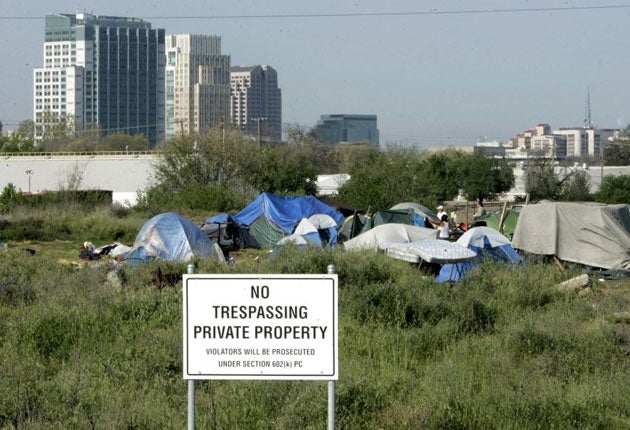
One passage shows the American tent cities of some of the millions made unemployed globally by the actions of men now relaxing, unpunished, in plush estates. "There's a case where people really don't understand," he admits. "I think they have, somewhat unconsciously, isolated themselves thoroughly from the consequences of their decisions. There's a section of the film where we show the drugs, the prostitution, the private elevators, the private planes, the giant mansions, the isolation of these guys. And that is an important element in this." Though their actions aren't equivalent, it's hard not to think, as Ferguson shows you the executive's lift that shoots straight to the top so he never sees an employee, of Hitler's willed moral blindness in the blacked-out train he rode through a devastated nation he never saw.
Ferguson gets giddily nearer the top with interviewees than he did with his first documentary, the Oscar-nominated Iraq investigation No End in Sight (2007). Did his status and personal wealth make them think he was one of them? "In some cases, I knew these people already. Certainly my government connections didn't help at all. Quite the contrary. Even people I've known quite well for 20 years who are in the Obama administration refused to speak with me, even off the record. That was... disappointing. They are not interested in being interviewed about their behaviour. Certainly not by somebody who would ask them tough questions."
Their wisdom is shown in the film's most high-voltage moment, when Glenn Hubbard, George W. Bush's chief economic adviser and a partisan advocate of deregulation, suddenly realises the bear-trap he's walked into. He drops his mask of civility and snarls: "You've got five minutes, mister. Give it your best shot."
"One thing I did come to realise as I was collecting these interviews," Ferguson says, "was that these people were not used to being challenged. In some cases it was disappointing that some people just stopped talking. But in some cases, I was surprised they continued talking for as long as they did."
When Ferguson made his own millions (with a software innovation sold to Apple in 1996), did temptations for moral carelessness come his way? "Any time you're in an environment where the stakes are high and there's a lot of money around, there are going to be temptations," he says. "I am proud to say that I conducted myself well. Everyone who was in my company is now a millionaire, including the woman who was my secretary. And you know, I don't think there's anything wrong with the stock market and people making money, if they make it fairly doing something productive. What happened here is an extraordinary amount of money was made by doing immoral things that did great damage."
I confess to Ferguson that watching the men who caused the crash, all not only unjailed but rewarded and seemingly untouchable, made me wish violence on them. He doesn't react to this, not sharing Moore's subliminal thirst for guillotines. Regulation, he thinks, will be enough. But this unlikely radical, who says he tries "to keep emotions out of my work", harbours dreams of change in his film.
"What it'll take is the American people to get angry and organised enough to force their leaders to do something," he says. "Wealth and power were as concentrated and unfair as now 100 years ago, for 30 years also. And then the people reacted. The environmental movement took a half-century. I'm optimistic in change, eventually."
'Inside Job' is released on Friday
Join our commenting forum
Join thought-provoking conversations, follow other Independent readers and see their replies
Comments
Bookmark popover
Removed from bookmarks